Native Plants
Q. Who is Mr. Smarty Plants?
A: There are those who suspect Wildflower Center volunteers are the culpable and capable culprits. Yet, others think staff members play some, albeit small, role. You can torture us with your plant questions, but we will never reveal the Green Guru's secret identity.
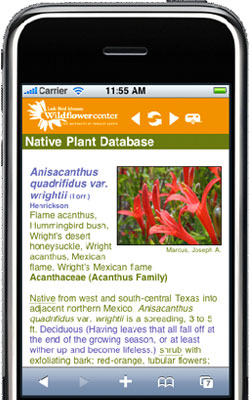
Did you know you can access the Native Plant Information Network with your web-enabled smartphone?

Ask Mr. Smarty Plants
Ask Mr. Smarty Plants is a free service provided by the staff and volunteers at the Lady Bird Johnson Wildflower Center.

rate this answer

Monday - March 15, 2010
From: Austin, TX
Region: Southwest
Topic: Edible Plants
Title: Edible Native Plants for a Small Austin Garden
Answered by: Dean Garrett
QUESTION:
Hello Mr. Smarty Plants (or Mrs. or Miss, whomever is answering this go'round)! First off, thank you so much for all the help you have given me in the past. Secondly, the company my husband works for is installing a community garden for employees and their families to use (huzzah!). I am far more versed in native plants for landscaping, but my husband would like to use our plot for raising vegetables. We did some research through Texas A&M and found a list of possible vegetables for our region and space restrictions. However, I would love to try incorporating some edible native plants. I found some books, but they are a bit out of our budget right now. Basically, I would like anything that could be used as seasoning or as a vegetable or green or edible flower that would work in a small (approximately 8x8) built up plot with plenty of sun. Do you have any favorites?! Thank you again!ANSWER:
There are locally native edible plants that can be used for your garden plot, but it was hard choosing them because of the particular constraints of community gardens. Community garden plots are typically small, contain highly disturbed soil, can’t have plants so big that they block sun from neighboring plots for too long, and can’t have plants that take a long time to get established, since there’s no guarantee that gardeners will stay more than a few years at most. As this earlier Mr. Smarty Plants answer shows, those constraints rule out a number of our best central Texas edibles. Nevertheless, there are still several that will do well in your plot and some that are attractive enough for you to get to do some landscaping at the same time.If you haven’t already, you should go to your local library and check out a copy of Delena Tull’s Edible and Useful Plants of Texas and the Southwest. Several copies are on hand at most branches of the Austin Public Library. It is probably the most referenced resource on this topic.
The following plants range from small shrubs that can easily be transplanted when it’s time to abandon the garden to small herbs/forbs that are usually considered weeds when seen in lawns and on roadsides but are well adapted to garden soil and do have recognized culinary uses.
Seasonings/Spices/Flavorings
Chile Pequín (Capsicum annuum var. glabriusculum), a wild chile pepper, is a small shrub with incredibly hot peppers from spring to fall. Though usually seen in dappled shade, it also grows in full sun, where it stays smaller and denser but blooms and fruits profusely. It is easily purchased at area native plant nurseries and is also widespread around town, so you could gather your own seed.
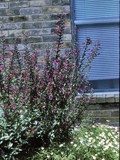
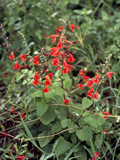
There are a few red-flowered native salvias that would be good for your situation. Salvia greggii, Autumn Sage, is a small shrub, easily transplanted and readily available in the nursery trade. Salvia penstemonoides, Big Red Sage, is a large perennial (three to five feet tall) sometimes available at native plant nurseries. Salvia coccinea, Scarlet Sage, is a small, prolific perennial usually no more than three feet tall that is easily found at nurseries. All have minty leaves that can be dried and used like culinary sage, and all have mildly sweet edible flowers.
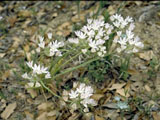
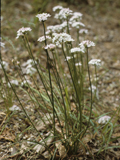
A couple of wild onion/garlic species, Allium canadense and Allium drummondii, have short stalks that can be used like chives, but they aren’t usually available commercially so you would have to gather your own or transplant some.
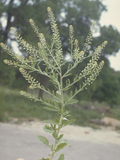
The local peppergrasses, Lepidium austrinum and Lepidium virginicum, are normally considered nondescript weeds, but their name comes from their seeds’ longstanding use as a pepper-flavored seasoning. In addition, the somewhat spicy young, basal leaves can be consumed as raw or cooked greens and are rich in Vitamin C and iron.
Fruit
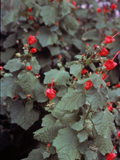
Turkscap (Malvaviscus arboreus var. drummondii) has edible spring-to-fall flowers and late summer-through-fall fruit. It normally grows in at least dappled shade but can grow in sun, though its leaves will be darker and more puckered there than in shade. Common in nurseries and in the wild.
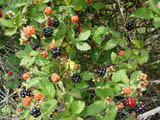
Southern Dewberry (Rubus trivialis) is a prickly, trailing plant with delicious, blackberry-like fruit in late spring and summer.
Tea
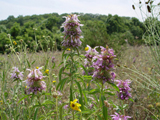
The leaves of the familiar Lemon Mint or Horsemint (Monarda citriodora) make a minty-lemony tea.
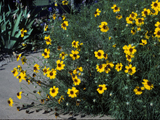
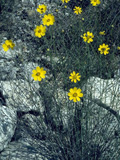
Two local Thelesperma species, Greenthread (Thelesperma filifolium) and Navajo Tea (Thelesperma simplicifolium), are also used for teas. A single dried stalk makes one cup of very mild tea. Greenthread is a very common roadside daisy, while Navajo Tea is found in rocky areas of exposed limestone and older Austin neighborhoods.
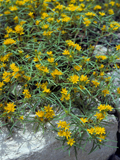
A trailing perennial called Limoncillo (Pectis angustifolia) has leaves that can be used for seasoning, and its leaves, stems, and flowers can be steeped for a lemony tea.
Greens
Locally native plants that qualify as edible greens are unfortunately usually considered weedy and will have to be dug up on your own, but they are good to eat.
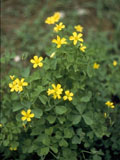
Common wood sorrel species, like Oxalis stricta, have a deliciously sour taste to their leaves and fruit, so sour that some people call them clover pickles (they have clover-like leaves and long, narrow fruits).
One of the names of pellitory species like Parietaria pensylvanica is Cucumber Plant. The young leaves can taste like fresh cucumber.
Good luck with your garden!
More Edible Plants Questions
Getting rid of invasive Florida betony from Myrtle Beach SC
April 28, 2012 - How can I get rid of Florida Betony from my lawn and flower beds/ garden area. Garden area was thoroughly dug up and hand picked of all tubules last year at least a foot deep. They are much worse now....
view the full question and answer
Fruit crops to grow in Tennessee mountains
May 27, 2013 - My property has a lot of rock formations throughout it and has hundreds of cedars where it is not pasture. I am wanting to grow fruit trees and berry bushes but don't know what can grow in this e...
view the full question and answer
Wild plum tree failing to bloom from Simonton TX
May 04, 2013 - I have a wild plum tree that has been in the ground for 3 or 4 years and it has not ever flowered. Why? I don't know what kind it is. I dug it up from a friends yard. Her wild plum trees have flowere...
view the full question and answer
A garlic plant with only one clove in Ft. Worth, TX?
August 08, 2011 - Is there a garlic that does not have cloves? I have been using what appears to be garlic from my garden and it is garlicy, hot and delicious. I have spent many hours online but cannot find this garlic...
view the full question and answer
Patience pays off with chile pequin in Austin
September 24, 2011 - Hello. Re my June 08, 2011 message -- Guess what! The chile pequin is finally flowering and setting fruit in its container on my apartment patio. You said patience, you were right, and hooray once aga...
view the full question and answer
| Support the Wildflower Center by Donating Online or Becoming a Member today. |