Native Plants

Plant Database
Search for native plants by scientific name, common name or family. If you are not sure what you are looking for, try the Combination Search or our Recommended Species lists.
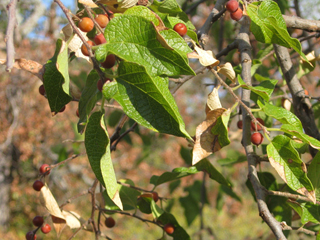
Fabre, Carl
Celtis laevigata var. reticulata
Celtis laevigata Willd. var. reticulata (Torr.) L.D. Benson
Netleaf Hackberry, Netleaf Sugar Hackberry, Western Hackberry, Sugar Hackberry, Texas Sugarberry, Palo Blanco, Acibuche
Ulmaceae (Elm Family)
Synonym(s): Celtis douglasii, Celtis occidentalis var. reticulata, Celtis reticulata, Celtis reticulata var. vestita
USDA Symbol: celar
USDA Native Status: L48 (N)
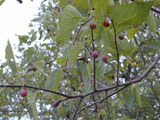
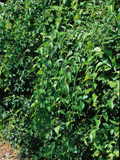
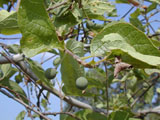
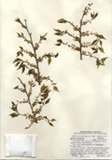
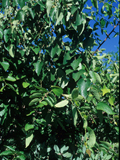
A tree or large shrub with gray bark, ridged on the trunk, smooth on the twigs. Leaves up to 3 inches long, smaller than those of Sugar Hackberry, with smooth margins, sometimes with teeth in the apical half, a pointed tip, and a slightly asymmetric base, the upper surface somewhat rough to the touch and darker green than the lower surface, midrib and veins light yellow on the lower. Flowers inconspicuous. Fruit spherical, 1/4 inch in diameter, reddish.
This is the native hackberry of the western United States, mainly in the Southwest, but extending eastward into the prairie states. The sweetish fruit is eaten by wildlife and was a food source for Native Americans. The branches often have deformed bushy growths called witches'-brooms, produced by mites and fungi. The leaves bear rounded, swollen galls caused by tiny, jumping plant lice. This hackberry is mostly confined to areas with a constant water supply.
Plant Characteristics
Duration: PerennialHabit: Tree
Leaf Retention: Deciduous
Leaf Arrangement: Alternate
Leaf Complexity: Simple
Inflorescence: Axillary
Fruit Type: Drupe
Size Notes: Up to about 50 feet tall.
Leaf: Green
Bloom Information
Bloom Color: WhiteBloom Time: Feb , Mar , Apr
Distribution
USA: AZ , CA , CO , ID , KS , LA , NM , NV , OK , OR , TX , UT , WA , WYNative Distribution: E. WA to s. CA, e. to ID, KS, TX & adjacent Mex.
Native Habitat: Stream banks; washes; canyons; dry, limestone hills
Growing Conditions
Water Use: LowLight Requirement: Part Shade
CaCO3 Tolerance: High
Soil Description: Rocky, moist to dry, limestone soils.
Conditions Comments: Seeds can be planted directly outdoors in the fall. Plant seeds 1/2 inch deep in a loose, fertile, and well-drained seedbed. Keep the soil moist. Withstands severe drought and high heat. Also fairly resistant to disease and insect problems.
Benefit
Conspicuous Flowers: yesInteresting Foliage: yes
Attracts: Birds , Butterflies
Deer Resistant: High
Propagation
Description: Stratified seed sown in spring or untreated seed sown in fall. Can be rooted from juvenile wood and from root sprouts or suckers.Seed Collection: Pick mature fruits in late summer until winter. Air-dry with pulp on or soak overnight and rub pulp off on screen. Store in sealed, refrigerated containers.
Seed Treatment: May require up to 120 days of moist chilling.
Commercially Avail: yes
Find Seed or Plants
Find seed sources for this species at the Native Seed Network.
Mr. Smarty Plants says
Edible plants native to Austin, TX
August 05, 2009
Hello,
I am a chef from Buenos Aires Argentina visiting Austin, Texas and would like to learn about native, edible plants in the region.
Please let me know if there are any native, edible plants...
view the full question and answer
National Wetland Indicator Status
| Region: | AGCP | AK | AW | CB | EMP | GP | HI | MW | NCNE | WMVE |
| Status: | UPL | FAC | UPL | UPL | UPL | FACU |
From the National Organizations Directory
According to the species list provided by Affiliate Organizations, this plant is on display at the following locations:Lady Bird Johnson Wildflower Center - Austin, TX
Santa Barbara Botanic Garden - Santa Barbara, CA
Sibley Nature Center - Midland, TX
Brackenridge Field Laboratory - Austin, TX
Nueces River Authority - Uvalde, TX
Texas Parks and Wildlife Department - Austin, TX
Texas Master Naturalists - Lost Pines Chapter - Bastrop, TX
Native Seed Network - Corvallis, OR
Herbarium Specimen(s)
NPSOT 0422 Collected Jun 4, 1987 in Bexar County by Harry CliffeNPSOT 1132 Collected Mar 27, 1995 in Bexar County by Harry Cliffe
Bibliography
Bibref 298 - Field Guide to Texas Trees (1999) Simpson, B.J.Bibref 481 - How to Grow Native Plants of Texas and the Southwest: Revised and Updated Edition (2001) Nokes, J.
Bibref 355 - Landscaping with Native Plants of Texas and the Southwest (1991) Miller, G. O.
Bibref 354 - Native & Naturalized Woody Plants of Austin & the Hill Country (1981) Lynch, D.
Bibref 995 - Native Landscaping from El Paso to L.A. (2000) Wasowski, S. and A. Wasowski
Bibref 297 - Trees of Central Texas (1984) Vines, Robert A.
Search More Titles in Bibliography
Additional resources
USDA: Find Celtis laevigata var. reticulata in USDA PlantsFNA: Find Celtis laevigata var. reticulata in the Flora of North America (if available)
Google: Search Google for Celtis laevigata var. reticulata
Metadata
Record Modified: 2016-04-18Research By: NPC