Native Plants

Plant Database
Search for native plants by scientific name, common name or family. If you are not sure what you are looking for, try the Combination Search or our Recommended Species lists.
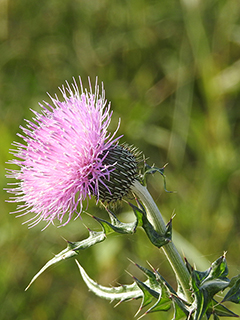
Pyle, Lynn
Cirsium texanum
Cirsium texanum Buckley
Texas Thistle
Asteraceae (Aster Family)
Synonym(s): Carduus austrinus, Cirsium texanum var. stenolepis
USDA Symbol: CITE2
USDA Native Status: L48 (N)
The Texas thistle grows 2-6 feet tall, without branches, or sparingly branched near the top. The numerous leaves are alternate, 4-9 inches long, smaller on the upper third of the stem. Leaves are green above and white below, with a woolly texture on the underside. The irregular lobes have spines at the tip but few elsewhere on the leaf. There is 1 flower head to a stem, with no ray flowers but numerous usually purplish disc flowers.
Bumblebees work the flowers when they mature.


Plant Characteristics
Duration: BiennialHabit: Herb
Root Type: Tap
Leaf Complexity: Simple
Leaf Margin: Lobed
Inflorescence: Head
Size Notes: Up to about 6 feet tall.
Leaf: Blades green & glabrous above, grayish or whitish beneath.
Flower: Flowers 1 mm broad in a larger flower head.
Fruit: Fruit is a cypsela (pl. cypselae). Though technically incorrect, the fruit is often referred to as an achene.
Bloom Information
Bloom Color: White , Pink , PurpleBloom Time: Apr , May , Jun , Jul , Aug
Bloom Notes: White to pinkish purple.
Distribution
USA: MO , OK , TXNative Distribution: Prairies and roadsides nearly throughout Texas, Oklahoma & Missouri, and south to northern Mexico.
Growing Conditions
Water Use: LowLight Requirement: Sun
Soil Moisture: Dry
Heat Tolerant: yes
Conditions Comments: Commonly recognized for its flower, Texas thistle is a drought tolerant species that blooms in early summer. The flower is a good nectar source for pollinators. Let the flower progress to seed, providing food for birds.
Benefit
Use Wildlife: Bumblebees work the flowers when they mature. Larvae of painted-lady butterfly feed on foliage. Goldfinches eat seeds and use fluff (silky) of ripened seeds to line nests.Use Other: Goldfinches reported to use the pappus bristles of the flower to line their nests. Also used as a nectar source for butterflies.
Conspicuous Flowers: yes
Attracts: Birds
Larval Host: Painted Lady
Nectar Source: yes
Value to Beneficial Insects
Special Value to Native BeesSpecial Value to Bumble Bees
Provides Nesting Materials/Structure for Native Bees
This information was provided by the Pollinator Program at The Xerces Society for Invertebrate Conservation.
Find Seed or Plants
Order seed of this species from Native American Seed and help support the Wildflower Center.
Mr. Smarty Plants says
Native host plants for Painted Lady Butterfly
June 01, 2006
I am looking for host plants for the Painted Lady Butterfly that I can plant in my school's (I am a teacher) native plant/butterfly garden. As part of the curriculum, each spring the 1st grade raises...
view the full question and answer
From the National Organizations Directory
According to the species list provided by Affiliate Organizations, this plant is on display at the following locations:Fredericksburg Nature Center - Fredericksburg, TX
Lady Bird Johnson Wildflower Center - Austin, TX
Sibley Nature Center - Midland, TX
Brackenridge Field Laboratory - Austin, TX
Patsy Glenn Refuge, c/o Wimberley Birding Society - Wimberley, TX
Stengl Biological Research Station - Smithville, TX
Texas Master Naturalists - Lost Pines Chapter - Bastrop, TX
National Butterfly Center - Mission, TX
Jacob's Well Natural Area - Wimberley, TX
NPSOT - Williamson County Chapter - Georgetown, TX
Herbarium Specimen(s)
NPSOT 0584 Collected May 11, 1990 in Bexar County by Harry CliffeNPSOT 0017 Collected May 17, 1990 in Bexar County by Judith C. Berry
NPSOT 0809 Collected Jun 4, 1994 in Comal County by Mary Beth White
NPSOT 0053 Collected May 4, 1990 in Bexar County by Lottie Millsaps
NPSOT 0872 Collected May 4, 1994 in Bexar County by Harry Cliffe
Wildflower Center Seed Bank
LBJWC-5 Collected 2006-05-16 in Travis County by Lady Bird Johnson Wildflower CenterBibliography
Bibref 281 - Shinners & Mahler's Illustrated Flora of North Central Texas (1999) Diggs, G. M.; B. L. Lipscomb; B. O'Kennon; W. F...Bibref 248 - Texas Wildflowers: A Field Guide (1984) Loughmiller, C. & L. Loughmiller
Bibref 328 - Wildflowers of Texas (2003) Ajilvsgi, Geyata.
Bibref 286 - Wildflowers of the Texas Hill Country (1989) Enquist, M.
Search More Titles in Bibliography
Web Reference
Webref 38 - Flora of North America (2019) Missouri Botanical Garden, St. Louis, MO & Harvard University Herbaria, Cambridge, MA.Webref 23 - Southwest Environmental Information Network (2009) SEINet - Arizona Chapter
Additional resources
USDA: Find Cirsium texanum in USDA PlantsFNA: Find Cirsium texanum in the Flora of North America (if available)
Google: Search Google for Cirsium texanum
Metadata
Record Modified: 2022-12-05Research By: RSB