Native Plants

Plant Database
Search for native plants by scientific name, common name or family. If you are not sure what you are looking for, try the Combination Search or our Recommended Species lists.
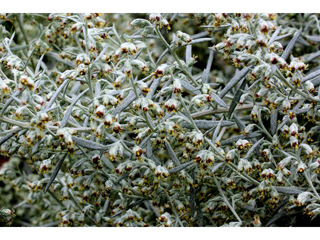
Smith, R.W.
Artemisia ludoviciana
Artemisia ludoviciana Nutt.
Louisiana Artemisia, Louisiana Sage, White Sage, Prairie Sage, Silver Sage, White Sagebrush, Louisiana Wormwood, Silver Wormwood, Louisiana Sagewort, Gray Sagewort, Cudweed Sagewort, Mugwort Wormwood
Asteraceae (Aster Family)
Synonym(s):
USDA Symbol: ARLU
USDA Native Status: L48 (N), CAN (N)
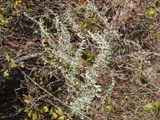
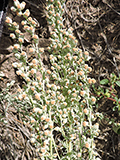
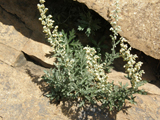
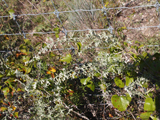
This is a stiff, aromatic, silvery-white perennial, 1 1/2-3 ft. tall, which can spread quickly to form large colonies. Shrub-like, white, densely matted with hairs, from rhizome. Small, yellowish flowers are secondary to the silver color of the erect stems and narrow leaves, created by a dense coat of hairs.
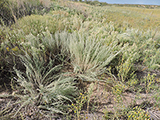
This is a common artemisia, with attractive, fragrant, whitish green foliage. Its adaptability and tendency to colonize makes it a good choice for a low-maintenance, knee- to waist-high groundcover. It can even take mowing.
Plant Characteristics
Duration: PerennialHabit: Subshrub
Root Type: Tap
Leaf Retention: Semi-evergreen
Size Notes: Usually up to about 3 feet tall. Rarely up to 4 feet tall in desert washes.
Leaf: White-gray. Northern populations have whiter, broader leaves.
Fruit: Fruit is a cypsela (pl. cypselae). Though technically incorrect, the fruit is often referred to as an achene.
Bloom Information
Bloom Color: Red , YellowBloom Time: Jun , Jul , Aug , Sep , Oct , Nov
Bloom Notes: Yellow, sometimes tinged red.
Distribution
USA: AR , AZ , CA , CO , CT , DE , GA , IA , ID , IL , IN , KS , KY , LA , MA , MD , ME , MI , MN , MO , MS , MT , NC , ND , NE , NH , NJ , NM , NV , NY , OH , OK , OR , PA , RI , SC , SD , TN , TX , UT , VA , VT , WA , WI , WYCanada: AB , BC , MB , NB , NT , ON , PE , QC , SK
Native Distribution: Much of North America, from Canada south to Mexico
Native Habitat: Dry slopes; canyons; open pine woods; dry prairies. Eastern populations more in uplands, western populations more in lowlands.
Growing Conditions
Water Use: LowLight Requirement: Sun
Soil Moisture: Dry
CaCO3 Tolerance: High
Drought Tolerance: High
Heat Tolerant: yes
Soil Description: Dry to mesic, rocky, shallow soils, well drained. Sand, loam, clay, caliche, limestone. Very adaptable.
Conditions Comments: Becomes leggy in fertile, moist soils.
Benefit
Use Ornamental: A colonizing groundcover plant that has attractive silvery foliage and takes tough conditions.Use Medicinal: Tea from leaves for stomach troubles. Tea of roots for laxative, inability to urinate and difficulty in childbirth. Crushed leaf as snuff for sinus attacks, nosebleed and headaches. Strong tea as wash for eczema, deodorant and antiperspirant for underarms and feet.
Use Other: Smoke for ceremonial uses. Tea from leaves for ceremonial bathing. Cut stalks used for fragrant wreaths and floral arrangements.
Conspicuous Flowers: yes
Fragrant Foliage: yes
Value to Beneficial Insects
Provides Nesting Materials/Structure for Native BeesThis information was provided by the Pollinator Program at The Xerces Society for Invertebrate Conservation.
Propagation
Propagation Material: Root Division , SeedsDescription: Increase by sowing seeds or dividing the rhizomes in spring or fall. Mature plants may also be divided.
Commercially Avail: yes
Maintenance: Mow in fall to have rosettes throughout winter.
Find Seed or Plants
Find seed sources for this species at the Native Seed Network.
View propagation protocol from Native Plants Network.
Mr. Smarty Plants says
Native grasses for East Texas that require no mowing or watering
June 16, 2010
What native grass can I grow in deep East Texas that would require no supplemental watering and no mowing?
view the full question and answer
Native host plants for Painted Lady Butterfly
June 01, 2006
I am looking for host plants for the Painted Lady Butterfly that I can plant in my school's (I am a teacher) native plant/butterfly garden. As part of the curriculum, each spring the 1st grade raises...
view the full question and answer
National Wetland Indicator Status
| Region: | AGCP | AK | AW | CB | EMP | GP | HI | MW | NCNE | WMVE |
| Status: | UPL | FACU | FACU | UPL | UPL | UPL | UPL | FACU |
From the National Organizations Directory
According to the species list provided by Affiliate Organizations, this plant is on display at the following locations:Santa Barbara Botanic Garden - Santa Barbara, CA
Texas Discovery Gardens - Dallas, TX
Sibley Nature Center - Midland, TX
Brackenridge Field Laboratory - Austin, TX
United States Botanic Garden - Washington, DC
Natural Biodiversity - Johnstown, PA
Native Seed Network - Corvallis, OR
Bibliography
Bibref 610 - Edible wild plants of the prairie : an ethnobotanical guide (1987) Kindscher, K.Bibref 946 - Gardening with Prairie Plants: How to Create Beautiful Native Landscapes (2002) Wasowski, Sally
Bibref 355 - Landscaping with Native Plants of Texas and the Southwest (1991) Miller, G. O.
Bibref 293 - Manual of the Vascular Plants of Texas (1979) Correll, D. S. & M. C. Johnston
Bibref 318 - Native Texas Plants: Landscaping Region by Region (2002) Wasowski, S. & A. Wasowski
Bibref 1294 - The Midwestern Native Garden: Native Alternatives to Nonnative Flowers and Plants An Illustrated Guide (2011) Adelman, Charlotte and Schwartz, Bernard L.
Search More Titles in Bibliography
Web Reference
Webref 30 - Calflora (2018) CalfloraWebref 38 - Flora of North America (2019) Missouri Botanical Garden, St. Louis, MO & Harvard University Herbaria, Cambridge, MA.
Webref 23 - Southwest Environmental Information Network (2009) SEINet - Arizona Chapter
Additional resources
USDA: Find Artemisia ludoviciana in USDA PlantsFNA: Find Artemisia ludoviciana in the Flora of North America (if available)
Google: Search Google for Artemisia ludoviciana
Metadata
Record Modified: 2022-11-22Research By: TWC Staff