Native Plants
Q. Who is Mr. Smarty Plants?
A: There are those who suspect Wildflower Center volunteers are the culpable and capable culprits. Yet, others think staff members play some, albeit small, role. You can torture us with your plant questions, but we will never reveal the Green Guru's secret identity.
Did you know you can access the Native Plant Information Network with your web-enabled smartphone?

Ask Mr. Smarty Plants
Ask Mr. Smarty Plants is a free service provided by the staff and volunteers at the Lady Bird Johnson Wildflower Center.

rate this answer

Wednesday - June 16, 2010
From: Carthage, TX
Region: Southwest
Topic: Grasses or Grass-like
Title: Native grasses for East Texas that require no mowing or watering
Answered by: Nan Hampton
QUESTION:
What native grass can I grow in deep East Texas that would require no supplemental watering and no mowing?ANSWER:
Bouteloua dactyloides (buffalograss) is the perfect grass to meet your criteria—once established it takes no supplemental watering and only rare, occasional mowing. Unfortunately, it is not a grass that one thinks of as growing in deep East Texas. However, the USDA Plants Database distribution map shows it occurring in Marion County just north of Panola County and also in Caddo Parrish in Louisiana just across the state line from Panola County. One thing I do know about East Texas is that the soil can be very sandy there. If the soil is sandy where you live, buffalograss will NOT do well. Also, if the site you want to grow it on is very shady, it will not do well. You can read our article, Native Lawns: Buffalograss, to learn more about it. You can also read about the research that the Wildflower Center has done on Native Lawns. Unfortunately, neither of the other two short native grasses, Bouteloua gracilis (blue grama) and Hilaria belangeri (curly-mesquite), are native to East Texas.
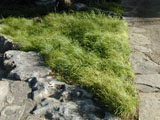
There are no other native turf grasses that meet your criteria but there are several grass-like sedges that have been used as substitutes for grass lawns. They are evergreen, require little or no mowing, some will grow in both sun and shade, and some will survive without supplemental watering. The ones listed in the article linked above that are native to Texas are Carex perdentata (sand sedge) and Carex texensis (Texas sedge).
If you are just looking for plants to cover your lawn area, we can recommend several that require little water, do not grow tall and/or can be occasionally mowed to maintain your desired height.
Here are several ground covers recommended by the Wasowskis in Native Texas Plants: Landscaping Region by Region that do well in the clay soils of the Dallas region:
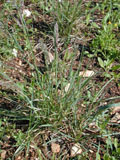
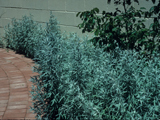
Artemisia ludoviciana (white sagebrush) is evergreen (maybe evergray is a better descriptor) grows 1 to 3 feet but can be mowed.
Calyptocarpus vialis (straggler daisy) grows less than 1 foot high. It goes dormant in cold winters.
Geum canadense (white avens) grows from 4 inches to over 3 feet, but can be mowed. It is evergreen if watered in summer.
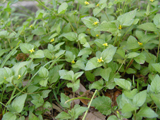
Phyla nodiflora (turkey tangle fogfruit) grows 3 to 4 inches high and is evergreen to dormant in winter.
Rivina humilis (rougeplant) grows 1 to 1.5 feet and is evergreen to dormant in winter.
Salvia lyrata (lyreleaf sage) grows 4 to 18 inches or more, but can be mowed and is evergreen if watered in summer.
Packera obovata (roundleaf ragwort) grows 3 inches to 2 feet but can be mowed and is evergreen.
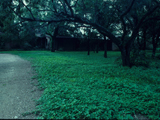
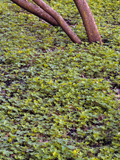
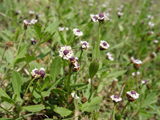
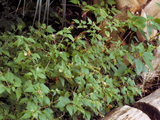
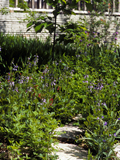
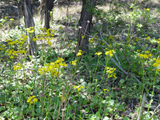
Here are photos of the above plants from our Image Gallery:
More Grasses or Grass-like Questions
A blue-eyed grass with salmon-colored blooms?
June 16, 2015 - Has anyone heard of a blue-eyed grass variety that has salmon-colored blooms? I have a photo if needed.
view the full question and answer
Native grasses for wood planter box in Houston
August 04, 2011 - Hi, I'm making a long wood planter box/bench for my wood deck. The area gets direct sun only in the late afternoon/evening and the deck serves as a play space for our one-year old son. I'd like to...
view the full question and answer
Lawn grass for Erath County, TX
October 02, 2012 - We live in Erath County in TX on ranch land. We are relatively dry. Our soil is combination of clay and red soil (brought in for building pad), and sandy. We have a sloped area, about 30%, that we w...
view the full question and answer
Native landscaping in Austin
August 24, 2009 - I am planning to convert a pretty large portion (app. 500 sq feet) of my front yard from St. Augustine to an area with native and well-adapted plants. I have solarized the area to kill off grass and ...
view the full question and answer
Texas native plants for cemetery site
February 09, 2005 - I am trying to landscape my mothers gravesite located in far East Texas (just outside of Nacogdoches) and I am looking for some evergreen bushes or any other decorative plants for that area. I am thi...
view the full question and answer
| Support the Wildflower Center by Donating Online or Becoming a Member today. |