Native Plants
Q. Who is Mr. Smarty Plants?
A: There are those who suspect Wildflower Center volunteers are the culpable and capable culprits. Yet, others think staff members play some, albeit small, role. You can torture us with your plant questions, but we will never reveal the Green Guru's secret identity.
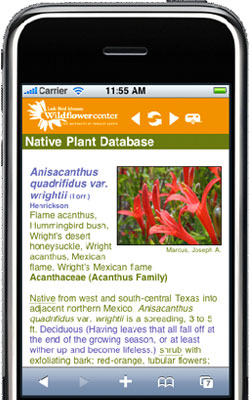
Did you know you can access the Native Plant Information Network with your web-enabled smartphone?

Ask Mr. Smarty Plants
Ask Mr. Smarty Plants is a free service provided by the staff and volunteers at the Lady Bird Johnson Wildflower Center.
rate this answer

Sunday - February 26, 2012
From: Breezy Point, NY
Region: Northeast
Topic: Privacy Screening, Shrubs, Trees
Title: Evergreen hedge for NY
Answered by: Anne Bossart
QUESTION:
I am looking for a native evergreen shrub that could be used as a hedge or privacy screen on the Rockaway peninsula in Queens county. It is a beach community with sand soil ( except where it has been enhanced with organic matter). Have had extreme difficulty finding native plants that would work. Any help appreciated, thank you.ANSWER:
People always wonder how garden designers decide what plant to put where when there are so many to choose from. As it turns out, there actually aren't so many. By the time you look at all the conditions of a location, you have excluded so many plants that don't meet them it is not so difficult making that selection.
Here is the list of constraints you have placed on the plant selection process:
Native- you have quickly eliminated most of the plants that are for sale in most nurseries (especially in the giant retailers)
Evergreen - you live in the north, so your choices will be fewer than if you lived further south. It's tough keeping your leaves alive when the water in them turns to ice. This is easier when your leaves are needles, but there are some broadleaved evergreens who have developed adaptations such as cell walls that are sturdy enough to resist rupture or by adjusting the carbohydrate content of the water in the leaves so that it doesn't crystallize
Shrub for hedge or privacy screen- most of the needle evergreens are trees that will grow way beyond your space within a few years. A few can be pruned and maintained as a hedge. Most of the broadleaved evergreens that can survive winter, do so by staying small enough to be close to the ground for protection (under the snow, or out of the wind) which doesn't give you much privacy.
Beach community with sandy soil- sandy soil provides extremely good drainage so it tends to be dry. However, the closer you get to the waters edge, the higher the water table, and the more moisture which is available to plants. So depending on which is your situation, you either require or have ruled out drought tolerant plants.
The final condition of your site which you haven't mentioned is light exposure. I would guess it would be full sun as there are no skyscrapers in beach communities and because you are looking for privacy. If there were already plantings along the edge of your property to shade yours, you would not need to plant any!
If you visit our Native Plant database you can do a Combination Search for New York, narrowing the search according to your conditions. It will generate a list of plants (with links to detailed information pages) native to your area that fit your description.
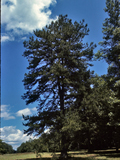
A search selecting New York, tree, 6-12 ft and 12-36 ft, evergreen, sun (and part shade) and ignoring moisture (so that all are chosen) yields three plants: Ilex opaca (American holly), Pinus virginiana (Virginia pine) and Pseudotsuga menziesii (Blue douglas fir) all of which will likely outgorw your site.
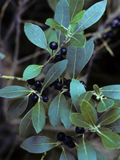
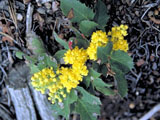
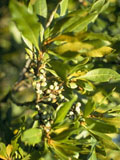
Doing it again selecting shrubs 3-6 ft and 6-12 ft yields five more: Ilex glabra (Inkberry), Juniperus communis var. depressa (Common juniper), Leucothoe fontanesiana (Drooping leucothoe), Mahonia aquifolium (Holly-leaf oregon-grape) and Taxus canadensis (American yew). Most of these are in the 3-6 foot range, which might not be all that useful for screening.
A couple of candidates that don't emerge from the search but might be useful are Morella pensylvanica (Northern bayberry) which is not dependably evergreen and Thuja occidentalis (Arborvitae) which is in the 70-100 ft range, but can be planted densely when young and kept pruned to hedge size for many years. Deer love it, though, if they are present in your area.
That may explain why you are having difficulty finding plants ... there aren't many. If you observe what plants do occur naturally in uninhabited seashore areas, you will see that not many of them will perform the task you are asking. You may have to consider deciduous plants (that will give you many more choices and densely planted large deciduous shrubs can give you plenty of screening, plus more interesting flowers, fragrance, fruit and fall color than evergreens) or some carefully selective adapted non-natives that are known not to be a threat to your native eco-system (and there are no guarantees). Go for a walk in your neighborhood, see what plants are thriving and ask questions.
We applaud your efforts to use native plants even in your highly urbanized location. The more native plants that you plant, the more your property will be alive with the birds, butterflies and other wildlife that would like to make it their home!
From the Image Gallery


More Shrubs Questions
Drought resistant flowering plants for Spring, TX
January 25, 2012 - Hi Mr. Smarty Pants. I live in Spring Tx. and wanted to plant a garden in my front yard. I'm looking for flowering plants that are colorful, easy to manage, and drought resistant but so far can't fi...
view the full question and answer
Chlorosis in yaupon from San Angelo TX
April 08, 2012 - Thank you for your information on the yaupon holly. We just finished clearing out the mulch and the red ground cover that popped up. I will quit watering it as much as the rest of the plants. Our y...
view the full question and answer
Native plant for border in central coastal Texas
September 29, 2015 - I am looking for a native plant suggestion for a border along my front porch in central coastal Texas. My site has heavy gumbo soil and strong sunlight. I want something not more than 2 or 3 feet t...
view the full question and answer
Identification of fragrant, white-flowered bush in Arizona
April 14, 2013 - I'd like to identify a flowering bush which has white sweet-smelling flowers.
It is growing in the Coconino National Forest in the area near the Airport vortex/Airport mesa in Sedona, Arizona.
...
view the full question and answer
Mountain Laurel not growing in Hallettesville, TX.
September 16, 2012 - Mountain laurel has been planted over 2 years. Well drained,sandy soil, full sun. They have not grown or set blooms despite occasional all purpose fertilizers. What is wrong?
view the full question and answer
| Support the Wildflower Center by Donating Online or Becoming a Member today. |