Native Plants

Plant Database
Search for native plants by scientific name, common name or family. If you are not sure what you are looking for, try the Combination Search or our Recommended Species lists.
Wasowski, Sally and Andy
Ilex opaca
Ilex opaca Aiton
American Holly, White Holly, Prickly Holly, Evergreen Holly, Christmas Holly, Yule Holly
Aquifoliaceae (Holly Family)
Synonym(s):
USDA Symbol: ILOP
USDA Native Status: L48 (N)
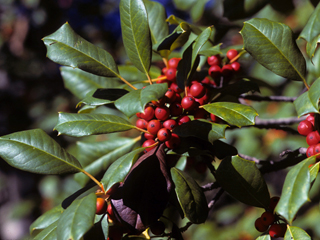
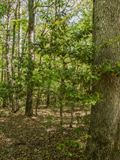
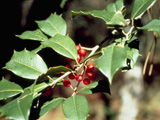
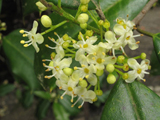
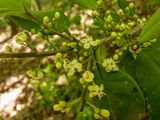
The height of American holly or Christmas holly ranges from 25 ft. to as tall as 60 ft. in the warmer parts of its range. The stout, stiff branches of this pyramidal evergreen bear dark green, non-glossy, spine-tipped leaves. New growth finally pushes off the old leaves in spring. Bright red berries occur on the female plants. A shorter, multi-trunked form may grow in lower-light situations. The bark is a light gray color.
The evergreen fruiting branches from wild and planted trees are popular Christmas decorations. Many improved varieties are grown for ornament, shade, and hedges. You must have both a male and female plant to have berries, or at least have the opposite sex growing wild somewhere nearby. The male must be the same holly species as the female and bloom at the same time. This is a very slow-growing tree. The whitish, fine-textured wood is especially suited for inlays in cabinetwork, handles, carvings, and rulers, and can be dyed various shades, even black. Many kinds of songbirds, gamebirds, and mammals eat the bitter berries of this and other hollies, but the fruits are poisonous to humans.
Plant Characteristics
Duration: PerennialHabit: Tree
Leaf Retention: Evergreen
Leaf Complexity: Simple
Leaf Pubescence: Glabrous
Leaf Texture: Smooth
Breeding System: Flowers Unisexual , Dioecious
Fruit Type: Drupe
Size Notes: In the westernmost portions of its range, height is normally from 15-25 feet, with 50-foot trees occasional. In moister regions, averages 40-50 feet, with occasional 75-100 foot trees.
Leaf: Green
Fruit: Red, sometimes orange or yellow, 1/4 to 1/3 inch. Although technically drupes, the fruit is commonly referred to as berries.
Bloom Information
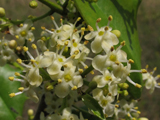
Bloom Color: White , GreenBloom Time: Mar , Apr , May , Jun
Bloom Notes: Tiny flowers.
Distribution
USA: AL , AR , CT , DC , DE , FL , GA , IL , IN , KY , LA , MA , MD , ME , MO , MS , NC , NJ , NY , OH , OK , PA , RI , SC , TN , TX , VA , WVNative Distribution: VA to n. FL, w. to s.e. MO & e. TX; also coastal areas from MA to MD
Native Habitat: Shaded woods and stream and river banks. Uplands and lowlands. Primarily an understory tree.
Growing Conditions
Water Use: MediumLight Requirement: Sun , Part Shade , Shade
Soil Moisture: Dry , Wet
Soil pH: Acidic (pH<6.8)
CaCO3 Tolerance: Low
Drought Tolerance: Low , Medium
Cold Tolerant: yes
Heat Tolerant: yes
Soil Description: Moist, well-drained, acidic soils. Acid-based, Sandy, Sandy Loam, Medium Loam. Not so good in clay.
Conditions Comments: For clay soils in areas of high humidity (like Houston), cultivar 'Savannah' is recommended.
Benefit
Use Ornamental: Long-living, Understory, Screens, Fruits ornamental, Attractive, Mass plantingUse Wildlife: Berries attract many bird and small mammal species. Also provides cover and nesting sites. Larval plant for Henry's Elfin butterfly.
Use Other: White wood used in furniture, woodworking, and other products.
Warning: All Ilex species may be somewhat toxic if ingested. Sensitivity to a toxin varies with a person’s age, weight, physical condition, and individual susceptibility. Children are most vulnerable because of their curiosity and small size. Toxicity can vary in a plant according to season, the plant’s different parts, and its stage of growth; and plants can absorb toxic substances, such as herbicides, pesticides, and pollutants from the water, air, and soil.
Attracts: Birds , Butterflies
Larval Host: Henry's Elfin butterfly.
Value to Beneficial Insects
Special Value to Honey BeesThis information was provided by the Pollinator Program at The Xerces Society for Invertebrate Conservation.
Propagation
Propagation Material: Seeds , Semi-hardwood CuttingsDescription: Seeds germinate best if planted immediately after collection. They may be pretreated with scarified or double-stratification but the essential element seems to be time. Once internal conditions in the seed are right (it may take years), it will germinate in warm, moist conditions. The sex of the seedlings won't be discernible for 5 to 12 years.
Seed Treatment: Some benefit may be obtained from 30-60 days treatment at 68-86 degrees followed by 60-90 days of 41 degrees.
Commercially Avail: yes
Maintenance: Supplemental water may be necessary in drier sands. For those who don't like the grand, magnolia-like look of branches extending to the ground, pruning for a visible trunk may be desirable.
Mr. Smarty Plants says
Tree for sound block near Houston
April 24, 2010
I live in Pearland, just south of Houston and am looking for a tree that I can plant along my fenceline between my neighbor and me that will block noise. We have a pool and entertain a lot, but they a...
view the full question and answer
Shrub for barrier fence in Alexandria, Virginia
August 19, 2009
Hi. we need plants to act as a barrier fence, 15 feet tall, partial shade. We are considering a holly or virginia magnolia. What can you suggest?
thank you,
Nikita
view the full question and answer
Eucalyptus tree for Spring, Texas
October 31, 2008
I've heard eucalyptus trees do not lose their leaves in the winter and grow considerably tall. I want to replace a decaying pine tree with a eucalyptus tree. Do you recommend that for the Spring, T...
view the full question and answer
Native evergreens for privacy in Crockett, TX
October 12, 2008
I need advice on what tall evergreens I can plant along a fence line for privacy. I need trees that will be at minimum 8 to 10 feet tall at maturity, are aesthetically pleasing and provide privacy.
...
view the full question and answer
Aging non-native weeping willow in Ohio
June 11, 2008
We had a weeping willow now for about 15 years and it was doing fine until this summer. It has new branches sort of but a lot of the older ones are dying. There are leaves of course and they are sti...
view the full question and answer
National Wetland Indicator Status
| Region: | AGCP | AK | AW | CB | EMP | GP | HI | MW | NCNE | WMVE |
| Status: | FAC | FACU | FACU | FACU | FACU |
From the National Organizations Directory
According to the species list provided by Affiliate Organizations, this plant is on display at the following locations:Pineywoods Native Plant Center - Nacogdoches, TX
Delaware Nature Society - Hockessin, DE
Crosby Arboretum - Picayune, MS
Texas Parks and Wildlife Department - Austin, TX
Georgia Native Plant Society - Atlanta, GA
Longwood Gardens - Kennett Square, PA
Mt. Cuba Center - Hockessin, DE
Wellspring Organic Farm and Education Center - West Bend, WI
Bibliography
Bibref 298 - Field Guide to Texas Trees (1999) Simpson, B.J.Bibref 1620 - Gardening with Native Plants of the South (Reprint Edition) (2009) Wasowski, S. with A. Wasowski
Bibref 355 - Landscaping with Native Plants of Texas and the Southwest (1991) Miller, G. O.
Bibref 318 - Native Texas Plants: Landscaping Region by Region (2002) Wasowski, S. & A. Wasowski
Bibref 291 - Texas Wildscapes: Gardening for Wildlife (1999) Damude, N. & K.C. Bender
Bibref 297 - Trees of Central Texas (1984) Vines, Robert A.
Search More Titles in Bibliography
From the Archive
Wildflower Newsletter 1989 VOL. 6, NO.6 - Landscape Restoration, Wildflower Outlook, Wildflower Center Fall Festival, Dire...Wildflower Newsletter 1992 VOL. 9, NO.1 - Research Update, Creating Native Lawn with Sod, Director's Report, What Makes Pl...
Additional resources
USDA: Find Ilex opaca in USDA PlantsFNA: Find Ilex opaca in the Flora of North America (if available)
Google: Search Google for Ilex opaca
Metadata
Record Modified: 2015-11-12Research By: TWC Staff