Native Plants
Q. Who is Mr. Smarty Plants?
A: There are those who suspect Wildflower Center volunteers are the culpable and capable culprits. Yet, others think staff members play some, albeit small, role. You can torture us with your plant questions, but we will never reveal the Green Guru's secret identity.
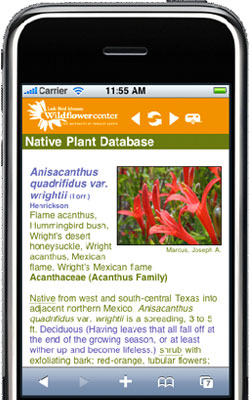
Did you know you can access the Native Plant Information Network with your web-enabled smartphone?

Ask Mr. Smarty Plants
Ask Mr. Smarty Plants is a free service provided by the staff and volunteers at the Lady Bird Johnson Wildflower Center.
rate this answer

Sunday - January 29, 2012
From: Alexander City, AL
Region: Southeast
Topic: Erosion Control, Grasses or Grass-like, Herbs/Forbs
Title: Restoring tornado-damaged property in Alexander City AL
Answered by: Barbara Medford
QUESTION:
Dear Mr Smartypants, We were struck by the outbreak of tornadoes last spring and our wonderful woods are now unsightly sloping pastures with erosion problems.. many stumps and coils of roots. We are interested in returning this land to woodland (but of course that will not be accomplished in our lifetimes) and have begun slowly reforesting with native hardwoods (we have planted 12 and will plant more in the fall). In the meantime, would it be reasonable to consider wildflowers for erosion control.. is this cost effective?.. would they reseed effectively?.. are their root systems enough to help with the erosion?.. if planted densely enough, would they inhibit weed growth?..what type of soil preparation would be necessary? Thanks for your help,ANSWER:
We are truly sorry to hear of the tornado damage done to your property, and congratulate you on your determination to return the property to woodland. Let us zero in on your concern about erosion and whether wildflowers will work.
In the wild, after a forest fire or tornado or hurricane devastates a property, vegetation will reappear, hopefully native to the area. In effect, this is a prairie, where natural evolution begins with small, sun-loving plants and grasses and gradually, as trees grow and more shade is present, begins to be a woodland again. Here is an article from Wisconsin on What is a Prairie? that could help you visualize this process. We also have our own How-To Article on Recreating a Prairie. Unfortunately for your case, most of the information and planting times have to deal with the Midwest, but the principles are the same.
We could also call your effort Meadow Gardening, since you are interested in establishing native wildflowers. Another of our How-To Articles is Meadow Gardening, which hopefully will more thoroughly deal with your issues. Finally, we have an How-To Article on Getting Started in Large Scale Wildflower Planting. We refer you to all these articles so you can know as much as we do about the various ways of dealing with your problem, written by people much smarter than we are.
Now, to get down to specifics. You already know from the articles that wildflowers will, indeed, reseed themselves. It sounds like you are committed to use of natives; so are we, so we're on the same page there. It is the matter of erosion that is as important as re-vegetating the soil. For this, you need grasses. While the roots of wildflowers will, of course, help hold the soil, grasses have longer, fibrous roots which are ideal for erosion control. We cited Prairie Gardens because this is what you begin with-grasses and wildflowers, which will eventually be overtaken by woody plants, shrubs and trees, both those that you plant and self-planting seeds. At some point, there will be too much shade for many wildflowers, as well as many of the grasses. But they should have done their job by then of holding the soil so that it was possible for plants to establish themselves.
We are going to our Native Plant Database and, using the Combination Search, look for ""herbs" (herbaceous blooming plants; i.e. wildflowers) native to Alabama. You can do the same thing, selecting on the Search page for height, light requirements, moisture needs, soils, etc, even height of plant, flower color or bloom time. You must realize that the more specifications you put in, the fewer the choices, or none at all. However, our original search gave us 1,235 herbaceous blooming plants to choose from, so go ahead, name some specifications, that is too long a list. We will choose a few that we think would work for you, follow the plant link to our webpage on the particular plant and see if it suits your needs. This is just practice to help you learn how to search on your own. Next we will search on "grass/grass-like" and list a few of those.
A word on suppressing weeds-wildflowers and native grasses could be considered "weeds." Plants don't necessarily grow where they should, but where they can get away with it. If you find some weeds you consider invasive coming up, you will have to deal with them as you can. The progression of your woodland will eventually make it a place where weeds or wildflowers can no longer get away with it.
Native wildflowers for revegetating a woodland in Alabama:
Achillea millefolium (Common yarrow) - perennial, blooms white and pink April to September, 1-3 ft. tall, sun or part shade.
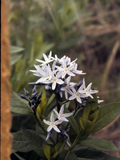
Amsonia ciliata (Fringed bluestar) - perennial, blooms blue March to June, 1-3 ft., part shade
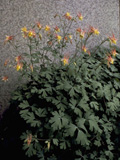
Aquilegia canadensis (Eastern red columbine) - perennial, blooms red and yellow Feb. to July, part shade or shade
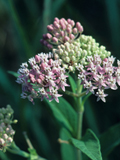
Asclepias incarnata (Swamp milkweed) - perennial, blooms pink and purple June to Oct., sun, part shade
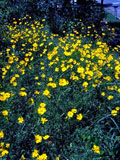
Coreopsis lanceolata (Lanceleaf coreopsis) - perennial, 2-3 ft., blooms yellow April to June, sun, part shade or shade
Dracopis amplexicaulis (Clasping coneflower)- annual, blooms yellow April to July, 1-3 ft., part shade
Native grasses for revegetating a woodland in Alabama:
Andropogon gerardii (Big bluestem) - perennial, 3-6 ft, part shade
Sorghastrum nutans (Indiangrass) - perennial, 3-8 ft., sun, part shade, shade
Panicum virgatum (Switchgrass) - perennial, 3-6 ft., sun, part shade
Schizachyrium scoparium (Little bluestem) - perennial, 18-24 in., sun, part shade
Chasmanthium latifolium (Inland sea oats) - perennial, 2-4 ft., part shade, shade
Elymus virginicus (Virginia wildrye) - perennial, 1-3 ft., part shade
From the Image Gallery

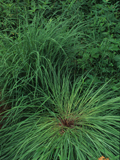
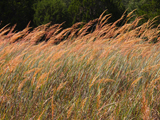
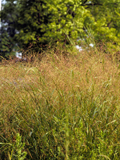
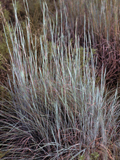

More Grasses or Grass-like Questions
Non-native, invasive bermudagrass from Memphis TN
August 17, 2012 - I live in central Memphis and have well-drained clay soil. I have converted much of the front yard from turf grass to beds of native plants, which survive our hot humid without supplemental watering e...
view the full question and answer
Top soil dressing for bermudagrass
February 25, 2009 - Need to apply top soil dressing to bermudagrass. Can you suggest any type? This area is heavy clay soil and need to even out the lawn as well as feed the grass.
view the full question and answer
Competition between peony and bulbs
November 06, 2015 - I am planting 3 herbaceous peony bare roots 3 feet apart from each other. I am told it will take 3 years before I get blooms. In the meantime, can i safely plant springtime flowering bulbs in th...
view the full question and answer
Slope Erosion control for Fairview NC
August 19, 2012 - Please recommend plants to help with soil erosion on a slope. The soil is red clay and area gets full sun. The slope is approximately 12' x 12'. I live in Fairview, NC
view the full question and answer
Native, durable, drought tolerant grasses for Amarillo, TX
May 13, 2005 - Are there any kinds of native grasses that are drought tolerant, durable and able to survive heavy foot traffic, and native to the Amarillo, Texas area?
view the full question and answer
| Support the Wildflower Center by Donating Online or Becoming a Member today. |