Native Plants

Plant Database
Search for native plants by scientific name, common name or family. If you are not sure what you are looking for, try the Combination Search or our Recommended Species lists.
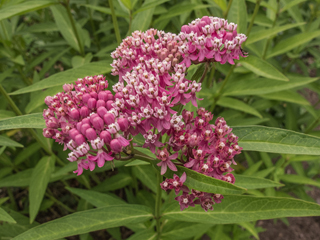
Brundage, Stephanie
Asclepias incarnata
Asclepias incarnata L.
Swamp Milkweed, Pink Milkweed
Asclepiadaceae (Milkweed Family)
Synonym(s):
USDA Symbol: asin
USDA Native Status: L48 (N), CAN (N)
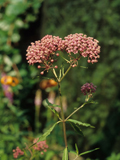
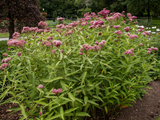
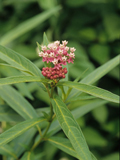
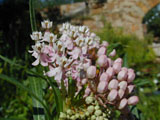
The large, bright, terminal blossoms of this tall, showy perennial are made up of small, rose-purple flowers. Deep pink flowers clustered at the top of a tall, branching stem, bearing numerous narrow, lanceolate leaves. Opposite, narrow, lance-shaped leaves line the erect, open-branched stem. Elongated, tan-brown seed pods persist into winter.
The juice of this wetland milkweed is less milky than that of other species. The genus was named in honor of Aesculapius, Greek god of medicine, undoubtedly because some species have long been used to treat a variety of ailments. The Latin species name means "flesh-colored."
Plant Characteristics
Duration: PerennialHabit: Herb
Leaf Arrangement: Opposite
Leaf Complexity: Simple
Leaf Shape: Lanceolate
Leaf Venation: Pinnate
Leaf Pubescence: Glabrous
Leaf Margin: Entire
Leaf Apex: Acute
Leaf Base: Rounded
Breeding System: Flowers Bisexual
Fruit Type: Follicle
Size Notes: Up to about 5 feet tall.
Leaf: Leaves: Long and narrow and taper off to a point, 2 3/4 - 6 in (7-15 1/4 cm) long and 1/2 - 1 in (1- 2 1/2 cm) wide. Glabrous. Leaf texture is coarse, color is green, and plant stands erect. The leaves on plants exposed to full sun are often purplish toward the end of the growing season. Leaf arrangement is opposite and attachment is petiolate.
Flower: Color is generally light pink to light purple but seeds of a reddish form known as pulchra are sold for gardens. Similarly, white variants are found in the wild and are sold by nurseries. 20+/- flowers per umbel.
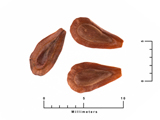
Fruit: Pods erect, long 4 in (10 cm) and narrow like the leaves. The pods are often in pairs. Seed Color is brown, 5/16 in (8 mm) long.
Bloom Information
Bloom Color: Pink , PurpleBloom Time: Jun , Jul , Aug , Sep , Oct
Distribution
USA: AL , AR , CO , CT , DC , DE , FL , GA , IA , ID , IL , IN , KS , KY , LA , MA , MD , ME , MI , MN , MO , MT , NC , ND , NE , NH , NJ , NM , NV , NY , OH , OK , PA , RI , SC , SD , TN , TX , UT , VA , VT , WI , WV , WYCanada: MB , NB , NS , ON , PE , QC
Native Distribution: Manitoba, Quebec, and Nova Scotia; from New England south to Georgia; west to Louisiana, and Texas; north to North Dakota.
Native Habitat: Wet Meadow, Prairie, Field, Riparian, Swamp, Marsh. Most often found on the margins of flooded plains, lakes, ponds, waterways, marshes, swamps, and other wet areas.
Growing Conditions
Water Use: HighLight Requirement: Sun , Part Shade
Soil Moisture: Moist , Wet
CaCO3 Tolerance: Medium
Soil Description: Rich, wet, very muddy to average garden moisture. One of the few ornamentals that thrives in mucky clay soils. Prefers neutral to slightly acidic soil but will tolerate heavy clay.
Conditions Comments: With its showy flower clusters that attract butterflies and hummingbirds, swamp milkweed is underutilized in gardens. In moist soils or in a pond, it will thrive. The interesting seed pods look like other milkweeds. Swamp milkweed will inevitably have aphids. The insects are not a problem unless the plant looks sick; at that point an effective treatment is to spray the plant and aphids with soapy water. Another possible treatment is to support the plant part with your hand and blast it with high-pressure water. Good for wetland gardens and habitat.
Benefit
Use Ornamental: Herbaceous perennial forming stately clump of upright stems with long narrow leaves and heads of fragrant soft mauve pink flowers, composed of many small intricate flowers.Use Wildlife: Milkweeds are an important food source for the monarch caterpillar.
Use Food: Although milkweeds are poisonous raw, the young shoots, leaves and seed pods are all edible cooked. When placed in cold water, brought to a boil and simmered till tender, milkweeds are said to be delicately flavoured and harmless. (Poisonous Plants of N.C. State) The flower buds, nectar-sweet flowers and seeds are also edible. (Kershaw)
Use Medicinal: In the past, the roots of swamp milkweed were simmered to make a tea taken in small quantities both as a general purge and to destroy and expel parasitic worms.
Warning: All parts. Toxic only in large quantities. Syptoms include, vomiting, stupor, weakness, spasms. Toxic Principle: Cardiac glycosides and resinoids.
Conspicuous Flowers: yes
Fragrant Flowers: yes
Interesting Foliage: yes
Attracts: Butterflies , Hummingbirds
Larval Host: Monarch and Queen butterflies.
Nectar Source: yes
Deer Resistant: High
Poisonous: yes
Value to Beneficial Insects
Special Value to Native BeesSpecial Value to Bumble Bees
Special Value to Honey Bees
Supports Conservation Biological Control
This information was provided by the Pollinator Program at The Xerces Society for Invertebrate Conservation.
Butterflies and Moths of North America (BAMONA)
|
Monarch (Danaus plexippus) 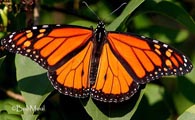 Larval Host |
Queen (Danaus gilippus) 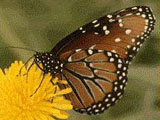 Larval Host |
Propagation
Propagation Material: SeedsDescription: Easy to start from seed. Established plants may be divided in spring.
Seed Collection: Watch plants closely and collect seed in October, November.
Seed Treatment: Heat helps germination.
Find Seed or Plants
Order seed of this species from Native American Seed and help support the Wildflower Center.
Find seed sources for this species at the Native Seed Network.
View propagation protocol from Native Plants Network.
Mr. Smarty Plants says
Native flowers for Door County, Wisconsin
September 02, 2009
We recently were required to put in a new septic system on our vacation property in Door County, WI. This left us with a clearing on our wooded lot where the septic field is now located. The installer...
view the full question and answer
Attracting butterflies in Tennessee
July 03, 2009
What flowers and plants do the caterpillars in Tennessee eat? And do you know what butterflies live in Tipton Co. Tennessee?
view the full question and answer
National Wetland Indicator Status
| Region: | AGCP | AK | AW | CB | EMP | GP | HI | MW | NCNE | WMVE |
| Status: | OBL | OBL | OBL | FACW | OBL | OBL | OBL |
From the National Organizations Directory
According to the species list provided by Affiliate Organizations, this plant is on display at the following locations:Lady Bird Johnson Wildflower Center - Austin, TX
Native Plant Center at Westchester Community College, The - Valhalla, NY
Delaware Nature Society - Hockessin, DE
Natural Biodiversity - Johnstown, PA
Native Seed Network - Corvallis, OR
Mt. Cuba Center - Hockessin, DE
Bibliography
Bibref 928 - 100 easy-to-grow native plants for Canadian gardens (2005) Johnson, L.; A. LeyerleBibref 1186 - Field Guide to Moths of Eastern North America (2005) Covell, C.V., Jr.
Bibref 1185 - Field Guide to Western Butterflies (Peterson Field Guides) (1999) Opler, P.A. and A.B. Wright
Bibref 1620 - Gardening with Native Plants of the South (Reprint Edition) (2009) Wasowski, S. with A. Wasowski
Bibref 946 - Gardening with Prairie Plants: How to Create Beautiful Native Landscapes (2002) Wasowski, Sally
Bibref 841 - Native Alternatives to Invasive Plants (2006) Burrell, C. C.
Bibref 1294 - The Midwestern Native Garden: Native Alternatives to Nonnative Flowers and Plants An Illustrated Guide (2011) Adelman, Charlotte and Schwartz, Bernard L.
Search More Titles in Bibliography
Research Literature
Reslit 148 - Effect of hostplant genotype and predators on iridoid glycoside content of pupae of a specialist insect herbivore, Junonia coenia (Nymphalidae) (1997) M. D. Bowers and N. E. StampReslit 527 - Effects of Phalaris arundinacea and nitrate-N addition on the establishment of wetland plant communities (2002) E. K. Green and S. M. Galatowitsch
Reslit 58 - Detection and characterization of phytoplasmas infecting ornamental and weed plants in Iran (2007) G. Babaie, B. Khatabi, H. Bayat, M. Rastgou, A. Ho...
Reslit 361 - Capturing genetic variation during ecological restorations: An example from Kankakee Sands in Indiana (2008) R. W. Dolan, D. L. Marr and A. Schnabel
Reslit 671 - Mating systems and interfertility of swamp milkweed (Asclepias incarnata ssp. incarnata and ssp. pulchra) (1999) C. T. Ivey, S. R. Lipow and R. Wyatt
Reslit 673 - Family outcrossing rates and neighborhood floral density in natural populations of swamp milkweed (Asclepias incarnata): potential statistical artifacts (1999) C. T. Ivey and R. Wyatt
Reslit 739 - Pollinator-mediated isolation in sympatric milkweeds (Asclepias): do floral morphology and insect behavior influence species boundaries? (2004) S. Kephart and K. Theiss
Reslit 839 - Diallel crosses reveal patterns of variation in fruit-set, seed mass, and seed number in Asclepias incarnata (1999) S. R. Lipow and R. Wyatt
Reslit 840 - Towards an understanding of the mixed breeding system of swamp milkweed (Asclepias incarnata) (2000) S. R. Lipow and R. Wyatt
Reslit 875 - Density-dependent reduction and induction of milkweed cardenolides by a sucking insect herbivore (2004) J. W. Martel and S. B. Malcolm
This information was provided by the Florida WIldflower Foundation.
Search More Titles in Research Literature
Additional resources
USDA: Find Asclepias incarnata in USDA PlantsFNA: Find Asclepias incarnata in the Flora of North America (if available)
Google: Search Google for Asclepias incarnata
Metadata
Record Modified: 2022-09-18Research By: TWC Staff, RLU