Native Plants

Q. Who is Mr. Smarty Plants?
A: There are those who suspect Wildflower Center volunteers are the culpable and capable culprits. Yet, others think staff members play some, albeit small, role. You can torture us with your plant questions, but we will never reveal the Green Guru's secret identity.
Did you know you can access the Native Plant Information Network with your web-enabled smartphone?

Ask Mr. Smarty Plants
Ask Mr. Smarty Plants is a free service provided by the staff and volunteers at the Lady Bird Johnson Wildflower Center.

rate this answer

Tuesday - March 29, 2011
From: Austin, TX
Region: Southwest
Topic: Compost and Mulch, Trees
Title: Smaller trees for limited space in yard in Austin
Answered by: Barbara Medford
QUESTION:
Follow up to "I have a choice of three shade trees from the city of Austin. They are Live Oak, Elm, Cedar. Although I am happy to have a free tree, I think the choices are not the best for my home. I have a small area in the front yard about 12 feet by 14 feet. But, due to pipes, etc the place they chose to plant the tree is about 8 feet from my door, 1 foot from the driveway, 1 foot from a fence, and 5 feet from the street. Wouldn't these type of trees end up causing foundation problems? And also problems with the driveway and fence? I'm thinking I shouldn't accept any of these trees. But, then what type of tree can I plant in that small area?" I recently asked a question on trees and I wanted to reply, but I didn't know how, so her it goes- with another question. First, THANK YOU for your help. I was looking all over the internet to find an answer to my question and I was also confused as to why they would suggest a to plant a tree so close to other structures. But, that's where my little yellow flag ended up on my driveway. I was thinking of a planting a crepe myrtle. The previous owner had planted a peach tree, but it died (it was also a small tree). I really need something for shade. I don't have any trees in my front yard and the heat is unbearable in the summer. I've been thinking also of making some sort of carport canopy type thing and adding a vine to grow along top of it (the metal carport things don't look too nice). I want something that looks pretty. What do you suggest? Any ideas?ANSWER:
The little yellow flag may have just been stuck there so the workers would know you were going to get a tree. Anyway, I think we're agreed that those trees are all too big for your small yard. Both of your alternate ideas are trees not native to North America. The Lady Bird Johnson Wildflower Center is dedicated to the growth, use, protection and propagation of plants native not only to North America but also to the area in which those plants are natively growing.
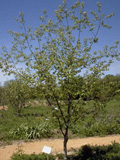
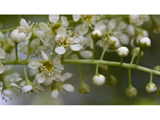
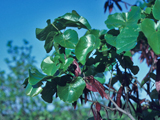
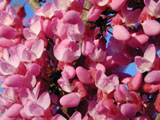
Lagerstroemia indica, crape myrtle, originated in Asia, and has been extensively hybridized and introduced, especially in the South. There are a number of species of the Prunus genus (from Botany. com), including plums, cherries and peach. Only a few, including Prunus caroliniana (Cherry laurel), Prunus mexicana (Mexican plum), and Prunus serotina var. eximia (Escarpment black cherry) grow natively in Central Texas. Prunus persica is believed to originate in China and needs a more acid soil than we have here. In addition to those native Prunus species, there are Cercis canadensis var. texensis (Texas redbud) and Ilex vomitoria (Yaupon), all of which are shrubs that can be trained into trees. They will not have such an invasive root structure as a tree, but still need to be placed far away enough from other features in your yard that their branches will not impinge on space needed for outfoor recreation, etc.
While these smaller native trees may not grow up to be the lovely old shade tree with a tire swing in it, none of which you have room for, they will be fairly rapid growers and will cast some shade and some cooling influence on your front yard. Be sure and follow each plant link to learn about that particular tree/shrub. If you hurry, you might still be able to plant these shrubs now, before it gets any hotter. Ordinarily, we suggest planting woody plants in Central Texas in winter or very early Spring. From North Dakota State University Extension, we consider this article on Transplanting Trees and Shrubs one of the best. We would only add that you should work some compost into the dirt you return to the hole for the tree to assist in good drainage and permitting the tiny new rootlets to access nutrients in the soil.
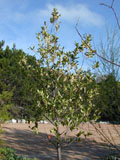
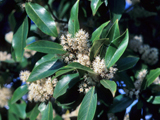
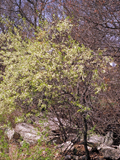
From our Native Plant Image Gallery:

More Compost and Mulch Questions
Replacement for grass under non-native weeping willow from Yorba Linda CA
April 24, 2012 - What would be a good replacement for the grass currently growing under a weeping willow? Something requiring low maintenance, the problem is with mowing over and around the roots.
view the full question and answer
What hydrangeas can be grown in Austin?
June 02, 2011 - I was told that oak leaf hydrangea was the only hydrangea variety that could be successfully grown in Austin TX. My oakleaf hydrangea is doing great and I would like to plant other varieties. Can you...
view the full question and answer
Are Eastern White Pine suitable for Waxhaw NC
February 13, 2011 - Pinus strobus ( White Pine )-
I wish to plant four of these evergreens along our property lines as a screen. Our county is selling one foot plants in a container. Our soil is clay. Are these t...
view the full question and answer
Desert willows not doing well in Navarro County, TX
May 16, 2009 - Planted 3 new desert willows , 3-4 ft.in February. Live in East Navarro County and soil is clay with slight slope to Richland Chambers lake area. Had a wet spring. These plantings appear not doing we...
view the full question and answer
Chlorosis in yaupon from San Angelo TX
April 08, 2012 - Thank you for your information on the yaupon holly. We just finished clearing out the mulch and the red ground cover that popped up. I will quit watering it as much as the rest of the plants. Our y...
view the full question and answer
| Support the Wildflower Center by Donating Online or Becoming a Member today. |