Native Plants

Q. Who is Mr. Smarty Plants?
A: There are those who suspect Wildflower Center volunteers are the culpable and capable culprits. Yet, others think staff members play some, albeit small, role. You can torture us with your plant questions, but we will never reveal the Green Guru's secret identity.
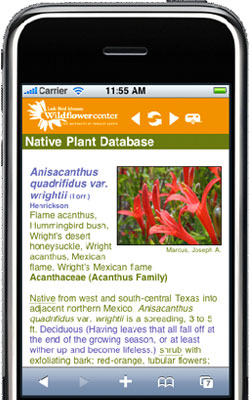
Did you know you can access the Native Plant Information Network with your web-enabled smartphone?

Ask Mr. Smarty Plants
Ask Mr. Smarty Plants is a free service provided by the staff and volunteers at the Lady Bird Johnson Wildflower Center.

rate this answer

Tuesday - April 24, 2012
From: Yorba Linda, CA
Region: California
Topic: Invasive Plants, Non-Natives, Compost and Mulch, Shade Tolerant, Grasses or Grass-like, Herbs/Forbs
Title: Replacement for grass under non-native weeping willow from Yorba Linda CA
Answered by: Barbara Medford
QUESTION:
What would be a good replacement for the grass currently growing under a weeping willow? Something requiring low maintenance, the problem is with mowing over and around the roots.ANSWER:
Actually, our first suggestion would be to get in your Time Machine and go back to the time when you planted that tree, and then don't do it! Here is a previous Mr. Smarty Plants answer to the same question.
The simple fact is that the willow is aggressive, invasive and non-native. That means it very nicely discourages or destroys any plant seeking to compete for space and resources. The Lady Bird Johnson Wildflower Center is dedicated to the growth, propagation and protection of plants native not only to North America but to the area in which the plant is being grown. The weeping willow originated in China.
But, if your Time Machine is not working, we know a spot where you can get all kinds of information and/or plants that fit your need. You need to decide ahead of time how much shade the plants will have to tolerate, under that tree.
You (or we) are in real luck because the Las Pilitas Nursery has a website on some of the California native plants that can be used as less than a foot high ground covers. We believe that the Escondido store would be the nearest to you in Orange County. They have contact information and directions on the webpage.
We have one other suggestion for that under-tree space. A good quality shredded bark mulch will cover the roots, help to protect the roots from heat or cold, prevent evaporation of moisture, is attractive and smells good. As it decomposes, it will go into the dirt under the tree, improving drainage and making nutrients in the soil more accessible to the roots. About every 6 months it will probably need to be replenished, but it will never need mowing.
More Shade Tolerant Questions
Fast-growing shade tree for New Braunfels, Texas
January 29, 2009 - I would like to plant a tree in the back of my property which is located in the Hill Country just north of New Braunfels. Could you please suggest something that is fast growing and will grow in full...
view the full question and answer
Need plants with red flowers to grow in shaded area in yard in Austin.
May 04, 2010 - I have a shaded area where all the shrubs die. I would like to plant some flowers there instead of shrubs. What red flower plants can sustain a lot of shade.
view the full question and answer
Native grass for sandy soil and shade
May 27, 2011 - We have a sandy soil and lots of shade. Is there a native grass that would do well under these conditions?
view the full question and answer
Alternative for sedges for turf-like lawn in shade
October 25, 2013 - When it comes to a turf-like lawn in shade, is it pretty much sedges or nothing among native options? By the way, I write from up north here in Iowa.
Thanks!
view the full question and answer
Ground cover for shady area in Maryland
April 27, 2010 - What ground cover grows well on a shady slope with close to surface tree roots?
view the full question and answer
| Support the Wildflower Center by Donating Online or Becoming a Member today. |