Native Plants

Q. Who is Mr. Smarty Plants?
A: There are those who suspect Wildflower Center volunteers are the culpable and capable culprits. Yet, others think staff members play some, albeit small, role. You can torture us with your plant questions, but we will never reveal the Green Guru's secret identity.
Did you know you can access the Native Plant Information Network with your web-enabled smartphone?

Ask Mr. Smarty Plants
Ask Mr. Smarty Plants is a free service provided by the staff and volunteers at the Lady Bird Johnson Wildflower Center.

rate this answer

Monday - May 10, 2010
From: Franklin Lakes, NJ
Region: Northeast
Topic: Invasive Plants, Problem Plants
Title: Eliminating dogbane from transplanted milkweed in Franklin Lakes NJ
Answered by: Barbara Medford
QUESTION:
We transplanted milkweed from the wild into our garden. Included in the clump of milkweed was dogbane. We weren't aware of how invasive dogbane is. We've has some success in digging it out but we're losing the battle! Do you have any suggestions to help us eliminate our dogbane problem?ANSWER:
Apocynum cannabinum (Indianhemp), also known as "dogbane" is native not only to Bergen Co., but just about the whole state of New Jersey, as seen in this USDA Plant Profile. So, you're not alone if that is any comfort. A number of varieties occur across the continent. This species can become a serious weed as it is aggressive and difficult to control. It is also a dangerous plant to have in your garden. From our page on this plant in the Native Plant Database: "POISONOUS PARTS: All parts, fresh or dry. Highly Toxic, May be Fatal if eaten. Symptom: Cardiac arrest. Toxic Principle: Resins and cardiac glycosides."
So, getting rid of it is a good goal. It is perennial, so just preventing it seeding out is not going to be enough, but it's a start. This plant is starting to bloom now-do whatever you can to keep those blooms from becoming seeds. Pull the whole plant out if you can, or keep trimming it as low as possible to keep it from re-blooming. The problem with just pulling it out, of course, is that you are probably also be pulling out some of your milkweed, and spraying it with herbicide will have the same effect, killing the milkweed just as surely as the dogbane. These plants may be found growing as colonies due to a long horizontal rootstock that develops from an initial taproot
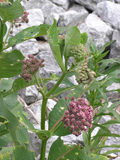
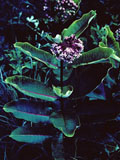
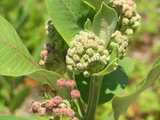
So, you have a multi-pronged problem; you must not only prevent it from re-seeding but also get out the root from which new plants can grow, as well. From this site, primitiveways.com, Dogbane, we learned that the milkweed you brought the dogbane in with is likely Asclepias syriaca (common milkweed), and extracted this information:
"Stems and leaves secrete a milky sap when broken. Sprouts emerging from the underground horizontal rootstock may be confused with Common Milkweed (Asclepias syriaca) emerging shoots. But note that they are not related to milkweeds, despite the milky sap and the similar leaf shape and growth habit. The flower shape is quite unlike that of milkweed flowers and the leaves of hemp dogbane are much smaller than those of common milkweed. When mature, these native plants may be distinguished by the branching in the upper portions of the plant that occurs in hemp dogbane, and also the smaller size of hemp dogbane compared to Common milkweed."
We noted that the common milkweed is native to exactly the same areas as the dogbane, so it's no wonder they got mixed up. You will have to be careful not to put herbicide on the milkweed, or leave the dogbane roots behind, thinking they are milkweed.
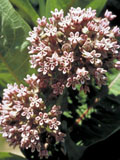
From our Native Plant Image Gallery:


More Invasive Plants Questions
Non-native, invasive Paulownia for San Marcos TX
April 24, 2012 - Can a Paulownia tree grow in San Marcos? If so were can I get one?
view the full question and answer
Plant mistakes from Cedar Park, TX
April 09, 2014 - At our "Wilts End" in Cedar Park, TX. and are looking for a tall shrub/tree that will hide a 6-ft tall concrete wall and muffle the noise from a busy street. The wall forms a very wide-angled V shap...
view the full question and answer
Native turf grass for Austin
March 24, 2014 - I am installing a xeriscape landscape in my yard. It will be in full sun and I am looking for an alternative to turf, such as monkey grass. However, I am concerned about the light. Suggestions?
view the full question and answer
Native plants to go between patio stones in Oceanside CA
February 24, 2010 - Hello Mr. Smarty Plants! I live in Oceanside CA about 5 mi from the coast and have an about 20' sq private patio with "issues". Patio has with flagstones, one side all sun all day, middle area part...
view the full question and answer
Large weed removal in Victoria VA
September 24, 2010 - I have a weed problem. Along my house and garage are several weeds that have grown to small-tree size. I plan to rip them out of the ground as soon as it cools off, but I've done this before and they...
view the full question and answer
| Support the Wildflower Center by Donating Online or Becoming a Member today. |