Native Plants

Plant Database
Search for native plants by scientific name, common name or family. If you are not sure what you are looking for, try the Combination Search or our Recommended Species lists.
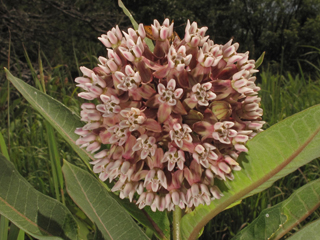
Cressler, Alan
Asclepias syriaca
Asclepias syriaca L.
Common Milkweed
Asclepiadaceae (Milkweed Family)
Synonym(s): Asclepias intermedia, Asclepias kansana, Asclepias syriaca var. kansana
USDA Symbol: assy
USDA Native Status: L48 (N), CAN (N)
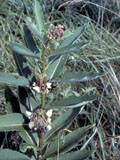
The Common Milkweed is the plant that most people associate with the word “milkweed”. This is a tall and conspicuous species that sometimes forms large clones. The umbels bear large balls of pink to purplish flowers that have an attractive odor. This species is known to form hybrids with both A. exaltata (in the east) and A. speciosa (in the west). Follicles split open in the fall and early winter dispensing wind borne seeds. Among the milkweeds, this species is the best at colonizing in disturbed sites. Within its range it can be found in a broad array of habitats from croplands, to pastures, roadsides, ditches and old fields. It is surprisingly rare in prairies in the Midwest being found mostly in disturbed sites within these habitats. As an indigenous species of the southern Great Plains, it has all the attributes of what some ecologists call a “fugitive species”. That is, one whose appearance and persistence is dependent on disturbance due to its inability to compete with other vegetation. In the northern parts of its range it seems to be a more permanent member of the floral communities.
The plant contains cardiac glycosides, allied to digitalins used in treating some heart disease. These glycosides, when absorbed by monarch butterfly larvae whose sole source of food is milkweed foliage, make the larvae and adult butterflies toxic to birds and other predators.
Plant Characteristics
Duration: PerennialHabit: Herb
Leaf Arrangement: Opposite
Leaf Shape: Elliptic , Lanceolate , Oblong , Ovate
Inflorescence: Umbel
Fruit Type: Follicle
Size Notes: Typically 3-5 feet (90-150 cm) but can reach 8 feet (240 cm) in ditches and gardens.
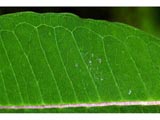
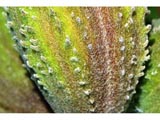
Leaf: 4-7 1/2 in (10-19 cm) long and 2-4 1/3 in (5-11 cm) wide. Shape is variable and is described as ovate, oblong, lanceolate or elliptic. The rich dark green of the top of the leaves contrasts with a lighter green on the underside. Leaf pairs often perpendicular to each other with short petioles.
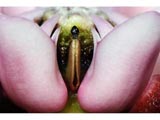
Flower: Slightly pendulous spherical umbels with as many as 100 flowers per umbel, but usually 30+/- flowers. 3+/- umbels per stem. Pedicels are 1 1/2 in (4 cm) long. Petals up to 1/3 in (9mm) long. Hoods and horns are white or purple. Corolla reflexes backward to expose the hoods and horns. Horn protrudes through the hoods.
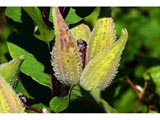
Fruit: Follicles approximately 3 1/2 in (9 cm) long to 1 2/3 in (4 cm) at the widest point. Fruit color is grayish and is thick at the base and tapers down to a narrow tip. Follicles are covered with hair and soft spikes. Fruits split open between September-October.
Bloom Information
Bloom Color: White , PurpleBloom Time: Jun , Jul , Aug
Distribution
USA: AL , AR , CT , DC , DE , GA , IA , IL , IN , KS , KY , LA , MA , MD , ME , MI , MN , MO , MS , MT , NC , ND , NE , NH , NJ , NY , OH , OK , OR , PA , RI , SC , SD , TN , TX , VA , VT , WI , WVCanada: MB , NB , NL , NS , ON , QC , SK
Native Distribution: Saskatchewan to New Brunswick; south to Georgia; west through Tennessee to Kansas and Iowa.
Native Habitat: Old fields, roadsides, and waste places.
Growing Conditions
Light Requirement: SunSoil Moisture: Moist
Soil Description: Medium to fine sandy, clayey, or rocky calcareous soils. Also found in well-drained loamy soils.
Conditions Comments: Not shade tolerant. Needs lots of sunlight.
Benefit
Use Food: According to the Field Guide to Medicinal Wild Plants or Edible Wild Plants, common milkweed is edible only under certain circumstances. Boiling can eliminate the bitter taste and toxicity of the sap, but this must be done very carefully to avoid the toxins. Eating milkweed is not recommended.Use Other: Native Americans used this species as a source of fibers and during the Second World War children in the northern states were encouraged to collect the seed pods that were processed for the coma, or floss, which was used for flotation in life vests. Today the coma is harvested for use in pillows and comforters.
Warning: Poisonous parts include milky sap from leaves, stems. Toxic only in large quantities. Symptoms include vomiting, stupor, weakness, spasms by ingesting other species; need careful identification. Toxic Principle: Resinoid, cardiac glycoside in other species (Poisonous Plants of N.C. State).
Conspicuous Flowers: yes
Fragrant Flowers: yes
Attracts: Butterflies
Larval Host: Monarch
Poisonous: yes
Value to Beneficial Insects
Special Value to Native BeesSpecial Value to Bumble Bees
Special Value to Honey Bees
Supports Conservation Biological Control
This information was provided by the Pollinator Program at The Xerces Society for Invertebrate Conservation.
Butterflies and Moths of North America (BAMONA)
|
Monarch (Danaus plexippus) 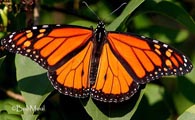 Larval Host |
Propagation
Propagation Material: SeedsDescription: Spreads via rhizomes and forms small to large clones. Rhizomes can be cut and transplanted early in the spring.
Find Seed or Plants
Find seed sources for this species at the Native Seed Network.
View propagation protocol from Native Plants Network.
Mr. Smarty Plants says
Native plants of dune erosion control in Michigan
May 30, 2008
We care for Lake Michigan dune near our home in New Buffalo and would like to provide erosion control with native species that will also enhance the beauty of the dune with long lasting flowers. The ...
view the full question and answer
National Wetland Indicator Status
| Region: | AGCP | AK | AW | CB | EMP | GP | HI | MW | NCNE | WMVE |
| Status: | UPL | FACU | FACU | UPL | FACU | UPL | FACU |
From the National Organizations Directory
According to the species list provided by Affiliate Organizations, this plant is on display at the following locations:Texas Discovery Gardens - Dallas, TX
Natural Biodiversity - Johnstown, PA
Native Seed Network - Corvallis, OR
Bibliography
Bibref 1186 - Field Guide to Moths of Eastern North America (2005) Covell, C.V., Jr.Bibref 1185 - Field Guide to Western Butterflies (Peterson Field Guides) (1999) Opler, P.A. and A.B. Wright
Bibref 946 - Gardening with Prairie Plants: How to Create Beautiful Native Landscapes (2002) Wasowski, Sally
Bibref 1294 - The Midwestern Native Garden: Native Alternatives to Nonnative Flowers and Plants An Illustrated Guide (2011) Adelman, Charlotte and Schwartz, Bernard L.
Search More Titles in Bibliography
Additional resources
USDA: Find Asclepias syriaca in USDA PlantsFNA: Find Asclepias syriaca in the Flora of North America (if available)
Google: Search Google for Asclepias syriaca
Metadata
Record Modified: 2020-09-08Research By: TWC Staff