Native Plants
Q. Who is Mr. Smarty Plants?
A: There are those who suspect Wildflower Center volunteers are the culpable and capable culprits. Yet, others think staff members play some, albeit small, role. You can torture us with your plant questions, but we will never reveal the Green Guru's secret identity.
Did you know you can access the Native Plant Information Network with your web-enabled smartphone?

Ask Mr. Smarty Plants
Ask Mr. Smarty Plants is a free service provided by the staff and volunteers at the Lady Bird Johnson Wildflower Center.

rate this answer

Tuesday - May 19, 2009
From: Troy, NY
Region: Northeast
Topic: Edible Plants, Poisonous Plants, Problem Plants
Title: Eliminating skunk cabbage in Troy, NY
Answered by: Barbara Medford
QUESTION:
My yard is overgrown with skunk cabbage. My question is how do I get rid of it?ANSWER:
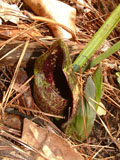
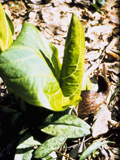
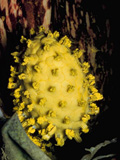
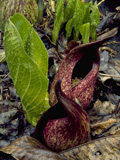
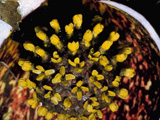
It's a darn shame that Symplocarpus foetidus (skunk cabbage) smells so bad, because it's really sort of fascinating. According to our webpage on that plant, the smell of the bruised leaves simulates that of decaying flesh, which attracts the insects, probably flies, that pollinate it. That webpage also says:
"Plant the skunk cabbage where you want it to stay, since a full-grown plant will have a bushel of soil adhering to its roots and is next to impossible to move. The bruised leaves have a foul odor which gives the skunk cabbage its name. Otherwise the plant has no odor."
That means people are actually planting it, but we don't blame you for wanting to get rid of it. As you see from the above paragraph, pulling it would probably be a real chore. And in the process, you would be crushing the leaves and releasing the very unpleasant odor. Just to add insult to injury, the young, uncurled leaves and roots are considered edible, and there are instructions for cooking it on our webpage. At the same time, everything else on the plant is considered toxic.
Since the plant doesn't grow in Texas (thank goodness) we went looking for some more information on it in an effort to answer your question. We found this essay by Craig Holdrege from The Nature Institute on Skunk Cabbage to be both entertaining and informative.
We tried to find some literature on getting rid of the skunk cabbage, but couldn't locate anything. We will try to come up with something on our own. To begin with, apparently this plant only flourishes in wetlands, swampy, marshy places. Is that the condition of your yard? Perhaps you need to address drainage in your area, and not just because of the skunk cabbage. That is something we can't help you with, just a suggestion.
The Lady Bird Johnson Wildflower Center recommends neither for nor against the use of herbicides. If you can find ways to rid your yard of this plant by manually cutting off the upper parts, please do so. The use of a toxic material is a last resort action, and can damage the environment if you use too much and the excess drains off into nearby waterways.
This plant spreads itself by seed, not by rhizomes. You need to eliminate the blooms, which carry the seed, before they have a chance to ripen and fall on the ground nearby. It's obvious from the information we already have that the roots are not going to let you pull them out. So, we would suggest cutting the plant off at the soil line, and immediately, before it can heal itself over (like in 5 minutes) use a small disposable sponge paintbrush and paint a glysophate herbicide over the root tip sticking out of the ground. Doing this early in the season would prevent the seeds from ever forming. Learn to recognize the leaves when they come up later, and immediately repeat cutting the stem off at ground level. Without leaves to provide nourishment for the roots, and without seeds to propagate the plant, the roots will eventually exhaust their food stores and die. You will need to do this very carefully so as not to contaminate the soil or plants you wish to preserve in the area. You won't get all the roots the first time around; so be on the lookout for the first of the spathes coming up in very early Spring, and cut them off. We realize this is going to be unpleasant, smelly work. Certainly you don't want to dispose of these plants in your compost pile and just draw more flies, plus the seeds could very well germinate in the compost. So, bag the whole lot up and send it to the dump.
More Edible Plants Questions
Plant identification
August 04, 2012 - We found a bush on our ranch in southern Gonzales County. It has oval shaped leaves about an inch long. There are no thorns on the branches. Fruit is round and smooth, the size of a small cherry to...
view the full question and answer
Plants for floodplain in Fairfield, New Jersey
March 21, 2010 - I have an easy question for you... I hope... We just moved into the floodplains of NJ in Fairfield and are interested in some plants. We would like to know what plants are best suited to grow in flood...
view the full question and answer
Edible plants beginning with I, T, X and Z in Colorado
March 26, 2009 - My friend would like to know a fruit or vegetable that he would plant in his garden and come back yearly. The plants would have to start with the letters I,T,X, & Z. It has to be edible, of course.
view the full question and answer
Identity of a plant in Florida with red fruit like a small tomato
September 03, 2012 - It looks like a small tomato but it isn't. It has a bunch of flakey seeds on the inside, which are a light brown in color. The outside is red, and I think it starts out growing green and also white....
view the full question and answer
Are yellow bells (Tecoma stans) edible?
January 25, 2009 - Can you tell me if any part of the yellow bell can be eaten and if so what part. Also is it useful in making natural paints?
view the full question and answer
| Support the Wildflower Center by Donating Online or Becoming a Member today. |