Native Plants

Plant Database
Search for native plants by scientific name, common name or family. If you are not sure what you are looking for, try the Combination Search or our Recommended Species lists.
Vick, Albert F. W.
Symplocarpus foetidus
Symplocarpus foetidus (L.) Salisb. ex W.P.C. Barton
Skunk Cabbage, Skunk-cabbage
Araceae (Arum Family)
Synonym(s): Spathyema foetida
USDA Symbol: syfo
USDA Native Status: L48 (N), CAN (N)
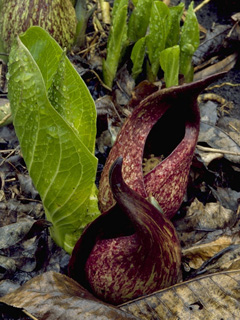
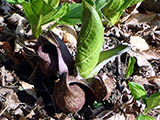
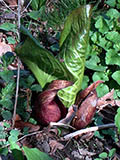
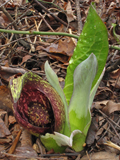
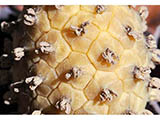
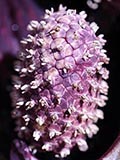
Very early in spring, the greenish-yellow spadix of this plant appears, enclosed by a reddish-brown spathe that is open at one side. As the flowers on the spadix wilt, green leaves unfold. These leaves become quite large with conspicuous venation giving a "quilted" appearance. The plant becomes 1-3 ft. tall. Flower appears before leaves. Through a chemical process, flower can heat itself to about 15 degrees Celcius. This allows it to burn its way through snow cover. Sometimes called first flower of spring. Emerging from moist earth in early spring, a large brownish-purple and green, mottled, shell-like spathe enclosing a knob-like spadix covered with tiny flowers. By late spring a tight roll of fresh green leaves beside the spathe unfolds to form huge, dark green, cabbagy leaves that may carpet an area.
This distinctive plant of marshy woods sprouts so early in spring that the heat of cellular respiration resulting from its rapid growth actually melts snow or ice around it. Its strong fetid odor, especially when the plant is bruised, resembles decaying flesh and lures insects that pollinate it.
Plant Characteristics
Duration: PerennialHabit: Herb
Fruit Type: Berry
Size Notes: Up to about 5 feet tall.
Bloom Information
Bloom Color: Yellow , Green , Purple , BrownBloom Time: Feb , Mar , Apr , May
Distribution
USA: CT , DC , DE , IA , IL , IN , MA , MD , ME , MI , MN , NC , NH , NJ , NY , OH , PA , RI , TN , VA , VT , WI , WVCanada: NB , NS , ON , QC
Native Distribution: N.S. to GA, w. to MN & IA
Native Habitat: Swamps & muddy ground
Growing Conditions
Water Use: HighLight Requirement: Shade
Soil Moisture: Wet
CaCO3 Tolerance: Low
Soil Description: Damp, humus-rich soil.
Conditions Comments: Plant the skunk cabbage where you want it to stay, since a full-grown plant will have a bushel of soil adhering to its roots and is next to impossible to move. The bruised leaves have a foul odor which gives the skunk cabbage its name. Otherwise the plant has no odor.
Benefit
Use Food: EDIBLE PARTS: Young, uncurled leaves and roots. Collect the bright green, unfurled leaves in the very early spring.FOOD PREPARATION: Soak young shoots and roots in warm water to remove dirt and debris. Do not use dish detergent or any type of sanitizer. Carefully handle leaves after collecting. Bruised leaves will give off an unpleasant smell. The smell disappears after cooking. Cook for 20 minutes, change the water at least twice and replace with fresh, boiling salted water. Serve like greens. Roots are very bitter and burning in their raw state. Peel, cut into small pieces, roast in an oven for at least one hour and grind in a flour or coffee grinder until quite fine. Add to bread dough or muffin batter. (Poisonous Plants of N.C.)
Warning: POISONOUS PARTS: All parts except uncurled leaves and roots. Toxic only if eaten in large quantities. Symptoms include burning and swelling of lips, tongue, and throat; nausea, vomiting, and diarrhea may also occur. Toxic Principle: Calcium oxalate crystals and possibly others.
Conspicuous Flowers: yes
Attracts: Birds
Propagation
Description: Sow seeds upon collection in a peaty soil kept constantly moist. Seedlings require considerable time to mature. To increase by division, dig around the dormant plant and remove it with as much of the deep-penetrating, offensive-smelling rhizome as possiSeed Collection: Skunk cabbage requires the whole of the growing season to mature its seeds. The fruiting spadix darkens and become spongy as it develops. In early fall, when the seeds are ripe, the spadix is often found on the ground at the base of the leaves. Remove seeds from spadix. Seeds can not be stored.
Commercially Avail: yes
Mr. Smarty Plants says
Skunk cabbage for Houston TX
September 19, 2009
Can you find skunk cabbage in the Houston, Texas area?
view the full question and answer
National Wetland Indicator Status
| Region: | AGCP | AK | AW | CB | EMP | GP | HI | MW | NCNE | WMVE |
| Status: | OBL | OBL | OBL | OBL | OBL |
From the National Organizations Directory
According to the species list provided by Affiliate Organizations, this plant is on display at the following locations:Mt. Cuba Center - Hockessin, DE
Bibliography
Bibref 1294 - The Midwestern Native Garden: Native Alternatives to Nonnative Flowers and Plants An Illustrated Guide (2011) Adelman, Charlotte and Schwartz, Bernard L.Search More Titles in Bibliography
Web Reference
Webref 38 - Flora of North America (2019) Missouri Botanical Garden, St. Louis, MO & Harvard University Herbaria, Cambridge, MA.Webref 23 - Southwest Environmental Information Network (2009) SEINet - Arizona Chapter
From the Archive
Wildflower Newsletter 1989 VOL. 6, NO.1 - Native Plants Facts, Winter Botany, Poster for Schoolchildren, Inside HerbariaWildflower Newsletter 1994 VOL. 11, NO.6 - Wildflower Center Featured Non-Profit in Neiman Marcus Christmas Book, Dana Leav...
Additional resources
USDA: Find Symplocarpus foetidus in USDA PlantsFNA: Find Symplocarpus foetidus in the Flora of North America (if available)
Google: Search Google for Symplocarpus foetidus
Metadata
Record Modified: 2023-02-28Research By: TWC Staff