Native Plants
Q. Who is Mr. Smarty Plants?
A: There are those who suspect Wildflower Center volunteers are the culpable and capable culprits. Yet, others think staff members play some, albeit small, role. You can torture us with your plant questions, but we will never reveal the Green Guru's secret identity.
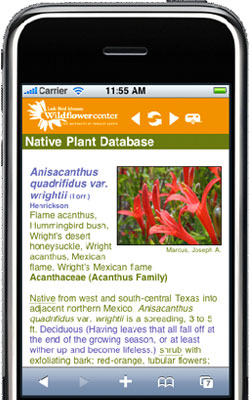
Did you know you can access the Native Plant Information Network with your web-enabled smartphone?

Ask Mr. Smarty Plants
Ask Mr. Smarty Plants is a free service provided by the staff and volunteers at the Lady Bird Johnson Wildflower Center.

rate this answer

Sunday - January 18, 2009
From: Austin, TX
Region: Southwest
Topic: Shrubs
Title: Evergreen shrubs for blocking car noise in Austin
Answered by: Barbara Medford
QUESTION:
I live on Bee Caves road and was wondering what is the best tree/shrub I could use to block noise from cars? I've seen evergreen mentioned, is this the right one to plant? Also, if there are existing trees sparsely along the fenceline, how close can I plant the new trees/shrubs to old ones? Lastly, when is best time to buy and plant these trees? Thank you,ANSWER:
Actually, "evergreen" is not a specific plant, but a reference to whether or not a plant loses all its foliage in cold weather. That is opposed to "deciduous" which means the plant does lose its foliage. However, you are correct that some sort of evergreen plant would be most effective in making a sound barrier, because there would always be leaves to help shut out the noise.
In terms of what evergreen tree or shrub would be most effective, we would recommend shrubs for quicker effect. We also recommend that you plant natives to the Austin area. Because they are natives and already accustomed to this environment, they will need less water, fertilizer and maintenance than a non-native. How closely they can be planted to existing trees is a question of the amount of sun the shrubs need, whether the planting of shrubs will disturb the roots of a valuable tree, and whether that tree would even tolerate a plant under it. Some trees, for instance, oaks and pecans, have some allelopathic qualities, meaning they exude chemicals, usually when they are somewhat mature, to protect their space from being invaded by other plants. In addition to the shade cast by a mature tree, the chemical defense from the trees makes it difficult to grow much of anything beneath them, including grass. Generally speaking it is best not to plant shrubs inside the dripline of the trees; that is, the edge of the tree canopy. The roots of the tree will probably still extend beyond that, but it should be easier to get some shrubs into the ground beyond the dripline. The foliage of the tree is still going to buffer some of the street noise, even though there is an open space around the trunks. If you have the space, you might consider planting 2 rows of the selected shrub, planting them 6 feet apart, but staggering them so the space will fill in more quickly. If you only have room for one row, plant the shrubs 3 feet apart for quicker coverage.
Before we make our list, there are some considerations we want to explain. All these shrubs require a good deal of sun, so they are not candidates for planting under your existing trees. Also, several are listed as "dioecious," which means that only the females have berries and there must be a male of the same species, blooming at the same time, within 30 to 40 feet, for the berries to develop. If you had a hedge of 12 yaupons, for example, a couple of males in that hedge would assure berries on the females. You can follow the links to each plant webpage and learn about their light and moisture requirements, speed of growth, etc. They are all commercially available, and if you have difficulty locating them, go to our Native Plant Suppliers section, type in your town and state in the "Enter Search Location" and you will get a list of native plant nurseries, seed suppliers and landscape consulants in the general area.
Finally, you asked when is the best time to buy and plant these shrubs. Now is good. It is better to plant woody plants in the Winter or very early Spring in this part of the country, while the plants are still semi-dormant. Newly planted shrubs are much more likely to be damaged by summer heat in Texas than by winter cold. It's easier on the gardener, too.
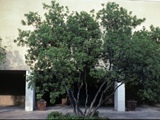
Ilex vomitoria (yaupon) - can grow 12 to 25 ft. tall, female has bright red berries, dioecious.
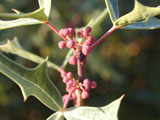
Leucophyllum frutescens (Texas barometer bush) - can grow 8 ft. tall and 4 to 6 ft. in width. Gray-green foliage a backdrop for bright pink flowers which can bloom intermittently year-round.
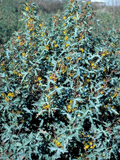
Mahonia trifoliolata (agarita) - 6 to 8 ft. tall, red, edible berries, spiky leaves.
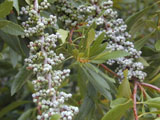
Morella cerifera (wax myrtle) - 6 to 12 ft. tall, fragrant folliage, blue berries on female plants in winter, attracts birds, dioecious.


More Shrubs Questions
Trimming Butterfly Plants
February 11, 2013 - I am looking for detailed information on trimming common butterfly plants: crucita, cenizo, sweet-stem, whitebrush, Mexican trixis, skeleton-leaf goldeneye, white plumbago, turk's cap, desert lantana...
view the full question and answer
Growing Evergreen sumac in clay soil of Texas
August 19, 2011 - I'm in need of a fast growing evergreen screening shrub/small tree. I'm considering the Evergreen Sumac but before I go further I need to know if this plant will thrive and remain evergreen in the D...
view the full question and answer
Eugenia Substitutes for Southern California
May 14, 2011 - Is there a eugenia bush (preferable one that can grow tall) without berries. We like this plant but the berries create a problem. We live in Los Angeles, CA. Thank you.
view the full question and answer
Large-scale container garden for New York City
August 17, 2013 - I am a community volunteer in NYC who is trying to help a non-profit set up two large container gardens (about 3 feet high by 4 feet long by 2 or so feet wide). The problem is that they want natives,...
view the full question and answer
Evergreen shrubs for New Jersey
September 01, 2009 - Need suggestions for Zone 6; Up to 2-3'H compact; evergreen foundation plants; deer resistant; sunny-partial shade; clay soil conditions.
Appreciate your input.
view the full question and answer
| Support the Wildflower Center by Donating Online or Becoming a Member today. |