Native Plants

Q. Who is Mr. Smarty Plants?
A: There are those who suspect Wildflower Center volunteers are the culpable and capable culprits. Yet, others think staff members play some, albeit small, role. You can torture us with your plant questions, but we will never reveal the Green Guru's secret identity.
Did you know you can access the Native Plant Information Network with your web-enabled smartphone?

Ask Mr. Smarty Plants
Ask Mr. Smarty Plants is a free service provided by the staff and volunteers at the Lady Bird Johnson Wildflower Center.

rate this answer

Thursday - December 04, 2008
From: Rapid City, SD
Region: Midwest
Topic: Erosion Control
Title: Native plants for erosion control in South Dakota
Answered by: Nan Hampton
QUESTION:
Dear Mr. Smarty Plants: I live in the Black Hills of South Dakota at about 5000 feet ASL. My house is on a steep hill. I had to clear a perimeter around my house of all the pine trees for fire suppression reasons. Now I have a bare, steep slope, and it only gets about 2-3 hours of direct sunlight, but filtered light all day. The house and the forest block direct light except from about 10-1. I want to plant native species plants that would control erosion, add color, and hopefully feed birds. Because of the steep slope, I was hoping to find a mix that could be planted beneath an erosion blanket. Otherwise, if I surface sow, I think all the seeds will end up at the bottom of the hill after the first rain. Do you have any suggestions.ANSWER:
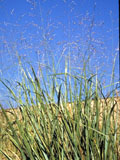
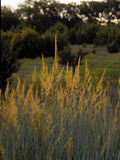
Your idea about using erosion-control blankets is certainly the way to go. The erosion-control fabric works by slowing the runoff water and allowing sediment to fall out rather than be washed away. Seeds are sown under the erosion-control material and grow up through the matting when they germinate. Underneath the matting the roots of the plants growing through the erosion-control material anchor the soil to stop the erosion. If you use erosion-control blankets made of biodegrable material, they will eventually disappear leaving the plants to control the problem.Grasses are excellent plants to stop the erosion because of their extensive fibrous root systems which hold the soil in place. The challenge is to find grasses and other plants that will grow well in your partial shade. The first three are attractive tall grasses (3-8 feet) and grow in sun or partial shade (2-6 hours per day):
Panicum virgatum (switchgrass)
Andropogon gerardii (big bluestem)
Sorghastrum nutans (Indiangrass)
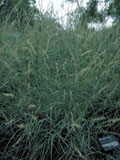
The following grasses tend to be less than 4 feet, but all will grow in sun or partial shade:
Bouteloua curtipendula (sideoats grama)
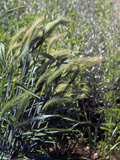
Elymus canadensis (Canada wildrye)
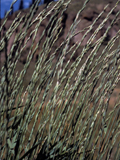
Pascopyrum smithii (western wheatgrass). This grass is widely used for erosion control.
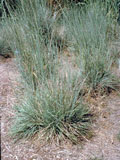
Schizachyrium scoparium (little bluestem)
Some of the grasses have seeds that do not germinate well (e.g., western wheatgrass, Pascopyrum smithii) and do better by planting rhizomes. This can be accomplished by making small holes in the erosion-control cloth. Be sure to check the PROPAGATON information on each of the species' pages.
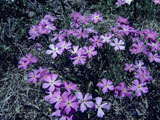
You can add other plants to the grasses and you can find recommendations by choosing South Dakota from the map or the pull-down menu on our Recommended Species page. This will give you a list of commercially available native plants that will do well in South Dakota landscapes. If you choose the Narrow Your Search option, you can select for shade tolerant plants under "Light requirement" by selecting "Part shade - 2-6 hours of sun per day". There are also choices that you can make for "Soil moisture", "Habit (general appearance", and more. Here are a few recommendations from that list:
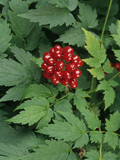
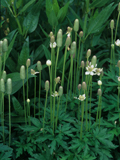
Anemone cylindrica (candle anemone)
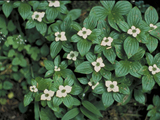
Cornus canadensis (bunchberry dogwood)
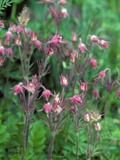
Geum triflorum (old man's whiskers)
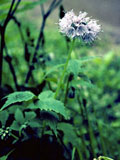
Hydrophyllum virginianum (eastern waterleaf)
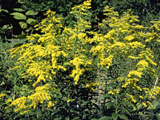
Solidago nemoralis (gray goldenrod)
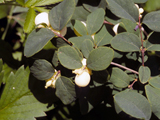
Symphoricarpos albus (common snowberry)

More Erosion Control Questions
Connecticut Plants for a Steep Slope
September 09, 2015 - I am looking for the best plants to retain a steep, dry, fully shaded slope in zone 5, Connecticut. It must be deer resistant. Plant height is not a factor.
view the full question and answer
Erosion Control for a NC Clay Slope
June 06, 2013 - Hi, We have a large slope on the road edge of our property that has been gradually eroding with spring rains (NC red clay). We would really like to plant something for erosion control but the bank is...
view the full question and answer
Native plants for erosion control in sun in Canton PA
August 03, 2010 - We just cleared a bank and need native plants and shrubs to grow for erosion control. Much sun.
Thank you.
view the full question and answer
Preventing erosion on a sloping lot
April 16, 2011 - I am trying to find a native plant to use on a sloped area in my back yard to help prevent the slope from eroding away (zone 7- N. Atlanta, GA). I want something evergreen, between 6 to 30 inches tal...
view the full question and answer
Native grass and/or wildflower seed mix for erosion control in North Carolina
June 23, 2009 - I'm looking for a native grass and/or wildflower seed mix to control erosion on a new mountain road in a pine forest (red clay dirt). The soil is dry and partly shaded, depending on the hour of the d...
view the full question and answer
| Support the Wildflower Center by Donating Online or Becoming a Member today. |