Native Plants

Q. Who is Mr. Smarty Plants?
A: There are those who suspect Wildflower Center volunteers are the culpable and capable culprits. Yet, others think staff members play some, albeit small, role. You can torture us with your plant questions, but we will never reveal the Green Guru's secret identity.
Did you know you can access the Native Plant Information Network with your web-enabled smartphone?

Ask Mr. Smarty Plants
Ask Mr. Smarty Plants is a free service provided by the staff and volunteers at the Lady Bird Johnson Wildflower Center.

rate this answer

Friday - October 05, 2007
From: Round Rock, TX
Region: Southwest
Topic: Trees
Title: Native trees for revegetation project
Answered by: Nan Hampton
QUESTION:
We live in a MUD just outside of Round Rock Texas. There is a developer building apartments behind about 20 houses. Last year, we got the developer to agree to leave 20' of native vegetation in the easement behind our fences. In June their contractor mistakenly cut down this 20' easement behind 3 houses. We have been in discussions since then and the developer has come up with a plan. One of the trees they are recommending is a Leyland Cypress. We have found notations on the internet regarding this evergreen some good, some bad. Other trees recommended were liveoaks, red oaks and cedar elm. Since the ultimate goal is for a tree based privacy barrier that grows as quickly as possible we are wondering which trees would be the best choice. Our soil is alkaline and rocky. The developer has offered to put in a 3' berm which would help with both soil conditions and starting height of the trees. We have a meeting to finalize this with them soon. Would it be possible for you to give us a recommendation for this type of landscaping? The developer is offering 6" caliper trees which they say is the largest they can put in. Our MUD Horticulturist says to put in 2" trees as 6" would be more stressed. Thank You for your assistance.ANSWER:
Here are recommendations concerning your developer's revegetation plan:1. We do NOT recommend Leyland Cypress. It is not a native. If you want evergreens, we suggest:
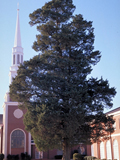
a. Juniperus virginiana (eastern redcedar)
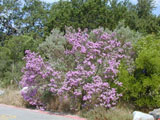
b. Sophora secundiflora (Texas mountain-laurel)
c. Leucophyllum frutescens (cenizo)
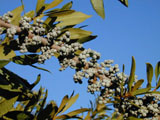
d. Morella cerifera (wax myrtle)
2. Since liveoaks and red oaks are susceptible to oak wilt disease, we recommend that you substitute, or at least include, some oaks that are resistant to oak wilt disease. Here are a couple of suggestions:
a. Quercus macrocarpa (bur oak)
b. Quercus muehlenbergii (chinkapin oak)
3. Ulmus crassifolia (cedar elm) is a good choice.
4. We agree with your horticulturist that the smaller diameter trees are better.



More Trees Questions
Fruit trees for Bellville, TX
January 03, 2010 - Which fruit trees will withstand heat and drought in the Bellville, Texas area?
view the full question and answer
Is a wasp colony in hollow in my oak tree harming it?
November 26, 2013 - I have wasps colonizing a hollow portion of a live oak here in my backyard in Austin ten feet from my backdoor. They are yellow and black banded, maybe an inch long. Two questions:
1. Are they hurt...
view the full question and answer
Failure to bloom of 4-year-old redbud in Rochester, NY
May 20, 2009 - I planted a redbud four years ago and it still hasn't flowered - it does get the lovely leaves. When I planted it it was only an 18 inch stick. How long before it will bloom or is something wrong?
view the full question and answer
Smarty Plants on women trying to conceive
July 10, 2005 - RE: Eucalyptus.
Is this bad for women trying to conceive? The smell is very powerful.
view the full question and answer
Xeric landscaping walls in Mansfield TX
November 15, 2009 - We have two stone, concave 10 ft. high entry walls to our private street. These are each 20 ft. in length and face the west. What xeriscaping accent plants would you recommend. Also, should we crea...
view the full question and answer
| Support the Wildflower Center by Donating Online or Becoming a Member today. |