Native Plants

Plant Database
Search for native plants by scientific name, common name or family. If you are not sure what you are looking for, try the Combination Search or our Recommended Species lists.
Waitt, Damon E.
Quercus macrocarpa
Quercus macrocarpa Michx.
Bur Oak, Burr Oak, Savanna Oak, Overcup Oak, Prairie Oak, Mossy-cup Oak, Mossy-overcup Oak, Blue Oak
Fagaceae (Beech Family)
Synonym(s):
USDA Symbol: quma2
USDA Native Status: L48 (N), CAN (N)
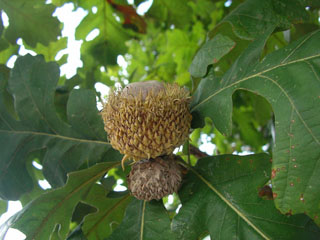
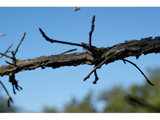
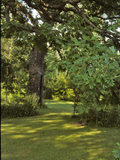
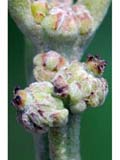
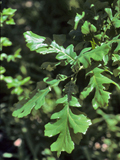
Bur oak is a large, deciduous tree with a very wide, open crown. Usually wider than tall, the tree can exceed 100 ft. in height and width. The massive trunk supports heavy, horizontal limbs and rough, deep-ridged bark. Leaves up to 9 inches long with a central midrib from which branch veins lead into rounded lobes. Lobes separated by deep sinuses reaching, in some cases, to within 1/2 inch of the midrib. Lobes beyond the midpoint of the blade wavy margined and longer and broader than those toward the base. Acorns large, up to 1 1/2 inches broad with 1/4 to more than 1/2 of the acorn enclosed in the cup. Cup with coarse scales and a fringed margin.
The acorns of this species, distinguished by very deep fringed cups, are the largest of all native oaks. The common name (sometimes spelled "Burr") describes the cup of the acorn, which slightly resembles the spiny bur of a chestnut. Bur Oak is the northernmost New World oak. In the West, it is a pioneer tree, bordering and invading the prairie grassland. Planted for shade, ornament, and shelter belts. Bur oak extends farther north than any other oak species and becomes shrubby at the northern and eastern limits of its range.
Plant Characteristics
Duration: PerennialHabit: Tree
Leaf Retention: Deciduous
Leaf Arrangement: Alternate
Leaf Complexity: Simple
Leaf Shape: Elliptic , Obovate
Leaf Venation: Pinnate
Leaf Margin: Lobed
Leaf Base: Cuneate , Rounded
Breeding System: Flowers Unisexual , Monoecious
Inflorescence: Catkin
Fruit Type: Nut
Size Notes: Slow growing, large tree, up to about 150 feet tall.
Leaf: Leaves dark green above, grayish-green with finely dense pubescence below.
Autumn Foliage: yes
Fruit: Acorns annual; 1 - 3 acorns on stout peduncle 1⁄4 - 3⁄4 inch (6 - 19 mm) long; deep cup with grayish pubescent scales, scales near cup rim forming a fringe around the nut, enclosing 1⁄2 - 7⁄8 of nut; light brown, broadly elliptical nut, finely pubescent, 1 - 2 inches (25 - 54 mm) long.
Bloom Information
Bloom Color: Yellow , Green , BrownBloom Time: Mar , Apr , May
Distribution
USA: AL , AR , CT , DC , DE , IA , IL , IN , KS , KY , LA , MA , MD , ME , MI , MN , MO , MS , MT , ND , NE , NH , NJ , NM , NY , OH , OK , PA , RI , SD , TN , TX , VA , VT , WI , WV , WYCanada: AB , MB , NB , ON , QC , SK
Native Distribution: Saskatchewan east to New Brunswick, southwest to Texas, and north to Montana.
Native Habitat: Prairies; open woods; sandy ridges; stream edges. Widely distributed and capable of withstanding a wide range of harsh conditions (one of the most drought resistant oaks) throughout eastern North America; usually found on limestone or calcareous clay.
Growing Conditions
Water Use: MediumLight Requirement: Sun , Part Shade , Shade
Soil Moisture: Dry , Moist , Wet
Soil pH: Acidic (pH<6.8)
CaCO3 Tolerance: Medium
Cold Tolerant: yes
Soil Description: Various soils & moisture conditions. Sandy, Sandy Loam, Medium Loam, Clay Loam, Clay, Caliche type, Limestone-based
Conditions Comments: The species name macrocarpa, refers to the golf ball sized acorns of this tree. The leaves of bur oak also are large, so they are easy to rake. Bur oak is drought resistant, long-lived and reasonably fast-growing for an oak. Tolerates limey soils better than other oaks. Resistant to oak wilt and a number of other problems. Sensitive to root zone disturbance caused by construction.
Benefit
Use Ornamental: Shade tree, Attractive, Fast growing, Long-living. A good urban tree since it is resistant to air pollution and car exhaust.Use Wildlife: Attracts songbirds, ground birds and mammals. Substrate-insectivorous birds, Fruit-birds, Fruit-mammals, Fruit-rodents, Fruit-deer.
Use Food: Acorns (nuts) are edible after tannins are leached or boiled out. Gather nuts during the fall from September to October. Only gather the ripe tan-to-brown acorns, rather than the unripe green ones. remove bitterness, shell the brown, ripe acorns and remove any corky skin layers, dice the meat, and boil the chunks in water from 15 to 30 minutes until the water turns brown. Then pour off the water and repeat the process until the water clears, indicating that the tannic acid has been removed. During the last boiling, salt water can be added; then the acorns can be deep fried or mixed in a soup. Finely chopped acorn meats can be added to bread doughs and muffin batters. After the leaching process, acorn meat can be frozen. To make flour, the boiled acorn meat can be split in two and dried by slowly baking in a 200 degree oven with the door cracked to allow moisture to escape. Crush or grind and use as a thickener or a flour. Another method is to roast the fresh acorn to work well in a grinder or blender. After grinding, place the flour into a cloth bag and boil to leach out bitterness. Leached acorns, after they are roasted until brittle, can be ground and used as a marginal coffee substitute.
Use Medicinal: Native Americans used bur oak as medication for heart problems and other ailments.
Use Other: This oak’s wood quality is similar to white oak and is often used for construction, flooring, and cooperage.
Warning: Acorns (seeds of nuts) and young leaves have low toxicity if eaten. Symptoms include stomach pain, constipation and later bloody diarrhea, excessive thirst and urination.
Interesting Foliage: yes
Attracts: Butterflies
Larval Host: Edwards' Hairstreak, Horace's Duskywing butterfly
Deer Resistant: No
Propagation
Description: Oaks are most often propagated from seed. No pretreatment is necessary. Plant immediately – outdoors or in deep containers to accomodate long initial taproot. The acorns sprout without a dormancy period and begin to germinate as soon as they fall fromSeed Collection: Best quality acorns are picked or shaken from the tree. Collect when color has changed to brown. Best if sown immediately as acorns lose viability quickly in storage. Short-term storage in moist, shaded saw dust or sand. Acorns to be sown immediately can be soaked in hot water for 15 min. to prevent weevil infestation. Stored seed should be fumigated with methyl bromide.
Seed Treatment: 30-60 days at 41 degrees may be beneficial.
Commercially Avail: yes
Find Seed or Plants
View propagation protocol from Native Plants Network.
Mr. Smarty Plants says
Plants for wildlife and trees for shade.
September 29, 2007
We live in Kempner Texas, our land has mostly cedar trees. We would like to make a wildlife habitat on the back side of our property. Can you recommend plants that will grow in shade to partial sun,...
view the full question and answer
Native trees for cemetery plot in Karnes County, TX
April 08, 2007
I'm looking for a tree for a cemetery plot in Karnes County at Pana Maria. There will be someone to regularly water it. I understand live oak and pecan are native to the area. I assume these would...
view the full question and answer
Invasive, non-native Paulownia
May 03, 2006
Hi. We would like to plant a fast growing tree that will provide shade for our house. What do you think of the Paulownia tree (Empress Tree) as a possibility for the Austin area? If this is not a g...
view the full question and answer
National Wetland Indicator Status
| Region: | AGCP | AK | AW | CB | EMP | GP | HI | MW | NCNE | WMVE |
| Status: | FACU | FAC | FAC | FACU | FAC | FACU | FACU |
From the National Organizations Directory
According to the species list provided by Affiliate Organizations, this plant is on display at the following locations:Texas Discovery Gardens - Dallas, TX
Sibley Nature Center - Midland, TX
NPSOT - Native Plant Society of Texas - Fredericksburg, TX
Texas Parks and Wildlife Department - Austin, TX
NPSOT - Fredericksburg Chapter - Fredericksburg, TX
NPSOT - Austin Chapter - Austin, TX
NPSOT - Williamson County Chapter - Georgetown, TX
Mt. Cuba Center - Hockessin, DE
Bibliography
Bibref 766 - Dale Groom's Texas Gardening Guide (2002) Groom, D.Bibref 1134 - Field Guide to Native Oak Species of Eastern North America (2003) Stein, John D. and Denise Binion
Bibref 298 - Field Guide to Texas Trees (1999) Simpson, B.J.
Bibref 946 - Gardening with Prairie Plants: How to Create Beautiful Native Landscapes (2002) Wasowski, Sally
Bibref 355 - Landscaping with Native Plants of Texas and the Southwest (1991) Miller, G. O.
Bibref 354 - Native & Naturalized Woody Plants of Austin & the Hill Country (1981) Lynch, D.
Bibref 318 - Native Texas Plants: Landscaping Region by Region (2002) Wasowski, S. & A. Wasowski
Bibref 291 - Texas Wildscapes: Gardening for Wildlife (1999) Damude, N. & K.C. Bender
Bibref 297 - Trees of Central Texas (1984) Vines, Robert A.
Search More Titles in Bibliography
From the Archive
Wildflower Newsletter 1986 VOL. 3, NO.4 - Fall Highlights Busy Season at the Center, Wildflower Days Welcome the Holidays,...Wildflower Newsletter 1998 VOL. 15, NO.6 - Landscaping with Native Trees, Society for Ecological Restoration Conference Rev...
Additional resources
USDA: Find Quercus macrocarpa in USDA PlantsFNA: Find Quercus macrocarpa in the Flora of North America (if available)
Google: Search Google for Quercus macrocarpa
Metadata
Record Modified: 2015-11-06Research By: TWC Staff