Native Plants

Plant Database
Search for native plants by scientific name, common name or family. If you are not sure what you are looking for, try the Combination Search or our Recommended Species lists.
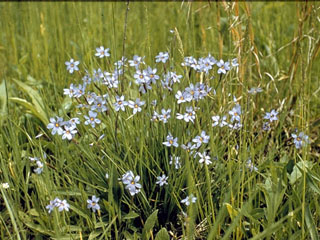
Vick, Albert F. W.
Sisyrinchium angustifolium
Sisyrinchium angustifolium Mill.
Narrowleaf Blue-eyed Grass, Narrow-leaf Blue-eyed-grass, Bermuda Blue-eyed Grass, Blue-eyed Grass
Iridaceae (Iris Family)
Synonym(s): Sisyrinchium bermudiana, Sisyrinchium graminoides
USDA Symbol: sian3
USDA Native Status: L48 (N), CAN (N)
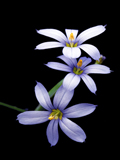
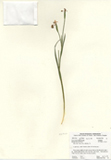
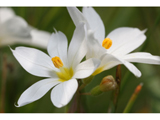
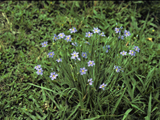
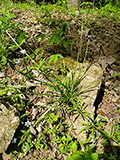
The numerous, narrow, light-green leaves of this perennial form dense, tufted clumps which steadily grow with new foliage during the season. The flattened, leaf-like flowering stems may be up to 18 in. long and bear star-shaped flowers a few inches above the leaves. Several delicate, blue or blue-violet flowers with yellow centers in 2 broad bracts top a flat stem, generally only 1 flower at a time in bloom; stems taller than the clusters of narrow, sword-shaped leaves near base.
Although the plant is small and has grass-like leaves, the flowers have all the features of the Iris family. The various species are all much alike and separation is based on such characteristics as branching pattern and leaf length. Common Blue-eyed Grass (S. montanum) is also a widespread species, with slightly wider leaves, over 1/4" (6 mm), and unbranched stalks.
Plant Characteristics
Duration: PerennialHabit: Herb
Fruit Type: Capsule
Size Notes: Up to about 18 inches tall.
Leaf: Green
Fruit: Brown
Bloom Information
Bloom Color: White , Yellow , Blue , VioletBloom Time: Mar , Apr , May , Jun , Jul
Bloom Notes: Pale blue to violet, occasionally white, bases yellow.
Distribution
USA: AL , AR , CT , DC , DE , FL , GA , IA , IL , IN , KS , KY , LA , MA , MD , ME , MI , MN , MO , MS , NC , NH , NJ , NY , OH , OK , PA , RI , SC , TN , TX , VA , VT , WI , WVCanada: BC , NS , PE , QC
Native Distribution: Nf. to Man. & Platte Co., WY, s. to FL & TX
Native Habitat: Meadows; damp fields; low, open woods
Growing Conditions
Water Use: MediumLight Requirement: Sun , Part Shade
Soil Moisture: Moist , Wet
CaCO3 Tolerance: Low
Soil Description: Moist, poor to average soils
Conditions Comments: This short-lived perennial will decline if allowed to dry out. Heavy mulch causes crown rot and rich, organic soils encourage rank, vegetative growth. Plants need to be divided at least every other year.
Benefit
Use Medicinal: Amerindians used root tea for diarrhea (in children); plant tea for worms, stomachaches. Several species used as laxatives. (Foster & Duke)Conspicuous Flowers: yes
Deer Resistant: No
Propagation
Propagation Material: SeedsDescription: Propagate by seed or division. Several dozen divisions can be expected from a mature, healthy specimen.
Seed Collection: Collect seed capsule when they have darkened to brown and become wrinkled.
Commercially Avail: yes
Find Seed or Plants
Find seed sources for this species at the Native Seed Network.
View propagation protocol from Native Plants Network.
Mr. Smarty Plants says
Native ground cover to replace grass in Florida.
February 04, 2008
Where can I find a list of ground covers to replace my grass. I live in the south of Ocala Florida.
view the full question and answer
National Wetland Indicator Status
| Region: | AGCP | AK | AW | CB | EMP | GP | HI | MW | NCNE | WMVE |
| Status: | FACW | FACW | FACW | FAC | FAC |
From the National Organizations Directory
According to the species list provided by Affiliate Organizations, this plant is on display at the following locations:Lady Bird Johnson Wildflower Center - Austin, TX
Delaware Nature Society - Hockessin, DE
Crosby Arboretum - Picayune, MS
Native Seed Network - Corvallis, OR
First United Methodist Church of Jefferson City - Jefferson City, TN
Mt. Cuba Center - Hockessin, DE
Bibliography
Bibref 417 - Field Guide to Medicinal Plants and Herbs of Eastern and Central North America (2000) Foster, S. & J. A. DukeBibref 946 - Gardening with Prairie Plants: How to Create Beautiful Native Landscapes (2002) Wasowski, Sally
Bibref 1294 - The Midwestern Native Garden: Native Alternatives to Nonnative Flowers and Plants An Illustrated Guide (2011) Adelman, Charlotte and Schwartz, Bernard L.
Search More Titles in Bibliography
Web Reference
Webref 38 - Flora of North America (2019) Missouri Botanical Garden, St. Louis, MO & Harvard University Herbaria, Cambridge, MA.Webref 23 - Southwest Environmental Information Network (2009) SEINet - Arizona Chapter
Research Literature
Reslit 897 - Sisyrinchium angustifolium P. Mill. (2011) K. M. MattsonReslit 1249 - Propagation protocol for production of container Sisyrinchium angustifolium Miller plants; USDA FS - Hiawatha National Forest, Marquette Michigan (2001) J. Schultz, P. Beyer and J. Williams
This information was provided by the Florida WIldflower Foundation.
Search More Titles in Research Literature
Additional resources
USDA: Find Sisyrinchium angustifolium in USDA PlantsFNA: Find Sisyrinchium angustifolium in the Flora of North America (if available)
Google: Search Google for Sisyrinchium angustifolium
Metadata
Record Modified: 2023-02-27Research By: TWC Staff