Native Plants

Plant Database
Search for native plants by scientific name, common name or family. If you are not sure what you are looking for, try the Combination Search or our Recommended Species lists.
Page, Lee
Salvia farinacea
Salvia farinacea Benth.
Mealy Blue Sage, Mealy Sage, Mealycup Sage
Lamiaceae (Mint Family)
Synonym(s): Salvia earlei, Salvia farinacea var. farinacea, Salvia farinacea var. latifolia
USDA Symbol: safa2
USDA Native Status: L48 (N)
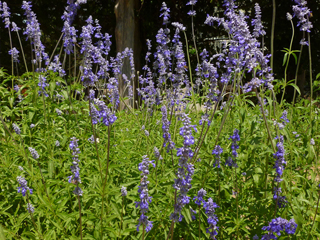
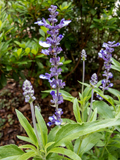
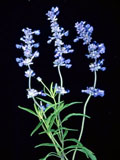
This 2-3 ft. upright or sprawling perennial, usually forms a mound as wide as the plant is tall. Mealy Sage is named for the mealy-white (sometimes purple) appearance of the sepals, which are covered with felted hairs. The blue flowers are 5-lobed and 2-lipped, 2/3-3/4 inch long, with 2 stamens and 1 pistil. They have the usual sage fragrance. The long, narrow leaves grow in clusters, out of which grow the flower stems. The leaves may or may not have teeth. Dark-blue to white, tubular flowers are densely congested in whorls along the upper stems, creating a 3-9 in. spike. Gray-green, lance-shaped leaves are numerous, especially in the lower portion of the plant.
Plant Characteristics
Duration: PerennialHabit: Herb
Size Notes: Up to about 3 feet tall.
Fruit: Nutlets.
Bloom Information
Bloom Color: White , BlueBloom Time: Apr , May , Jun , Jul , Aug , Sep , Oct
Distribution
USA: CT , FL , LA , NM , OH , OK , TXNative Distribution: C. & w. TX & NM
Native Habitat: Prairie, Plains, Meadows, Pastures, Savannas, Woodlands' edge, Opening, Dry calcalreous substrates
Growing Conditions
Water Use: LowLight Requirement: Sun
Soil Moisture: Moist
Soil pH: Acidic (pH<6.8)
Soil Description: Limestone soils. Calcareous, Limestone-based, Caliche type, Sandy, Sandy Loam, Medium Loam, Clay Loam, Clay.
Conditions Comments: Mealy blue sage grows well in perennial borders and wildflower meadows. The foliage is aromatic and deer resistant. When new basal foliage appears, cut the old flower stems to keep the plants lush. Will bloom off and on throughout the summer. Butterflies and hummingbirds enjoy the nectar. Mealy blue sage provides an attractive mass of color in beds, borders and naturalized areas. Wet soil will make the plant leggy and weak.
Benefit
Use Ornamental: It is an excellent plant for a flower bed, and is often planted in groupings to create an attractive mass of color. The leaves have a grayish cast which make a good contrast to lush green foliage of other plants. It is a good plant for a rock garden. Showy, Blooms ornamental, Mass planting, Perennial garden.Use Wildlife: Nectar-Hummingbirds, Nectar-Bees
Conspicuous Flowers: yes
Fragrant Flowers: yes
Fragrant Foliage: yes
Attracts: Butterflies , Hummingbirds
Nectar Source: yes
Deer Resistant: High
Value to Beneficial Insects
Special Value to Native BeesThis information was provided by the Pollinator Program at The Xerces Society for Invertebrate Conservation.
Propagation
Propagation Material: Seeds , Softwood CuttingsDescription: Propagate by seed or cuttings.
Seed Collection: Collect the seeds as the capsules begin to dry but before they have dropped the seeds. Spread seeds in thin layers to dry a few days before storing in sealed, refrigerated containers.
Seed Treatment: Generally, a cold-moist stratification period is required for germination of Salvia seed. This species does require light for germination.
Commercially Avail: yes
Maintenance: After an extended period of flowering, you may wish to prune it halfway back to produce thicker, more compact foliage and a shorter flowering plant. Pruning may delay flowering for several weeks, but it is important in preventing leggy plants.
Find Seed or Plants
Order seed of this species from Native American Seed and help support the Wildflower Center.
Find seed sources for this species at the Native Seed Network.
Mr. Smarty Plants says
Deer resistant, sun tolerant plants for landscaping
April 19, 2007
I live in Driftwood and am looking for flowering, deer-resistant plants for the northern side of my house; however the house turn just enough to the west that the flowerbed receives about 3 hours of a...
view the full question and answer
List of native perennial Texas flowers
March 13, 2006
Good day, I am searching for a list of native Texas flowers (preferably perennials) for a flower garden.
Thank you.
view the full question and answer
From the National Organizations Directory
According to the species list provided by Affiliate Organizations, this plant is on display at the following locations:Naval Air Station Kingsville - Kingsville, TX
Fredericksburg Nature Center - Fredericksburg, TX
Lady Bird Johnson Wildflower Center - Austin, TX
Texas Discovery Gardens - Dallas, TX
Sibley Nature Center - Midland, TX
Patsy Glenn Refuge, c/o Wimberley Birding Society - Wimberley, TX
Nueces River Authority - Uvalde, TX
Texas Parks and Wildlife Department - Austin, TX
NPSOT - Fredericksburg Chapter - Fredericksburg, TX
NPSOT - Austin Chapter - Austin, TX
Native Seed Network - Corvallis, OR
Jacob's Well Natural Area - Wimberley, TX
NPSOT - Williamson County Chapter - Georgetown, TX
Wildflower Center Seed Bank
LBJWC-ENH-1 Collected 2009-05-21 in Lampasas County by Lady Bird Johnson Wildflower CenterBibliography
Bibref 946 - Gardening with Prairie Plants: How to Create Beautiful Native Landscapes (2002) Wasowski, SallyBibref 841 - Native Alternatives to Invasive Plants (2006) Burrell, C. C.
Bibref 318 - Native Texas Plants: Landscaping Region by Region (2002) Wasowski, S. & A. Wasowski
Search More Titles in Bibliography
Web Reference
Webref 23 - Southwest Environmental Information Network (2009) SEINet - Arizona ChapterAdditional resources
USDA: Find Salvia farinacea in USDA PlantsFNA: Find Salvia farinacea in the Flora of North America (if available)
Google: Search Google for Salvia farinacea
Metadata
Record Modified: 2023-02-24Research By: TWC Staff