Native Plants

Plant Database
Search for native plants by scientific name, common name or family. If you are not sure what you are looking for, try the Combination Search or our Recommended Species lists.
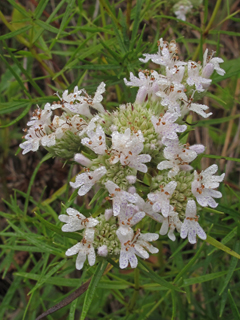
Cressler, Alan
Pycnanthemum tenuifolium
Pycnanthemum tenuifolium Schrad.
Narrowleaf Mountain Mint, Slender Mountain Mint, Common Horsemint
Lamiaceae (Mint Family)
Synonym(s): Koellia flexuosa, Pycnanthemum flexuosum
USDA Symbol: pyte
USDA Native Status: L48 (N), CAN (N)
This stiff, erect, compact, clump-forming mint has narrow leaves subtending the flower clusters. The minty-smelling plants are 20-30 in. tall and have terminal flower clusters composed of numerous, small, two-lipped corollas varying from whitish to lavender, with purple spots.


Plant Characteristics
Duration: PerennialHabit: Herb
Fruit Type: Nut
Size Notes: Normally around 2 feet tall, but can reach 4 feet in rich soil.
Leaf: Pale green.
Fruit: Nutlets, black.
Bloom Information
Bloom Color: White , Blue , PurpleBloom Time: Jun , Jul , Aug , Sep
Bloom Notes: White, with blue or purple spots. Begins flowering when grown to about one foot wide.
Distribution
USA: AL , AR , CT , DC , DE , FL , GA , IA , IL , IN , KS , KY , LA , MA , MD , ME , MI , MN , MO , MS , NC , NE , NH , NJ , NY , OH , OK , PA , RI , SC , TN , TX , VA , VT , WI , WVCanada: ON
Native Distribution: ME to GA, w. to WI, IA, e. KS & e. TX
Native Habitat: Upland prairies; dry, rocky, open woods; low, wet areas as well as fast-draining Post Oak woods and pine barrens
Growing Conditions
Water Use: MediumLight Requirement: Sun , Part Shade
Soil Moisture: Dry , Moist
Soil pH: Acidic (pH<6.8)
Drought Tolerance: Medium
Soil Description: Various moist to dry soils.
Conditions Comments: The similar and closely related P. flexuosum is a more coastal species.
Benefit
Use Ornamental: Silvery foliage and long blooming period.Use Wildlife: Bees and butterflies use flowers. Deer eat leaves. Numerous animals eat seeds.
Use Food: Dried leaves used as flavoring and in teas.
Use Other: Rub leaves on skin to repel mosquitoes.
Conspicuous Flowers: yes
Interesting Foliage: yes
Fragrant Foliage: yes
Attracts: Birds , Butterflies
Nectar Source: yes
Deer Resistant: No
Value to Beneficial Insects
Special Value to Native BeesSpecial Value to Bumble Bees
Special Value to Honey Bees
Supports Conservation Biological Control
This information was provided by the Pollinator Program at The Xerces Society for Invertebrate Conservation.
Propagation
Propagation Material: Root Division , SeedsDescription: Best propagated by cuttings or divisions. Tip cuttings are easy and reliable, taken in June. To make divisions, lift the clump in late fall or early spring and use pruning shears to divide the shallow root system. Seeds are so tiny it is best to plant
Seed Collection: Collect seed after the first few frosts. To check for ripe seed, bend over the stem and shake it; if black seeds fall out, collect right away. Store in sealed, refrigerated containers.
Seed Treatment: No pretreatment necessary.
Commercially Avail: yes
Maintenance: To keep it from getting too wide, divide it by the roots occasionally.
Find Seed or Plants
Order seed of this species from Native American Seed and help support the Wildflower Center.
Mr. Smarty Plants says
Edible Plants for North Georgia
January 10, 2010
We are planning a forest food garden in the hollers of the N GA Mountains.
Which edible fruit, nut, berry, herb and creepers would be best for this reddish, clay-like soil? The food garden is in...
view the full question and answer
Edible Plants for a Virginia Rain Garden
October 21, 2009
Can you recommend edible plants that would be appropriate for use in a rain garden? I'm located in Charlottesville, VA, but this can be in general as well.
view the full question and answer
Possibly escaped non-native Buddleja davidii in Missouri
March 15, 2006
About 3 years ago my wife and I were traveling thru southeastern Missouri and stopped at a road side rest station on Interstate 44. While we were there we noticed a shrub about 4 to 5 feet tall with p...
view the full question and answer
National Wetland Indicator Status
| Region: | AGCP | AK | AW | CB | EMP | GP | HI | MW | NCNE | WMVE |
| Status: | FACW | FACW | FAC | FAC | FAC |
From the National Organizations Directory
According to the species list provided by Affiliate Organizations, this plant is on display at the following locations:First United Methodist Church of Jefferson City - Jefferson City, TN
Bibliography
Bibref 1620 - Gardening with Native Plants of the South (Reprint Edition) (2009) Wasowski, S. with A. WasowskiBibref 841 - Native Alternatives to Invasive Plants (2006) Burrell, C. C.
Bibref 1294 - The Midwestern Native Garden: Native Alternatives to Nonnative Flowers and Plants An Illustrated Guide (2011) Adelman, Charlotte and Schwartz, Bernard L.
Search More Titles in Bibliography
Web Reference
Webref 23 - Southwest Environmental Information Network (2009) SEINet - Arizona ChapterAdditional resources
USDA: Find Pycnanthemum tenuifolium in USDA PlantsFNA: Find Pycnanthemum tenuifolium in the Flora of North America (if available)
Google: Search Google for Pycnanthemum tenuifolium
Metadata
Record Modified: 2023-04-07Research By: TWC Staff