Native Plants

Plant Database
Search for native plants by scientific name, common name or family. If you are not sure what you are looking for, try the Combination Search or our Recommended Species lists.
Wasowski, Sally and Andy
Pseudotsuga menziesii
Pseudotsuga menziesii (Mirb.) Franco
Douglas Fir, Blue Douglas Fir
Pinaceae (Pine Family)
Synonym(s):
USDA Symbol: psme
USDA Native Status: L48 (N), CAN (N)
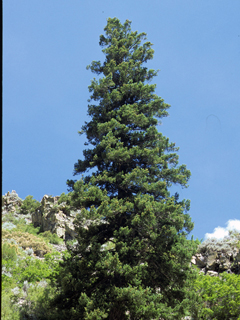
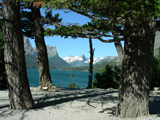
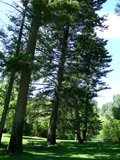
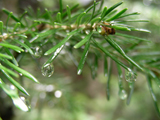
This evergreen grows from 15-300 ft. tall depending on environment and variety. In mesic sites, the conical, columnar tree is usually 75-100 ft. tall. Limbs are straight - the lower drooping, upper ascending. Flattened needles vary in color depending on seed source. Large to very large tree with narrow, pointed crown of slightly drooping branches; 2 distinct geographic varieties: Coast and Rocky Mountain. The Rocky Mt. type is bluish-green; Pacific coast is dark-green; and yellow-green types exist. Pendulous cones are ever-present.
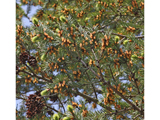
Coast Douglas-fir (var. menziesii), the typical Douglas-fir of the Pacific Coast, is a very large tree with long, dark yellow-green needles and large cones with spreading bracts. Rocky Mountain Douglas-fir (var. glauca), of the Rocky Mountain region, is a medium-sized to large tree with shorter, blue-green needles and smaller cones with bracts bent upward. One of the world's most important timber species, Douglas-fir ranks first in the United States in total volume of timber, in lumber production, and in production of veneer for plywood. It is one of the tallest trees as well and a popular Christmas tree. David Douglas (1798-1834), the Scottish botanical collector, who sent seeds back to Europe in 1827, is commemorated in the common name. The foliage is consumed by grouse and by deer and elk; birds and mammals eat the seeds.
Plant Characteristics
Duration: PerennialHabit: Tree
Leaf Retention: Evergreen
Leaf Complexity: Simple
Breeding System: Flowers Unisexual , Monoecious
Fruit Type: Cone
Size Notes: Up to about 300 feet tall, often much shorter.
Leaf: Green
Fruit: Brown
Bloom Information
Bloom Color: Red , YellowBloom Time: Apr
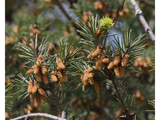
Bloom Notes: Flowers inconspicuous. Pollen cones yellowish red.
Distribution
USA: AZ , CA , CO , ID , MN , MT , NM , NV , NY , OR , TX , UT , WA , WYCanada: AB
Native Distribution: Mts. of Alt. to w. TX & n. Mex., w. to B.C. & CA
Native Habitat: Moist, well-drained, mountain sites
Growing Conditions
Water Use: MediumLight Requirement: Part Shade
Soil Moisture: Dry
CaCO3 Tolerance: Low
Soil Description: Igneous, Limestone-based, Sandy, Sandy Loam, Moist, well-drained, neutral or slightly acid soils.
Conditions Comments: Douglas fir in the Pacific Northwest can reach 300 ft. At the other extreme, some Douglas firs in Big Bend National Park grow only 15 ft. tall. Branches grow to the ground on solitary trees; trees in groves self-prune, revealing the thick bark. The tree fails on dry, poor soils; in crowded spaces; or in high winds. In the proper environment the tree is fast-growing and seedlings are likely to establish.
Butterflies and Moths of North America (BAMONA)
|
Pine White (Neophasia menapia) 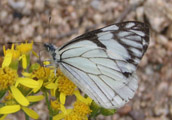 Adult Food Source |
Propagation
Propagation Material: SeedsDescription: Propagates easily by seed and is easily transplanted when young. Douglas fir does not take well to propagation by cuttings.
Seed Treatment: Seeds may or may not need a 3-6 week cool-moist treatment depending on seed source.
Commercially Avail: yes
Find Seed or Plants
Find seed sources for this species at the Native Seed Network.
View propagation protocol from Native Plants Network.
Mr. Smarty Plants says
Columnar evergreen for Colorado
July 04, 2008
I am looking for an evergreen 6-8 (or more) feet tall, very columnar; 3 feet spread in diameter, zone 5, full sun, dark green, clayish-OK soil.
Thank you so much!
view the full question and answer
National Wetland Indicator Status
| Region: | AGCP | AK | AW | CB | EMP | GP | HI | MW | NCNE | WMVE |
| Status: | FACU | FACU | FACU | FACU | FACU |
From the National Organizations Directory
According to the species list provided by Affiliate Organizations, this plant is on display at the following locations:United States Botanic Garden - Washington, DC
Native Seed Network - Corvallis, OR
Bibliography
Bibref 1186 - Field Guide to Moths of Eastern North America (2005) Covell, C.V., Jr.Bibref 298 - Field Guide to Texas Trees (1999) Simpson, B.J.
Bibref 1185 - Field Guide to Western Butterflies (Peterson Field Guides) (1999) Opler, P.A. and A.B. Wright
Bibref 318 - Native Texas Plants: Landscaping Region by Region (2002) Wasowski, S. & A. Wasowski
Bibref 291 - Texas Wildscapes: Gardening for Wildlife (1999) Damude, N. & K.C. Bender
Search More Titles in Bibliography
Web Reference
Webref 3 - Flora of North America (2014) Missouri Botanical Garden, St. Louis, MO & Harvard University Herbaria, Cambridge, MA.Additional resources
USDA: Find Pseudotsuga menziesii in USDA PlantsFNA: Find Pseudotsuga menziesii in the Flora of North America (if available)
Google: Search Google for Pseudotsuga menziesii
Metadata
Record Modified: 2022-10-10Research By: TWC Staff