Native Plants

Plant Database
Search for native plants by scientific name, common name or family. If you are not sure what you are looking for, try the Combination Search or our Recommended Species lists.
Reveal, James L.
Prunus ilicifolia
Prunus ilicifolia (Nutt. ex Hook. & Arn.) D. Dietr.
Hollyleaf Cherry
Rosaceae (Rose Family)
Synonym(s):
USDA Symbol: pril
USDA Native Status: L48 (N)
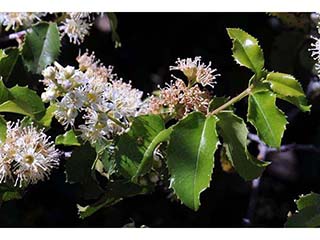
Small evergreen tree with short trunk, dense crown of stout, spreading branches, spiny-toothed leaves, and red cherries; hairless throughout; often a shrub. Hollyleaf Cherry is a dense, evergreen shrub or small tree with dark-green, holly-like leaves; white flower spikes; and red or dark-purple to black, cherry fruits.
Hollyleaf Cherry has been planted as an ornamental and a hedge plant from the time of the Spanish settlement in California. Although sweetish and edible, the cherries are mostly stone and are consumed only by wildlife. Native Americans used to crack the dried fruit and prepare meal from the ground seeds, after leaching them of poisons. The common and scientific names both refer to the hollylike leaves, which are used as Christmas decorations.


Plant Characteristics
Duration: PerennialHabit: Shrub
Leaf Retention: Evergreen
Fruit Type: Drupe
Size Notes: Up to about 50 feet tall, often much shorter.
Bloom Information
Bloom Color: WhiteBloom Time: Feb , Mar , Apr , May
Distribution
USA: CANative Distribution: Coast Ranges from Napa Co., s. to s. CA
Native Habitat: Dry slopes below 5000 ft.
Growing Conditions
Light Requirement: SunSoil Moisture: Dry
Soil Description: Dry, rocky soils.
Benefit
Use Wildlife: Birds and other wildlife eat the fruit.Warning: The seeds of all Prunus species, found inside the fruits, contain poisonous substances and should never be eaten. Sensitivity to a toxin varies with a person’s age, weight, physical condition, and individual susceptibility. Children are most vulnerable because of their curiosity and small size. Toxicity can vary in a plant according to season, the plant’s different parts, and its stage of growth; and plants can absorb toxic substances, such as herbicides, pesticides, and pollutants from the water, air, and soil.
Attracts: Birds
Value to Beneficial Insects
Special Value to Native BeesThis information was provided by the Pollinator Program at The Xerces Society for Invertebrate Conservation.
Propagation
Description: In addition to seed, Prunus species may be rooted from dormant hardwood, softwood, semi-hardwood, or root cuttings. Semi-hardwood and softwood cuttings taken in summer root easiest.Seed Collection: Collect fruit when it is filled out, firm, and its ripe color. Clean seeds from pulp and briefly air dry. (Seeds to be sown immediately in fall do not need drying.) Storage viability is maintained at 31-41 degrees.
Seed Treatment: Fresh seeds require no treatment; stored seeds benefit from 1-3 months stratification.
Commercially Avail: yes
Find Seed or Plants
View propagation protocol from Native Plants Network.
Bibliography
Bibref 995 - Native Landscaping from El Paso to L.A. (2000) Wasowski, S. and A. WasowskiSearch More Titles in Bibliography
Web Reference
Webref 30 - Calflora (2018) CalfloraWebref 3 - Flora of North America (2014) Missouri Botanical Garden, St. Louis, MO & Harvard University Herbaria, Cambridge, MA.
Webref 23 - Southwest Environmental Information Network (2009) SEINet - Arizona Chapter
From the Archive
Wildflower Newsletter 1984 VOL. 1, NO.4 - Lady Bird Heartened by Progress, Horticultural Society Annual Meeting Held, Dire...Additional resources
USDA: Find Prunus ilicifolia in USDA PlantsFNA: Find Prunus ilicifolia in the Flora of North America (if available)
Google: Search Google for Prunus ilicifolia
Metadata
Record Modified: 2023-05-10Research By: TWC Staff