Native Plants

Plant Database
Search for native plants by scientific name, common name or family. If you are not sure what you are looking for, try the Combination Search or our Recommended Species lists.
Wasowski, Sally and Andy
Prunus angustifolia
Prunus angustifolia Marshall
Chickasaw Plum, Sandhill Plum
Rosaceae (Rose Family)
Synonym(s):
USDA Symbol: pran3
USDA Native Status: L48 (N)
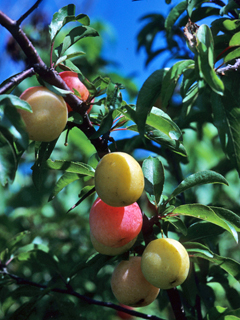
A twiggy, thicket-forming tree, 15-30 ft. tall, with fragrant white flowers in flat-topped clusters and yellow fruit ripening to red in August or September. Short, crooked trunk and flat-topped crown. Scaly, nearly black bark. Reddish branches are covered with thorn-like side branches. Pale-yellow fall foliage. Thicket-forming shrub or sometimes a small tree, with slender, spreading branches, small white flowers, and red plums.
Cultivated by the Chickasaw Indians and other indigenous peoples before the arrival of Europeans. This plum is eaten fresh and made into jellies and preserves. Improved varieties are grown in the Southeast.




Plant Characteristics
Duration: PerennialHabit: Tree
Leaf Retention: Deciduous
Fruit Type: Drupe
Size Notes: Usually up to about 15 feet tall, sometimes taller.
Leaf: Green
Autumn Foliage: yes
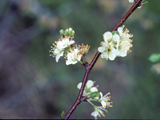
Flower: Flowers 8-9 mm wide.
Fruit: Red up to 25 mm long.
Bloom Information
Bloom Color: WhiteBloom Time: Feb , Mar , Apr , May
Distribution
USA: AL , AR , CA , CO , DC , DE , FL , GA , IL , IN , KS , KY , LA , MD , MO , MS , NC , NE , NJ , NM , OK , PA , SC , TN , TX , VA , WVNative Distribution: NJ to IL, MO & s. NE, s. to FL & TX. Introduced elsewhere.
Native Habitat: Open woodlands, woodland edges, forest openings, savannas, prairies, plains, meadows, pastures, fence rows, roadsides
Growing Conditions
Water Use: Low , MediumLight Requirement: Sun , Part Shade
Soil Moisture: Dry
CaCO3 Tolerance: High
Soil Description: Sandy, loose
Conditions Comments: In full sun, will be more dense and full and will colonize more thickly. In the part shade of woodlands, will be more airy, loose, and delicate in appearance and will colonize more loosely.
Benefit
Use Ornamental: Attractive, aromatic thicket plum for landscape restorations and shelter belt plantings.Use Wildlife: Birds and mammals eat the fruit. Various insects visit the flowers. Provides cover and nesting sites for wildlife.
Use Food: Ripe fruit can be eaten fresh and is made into jellies, desserts, and preserves.
Conspicuous Flowers: yes
Fragrant Flowers: yes
Attracts: Birds , Butterflies
Nectar Source: yes
Value to Beneficial Insects
Special Value to Native BeesThis information was provided by the Pollinator Program at The Xerces Society for Invertebrate Conservation.
Propagation
Propagation Material: Hardwood Cuttings , Root Cuttings , Seeds , Semi-hardwood Cuttings , Softwood CuttingsDescription: Prunus species may be rooted from dormant hardwood, softwood, semi-hardwood, or root cuttings. Semi-hardwood and softwood cuttings taken in summer root easiest. Germination of most seeds requires cold stratification.
Seed Collection: Collect fruit when it is filled out, firm, and its ripe color. Clean seeds from pulp and briefly air dry. (Seeds to be sown immediately in fall do not need drying.) Storage viability is maintained at 31-41 degrees.
Seed Treatment: For spring sowing, stratify seeds in moist sand for 30-60 days in a greenhouse, then cold stratify (36-41 degrees) for 60-90 days. Plant well before high temperatures.
Commercially Avail: yes
Find Seed or Plants
View propagation protocol from Native Plants Network.
From the National Organizations Directory
According to the species list provided by Affiliate Organizations, this plant is on display at the following locations:Crosby Arboretum - Picayune, MS
Texas Parks and Wildlife Department - Austin, TX
Texas Master Naturalists - Lost Pines Chapter - Bastrop, TX
NPSOT - Williamson County Chapter - Georgetown, TX
Bibliography
Bibref 946 - Gardening with Prairie Plants: How to Create Beautiful Native Landscapes (2002) Wasowski, SallyBibref 318 - Native Texas Plants: Landscaping Region by Region (2002) Wasowski, S. & A. Wasowski
Bibref 291 - Texas Wildscapes: Gardening for Wildlife (1999) Damude, N. & K.C. Bender
Bibref 297 - Trees of Central Texas (1984) Vines, Robert A.
Search More Titles in Bibliography
Web Reference
Webref 57 - Atlas of Florida Plants (2020) Institute for Systematic BotanyWebref 38 - Flora of North America (2019) Missouri Botanical Garden, St. Louis, MO & Harvard University Herbaria, Cambridge, MA.
Webref 23 - Southwest Environmental Information Network (2009) SEINet - Arizona Chapter
Research Literature
Reslit 373 - Growth of Chickasaw Plum in Oklahoma (2008) S. W. Dunkin, F. S. Guthery and R. E. WillReslit 680 - Hosts of plum curculio, Conotrachelus nenuphar (Coleoptera : Curculionidae), in Central Georgia (2006) D. Jenkins, T. Cottrell, D. Horton, A. Hodges and ...
Reslit 1223 - Postestablishment landscape performance of Florida native and exotic shrubs under irrigated and nonirrigated conditions (2008) S. M. Scheiber, E. F. Gilman, D. R. Sandrock, M. P...
Reslit 1267 - Control of plum curculio, Conotrachelus nenuphar, with entomopathogenic nematodes: Effects of application timing, alternate host plant, and nematode strain (2008) D. I. Shapiro-Ilan, R. F. Mizell, T. E. Cottrell a...
Reslit 2010 - 'AU-Cherry' Plum (1991) J. D. Norton, G. E. Boyhan, D. A. Smith and B. R. ...
Reslit 2011 - 'AU-Rosa' Plum (1991) J. D. Norton, G. E. Boyhan, D. A. Smith and B. R. ...
This information was provided by the Florida WIldflower Foundation.
Search More Titles in Research Literature
Additional resources
USDA: Find Prunus angustifolia in USDA PlantsFNA: Find Prunus angustifolia in the Flora of North America (if available)
Google: Search Google for Prunus angustifolia
Metadata
Record Modified: 2023-05-10Research By: TWC Staff