Native Plants

Plant Database
Search for native plants by scientific name, common name or family. If you are not sure what you are looking for, try the Combination Search or our Recommended Species lists.
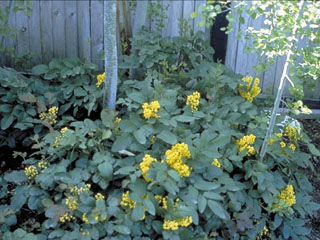
Alder, Michael G.
Mahonia repens
Mahonia repens (Lindl.) G. Don
Creeping Barberry, Creeping Oregon-grape
Berberidaceae (Barberry Family)
Synonym(s): Berberis amplectens, Berberis aquifolium var. repens, Berberis pumila, Berberis repens, Berberis sonnei, Mahonia amplectens, Mahonia pumila, Mahonia sonnei, Odostemon pumilus, Odostemon repens
USDA Symbol: mare11
USDA Native Status: L48 (N), CAN (N)
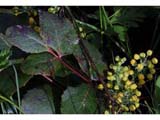
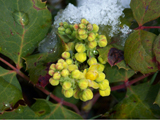
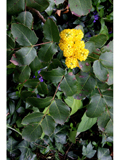
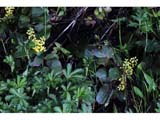
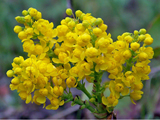
Creeping Oregon-grape or creeping barberry is a stoloniferous, sprawling evergreen of stiff habit with small, fragrant, yellow flowers in drooping racemes, followed by showy, purple fruit. The leathery, holly-like, compound leaves are a muted green, some turning mauve, rose, and rust-colored in winter. The plant grows 1-3 ft. in height.
A beautiful foliage groundcover for shade in the western mountains of the continent, Creeping Barberry has muted green leaves that are occasionally shades of pastel pinks, purples, and oranges. It thrives in good garden soil, but does not tolerate high heat or drying wind. Its yellow spring blooms attract pollinators and its berries attract birds.
Plant Characteristics
Duration: PerennialHabit: Shrub
Leaf Retention: Evergreen
Leaf Pubescence: Glabrous
Leaf Texture: Smooth
Breeding System: Flowers Bisexual
Fruit Type: Berry
Size Notes: 6 to 10 inches high in the wild; 1 to 2 feet high in cultivation
Leaf: Bluish green with some leaves in pastel pinks and oranges
Flower: Flowers up to quarter inch.
Fruit: Blue 6-10 mm
Bloom Information
Bloom Color: YellowBloom Time: Apr , May , Jun , Jul
Bloom Notes: In Texas, tends to bloom in early April.
Distribution
USA: AZ , CA , CO , ID , IN , MN , MT , ND , NE , NM , NV , OR , PA , SD , TX , UT , WA , WYCanada: AB , BC
Native Distribution: Mountains: British Columbia and Alberta south and east through California to the Black Hills, s. to Arizona and west Texas.
Native Habitat: Dry, open woods & hills at high elevations
Growing Conditions
Water Use: MediumLight Requirement: Part Shade
Soil Moisture: Dry , Moist
Soil pH: Acidic (pH<6.8)
CaCO3 Tolerance: Medium
Drought Tolerance: High
Cold Tolerant: yes
Soil Description: Rich, well-drained sandy, loamy, chalky, or granitic soils.
Conditions Comments: Will not do well in too much heat or in drying winds.
Benefit
Use Ornamental: An attractive foliage groundcover for cool climates in shade.Use Wildlife: Fruit is eaten by birds and other wildlife. Provides wildlife cover.
Conspicuous Flowers: yes
Interesting Foliage: yes
Attracts: Birds
Value to Beneficial Insects
Special Value to Native BeesThis information was provided by the Pollinator Program at The Xerces Society for Invertebrate Conservation.
Propagation
Propagation Material: Root Division , Seeds , Softwood CuttingsDescription: Propagate using treated seed, divisions, or leafy, spring cuttings. The easiest method is spring or fall divisions.
Seed Collection: Ripe fruits may be picked by hand, using heavy gloves, or flailed onto cloth beneath the bushes. Seeds can be removed through maceration and flotation. Air dry and store in sealed, refrigerated containers.
Seed Treatment: Successive cold, warm, and cold stratification: moist chill at 34 degrees for 30 days; follow by warm moist storage at 68 degrees for 30 more days; and finally stratify at 34 degrees for up to 196 days.
Commercially Avail: yes
Maintenance: Pinch new growth to keep the plant compact and dense. Protect foliage from intense sun and winds. The spread of underground stems can be checked by occasional root pruning. Water during hot summers.
Find Seed or Plants
Find seed sources for this species at the Native Seed Network.
View propagation protocol from Native Plants Network.
Mr. Smarty Plants says
Flowering and evergreen shrubs for landscape in Indiana
May 29, 2010
I live in Southern Indiana and we are getting ready to redesign our front landscape. Currently, we have some yews and other shrubs that are unruly and require a lot of pruning and care. My husband hat...
view the full question and answer
Replacing grass with xeric plants in Nevada
March 20, 2009
I am looking to xeriscape my front yard - remove all grass! I am thinking 3-4 larger plants: bird of paradise (mesquite??), aloe, and ..?? Also, possibly a Chilean mesquite.
Do you have suggestio...
view the full question and answer
Groundcover for erosion control
September 23, 2008
I live in southern california. What is the best groundcover
to plant on a slope to prevent erosion?
view the full question and answer
Alternatives to non-native heather (Calluna vulgaris)
April 27, 2007
I live in Vernon, BC, Canada. I plan to put a heather plant in my garden, but my space is limited. I know that it will grow approx. 2 ft. high and that it likes well drained and acidic soil, but how...
view the full question and answer
From the National Organizations Directory
According to the species list provided by Affiliate Organizations, this plant is on display at the following locations:Santa Barbara Botanic Garden - Santa Barbara, CA
Native Seed Network - Corvallis, OR
Bibliography
Bibref 841 - Native Alternatives to Invasive Plants (2006) Burrell, C. C.Bibref 318 - Native Texas Plants: Landscaping Region by Region (2002) Wasowski, S. & A. Wasowski
Search More Titles in Bibliography
Additional resources
USDA: Find Mahonia repens in USDA PlantsFNA: Find Mahonia repens in the Flora of North America (if available)
Google: Search Google for Mahonia repens
Metadata
Record Modified: 2015-10-14Research By: TWC Staff