Native Plants

Plant Database
Search for native plants by scientific name, common name or family. If you are not sure what you are looking for, try the Combination Search or our Recommended Species lists.
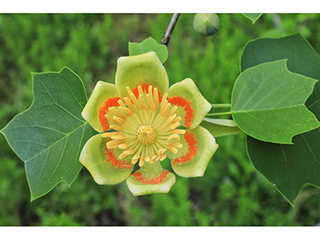
Cressler, Alan
Liriodendron tulipifera
Liriodendron tulipifera L.
Tulip Tree, Tulip Poplar, Yellow Poplar
Magnoliaceae (Magnolia Family)
Synonym(s):
USDA Symbol: litu
USDA Native Status: L48 (N), CAN (N)
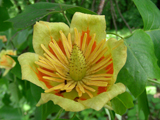
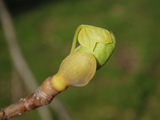
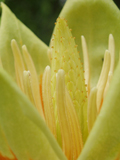
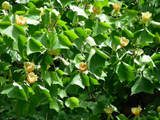
One of the tallest and most beautiful eastern hardwoods, with a long, straight trunk, a narrow crown that spreads with age, and large showy flowers resembling tulips or lilies. A tall, straight, deciduous tree, up to150 ft. tall (sometimes taller), tuliptree has a medium to narrow crown and distinctive, star-shaped foliage. The leaves are waxy and smooth, and dependably turn bright gold in fall. Showy, yellow-orange, tulip-like flowers are often missed because they are up 50 ft. or higher in the tops of trees. Cone-shaped seedheads remain after leaves have fallen.
Introduced into Europe from Virginia by the earliest colonists and grown also on the Pacific Coast. Very tall trees with massive trunks existed in the primeval forests but were cut for the valuable soft wood. Pioneers hollowed out a single log to make a long, lightweight canoe. One of the chief commercial hardwoods, Yellow Poplar is used for furniture, as well as for crates, toys, musical instruments, and pulpwood.
Plant Characteristics
Duration: PerennialHabit: Tree
Leaf Retention: Deciduous
Leaf Arrangement: Alternate
Leaf Complexity: Simple
Leaf Venation: Pinnate
Leaf Margin: Entire
Breeding System: Flowers Bisexual
Fruit Type: Aggregate , Samara
Size Notes: Up to about 150 feet tall.
Leaf: Green
Autumn Foliage: yes
Fruit: Cone-like aggregate of samaras.
Bloom Information
Bloom Color: Yellow , Green , BrownBloom Time: Apr , May , Jun
Distribution
USA: AL , AR , CT , DC , DE , FL , GA , IA , IL , IN , KY , LA , MA , MD , MI , MO , MS , NC , NJ , NY , OH , PA , RI , SC , TN , TX , VA , VT , WVCanada: ON
Native Distribution: W. VT to s. MI & s.e IL, s. to n. FL & LA
Native Habitat: Low, rich woods; stream banks
Growing Conditions
Water Use: MediumLight Requirement: Sun , Part Shade , Shade
Soil Moisture: Moist
Soil pH: Acidic (pH<6.8)
CaCO3 Tolerance: Low
Soil Description: Rich, moist soils.
Conditions Comments: Tulip tree is insect and disease free. It is intolerant of compacted soil and should not be placed in confined beds or planters near pavement. It grows very rapidly in deep, rich well-drained soils with uniform rainfall. Dry summer weather causes physiological problems. Tulip tree drops its foliage in response to drought and is somewhat weak-wooded.
Benefit
Use Wildlife: This is a favorite nesting tree for birds and the flowers attract hummingbirds.Use Medicinal: A pioneer species.
First Nations used the inner bark medicinally as worming medicine, antiarthritic, cough syrup and cholera remedy. (Athenic)
Conspicuous Flowers: yes
Attracts: Birds , Butterflies , Hummingbirds
Larval Host: Eastern Tiger Swallowtail (Papilio glaucus)
Value to Beneficial Insects
Special Value to Honey BeesThis information was provided by the Pollinator Program at The Xerces Society for Invertebrate Conservation.
Butterflies and Moths of North America (BAMONA)
|
Tuliptree silkmoth (Callosamia angulifera) 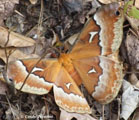 Larval Host |
Eastern Tiger Swallowtail (Papilio glaucus) 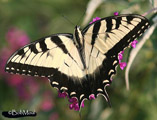 Larval Host |
Propagation
Description: Sow seeds in fall or stratify. Germination percentages are generally quite low. Collect cuttings in summer.Seed Collection: Collect cones from trees before they dry completely. Thoroughly air dry cone to separate samaras for storage. Drying may take 20 days. Store in sealed refrigerated containers.
Seed Treatment: Stratify 60-90 days at 36 degrees.
Commercially Avail: yes
Find Seed or Plants
View propagation protocol from Native Plants Network.
National Wetland Indicator Status
| Region: | AGCP | AK | AW | CB | EMP | GP | HI | MW | NCNE | WMVE |
| Status: | FACU | FACU | FACU | FACU | FACU |
From the National Organizations Directory
According to the species list provided by Affiliate Organizations, this plant is on display at the following locations:Delaware Nature Society - Hockessin, DE
Crosby Arboretum - Picayune, MS
Georgia Native Plant Society - Atlanta, GA
Mt. Cuba Center - Hockessin, DE
Wellspring Organic Farm and Education Center - West Bend, WI
Bibliography
Bibref 1186 - Field Guide to Moths of Eastern North America (2005) Covell, C.V., Jr.Bibref 1185 - Field Guide to Western Butterflies (Peterson Field Guides) (1999) Opler, P.A. and A.B. Wright
Bibref 1620 - Gardening with Native Plants of the South (Reprint Edition) (2009) Wasowski, S. with A. Wasowski
Search More Titles in Bibliography
Web Reference
Webref 38 - Flora of North America (2019) Missouri Botanical Garden, St. Louis, MO & Harvard University Herbaria, Cambridge, MA.Webref 23 - Southwest Environmental Information Network (2009) SEINet - Arizona Chapter
From the Archive
Wildflower Newsletter 1996 VOL. 13, NO.1 - Conservation in Garden Maintenance, To Prune or Not to Prune, Education Director...Additional resources
USDA: Find Liriodendron tulipifera in USDA PlantsFNA: Find Liriodendron tulipifera in the Flora of North America (if available)
Google: Search Google for Liriodendron tulipifera
Metadata
Record Modified: 2023-04-13Research By: TWC Staff