Native Plants

Plant Database
Search for native plants by scientific name, common name or family. If you are not sure what you are looking for, try the Combination Search or our Recommended Species lists.
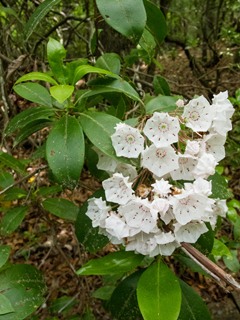
Brundage, Stephanie
Kalmia latifolia
Kalmia latifolia L.
Mountain Laurel, Calico Bush, Kalmia, Mountain-laurel
Ericaceae (Heath Family)
Synonym(s): Kalmia latifolia var. laevipes
USDA Symbol: kala
USDA Native Status: L48 (N)
The broadleaf evergreen Mountain-laurel is usually a 12-20 ft. shrub, but is occasionally taller and single-trunked, attaining small tree stature. Evergreen, many-stemmed, thicket-forming shrub or sometimes a small tree with short, crooked trunk; stout, spreading branches; a compact, rounded crown; and beautiful, large, pink flower clusters. Its flowers are very showy. They are bell-shaped, white to pink with deep rose spots inside, and occur in flat-topped clusters. The leaves are oval, leathery, and glossy, and change from light-green to dark-green to purple throughout the year.
Mountain Laurel is one of the most beautiful native flowering shrubs and is well displayed as an ornamental in many parks. The stamens of the flowers have an odd, springlike mechanism which spreads pollen when tripped by a bee. The wood has been used for tool handles and turnery, and the burls, or hard knotlike growths, for briar tobacco pipes. Linnaeus named this genus for his student Peter Kalm (1716-79), a Swedish botanist who traveled in Canada and the eastern United States.


Plant Characteristics
Duration: PerennialHabit: Shrub
Root Type: Tap
Leaf Retention: Evergreen
Leaf Complexity: Simple
Breeding System: Flowers Bisexual
Fruit Type: Capsule
Size Notes: Up to about 35 feet tall when growing as a tree. Usually shrub-like and much shorter.
Leaf: Green
Fruit: Brown
Bloom Information
Bloom Color: White , Pink , PurpleBloom Time: Apr , May , Jun , Jul
Distribution
USA: AL , CT , DC , DE , FL , GA , IN , KY , LA , MA , MD , ME , MS , NC , NH , NJ , NY , OH , PA , RI , SC , TN , VA , VT , WVCanada: ON
Native Distribution: FL Panhandle to LA, n. to N.B., s. Ont. & Ohio R. valley of IN
Native Habitat: Wet to dry woods & pastures; cool meadows & slopes
Growing Conditions
Water Use: LowLight Requirement: Part Shade
Soil Moisture: Moist
CaCO3 Tolerance: None
Soil Description: Cool, moist rocky or sandy soils.
Benefit
Warning: POISONOUS PARTS: All parts. Highly Toxic, Maybe Be Fatal if Eaten! Symptoms include: salivation, watering of eyes and nose, slow pulse, nausea, vomiting, sweating, abdominal pain, headache, tingling of skin, lack of coordination, convulsions, paralysis. Toxic Principle: Andromedotoxin, a resinoid; arbutin, a glycoside. (Poisonous Plants of N.C.)Conspicuous Flowers: yes
Attracts: Birds
Butterflies and Moths of North America (BAMONA)
|
Laurel sphinx (Sphinx kalmiae) 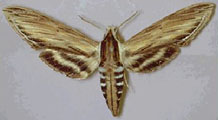 Larval Host |
Propagation
Seed Collection: Seeds are tiny and mature late.Seed Treatment: Germination is enhanced by cold-moist stratification.
Commercially Avail: yes
Find Seed or Plants
View propagation protocol from Native Plants Network.
Mr. Smarty Plants says
Flowering and evergreen shrubs for landscape in Indiana
May 29, 2010
I live in Southern Indiana and we are getting ready to redesign our front landscape. Currently, we have some yews and other shrubs that are unruly and require a lot of pruning and care. My husband hat...
view the full question and answer
Plant identfication
October 21, 2009
Hi...Can you please identfy the tall, evergreen shrub with purple plum-colored foliage that I have noticed in winter locally?...Hope so, need he color! THX
view the full question and answer
National Wetland Indicator Status
| Region: | AGCP | AK | AW | CB | EMP | GP | HI | MW | NCNE | WMVE |
| Status: | FACU | FACU | FACU | FACU |
From the National Organizations Directory
According to the species list provided by Affiliate Organizations, this plant is on display at the following locations:Native Plant Center at Westchester Community College, The - Valhalla, NY
Delaware Nature Society - Hockessin, DE
Crosby Arboretum - Picayune, MS
Mt. Cuba Center - Hockessin, DE
Bibliography
Bibref 1186 - Field Guide to Moths of Eastern North America (2005) Covell, C.V., Jr.Bibref 1185 - Field Guide to Western Butterflies (Peterson Field Guides) (1999) Opler, P.A. and A.B. Wright
Bibref 1620 - Gardening with Native Plants of the South (Reprint Edition) (2009) Wasowski, S. with A. Wasowski
Search More Titles in Bibliography
Web Reference
Webref 38 - Flora of North America (2019) Missouri Botanical Garden, St. Louis, MO & Harvard University Herbaria, Cambridge, MA.Webref 23 - Southwest Environmental Information Network (2009) SEINet - Arizona Chapter
From the Archive
Wildflower Newsletter 1988 VOL. 5, NO.2 - Researching Wildflower Seed Quality, Wildflower Center Receives $500 -000 Gift, ...Wildflower Newsletter 1992 VOL. 9, NO.1 - Research Update, Creating Native Lawn with Sod, Director's Report, What Makes Pl...
Wildflower Newsletter 1992 VOL. 9, NO.2 - Native Landscaping City Restrictions and Homeowner Association, Director's Repor...
Wildflower Newsletter 1996 VOL. 13, NO.6 - Winter Wonderland, Origins of the Christmas Tree, Development Director\\\'s Repo...
Wildflower Newsletter 1998 VOL. 15, NO.5 - Native Shrubs Providing Landscape Heritage and Habitat, Executive Director\'s Re...
Additional resources
USDA: Find Kalmia latifolia in USDA PlantsFNA: Find Kalmia latifolia in the Flora of North America (if available)
Google: Search Google for Kalmia latifolia
Metadata
Record Modified: 2023-02-15Research By: TWC Staff