Native Plants

Plant Database
Search for native plants by scientific name, common name or family. If you are not sure what you are looking for, try the Combination Search or our Recommended Species lists.
Juniperus californica
Juniperus californica Carrière
California Juniper, Desert White Cedar
Cupressaceae (Cypress Family)
Synonym(s): Juniperus cedrosiana, Juniperus cerrosianus, Juniperus pyriformis, Sabina californica
USDA Symbol: juca7
USDA Native Status: L48 (N)
A tree-like shrub, usually 10-15 ft. high, with stout, irregular stems and a broad, erect, open habit. Bark is ashy gray, foliage is bluish-gray and scale-like, and berry-like cones are bluish, turning reddish-brown.
Able to withstand heat and drought, this species extends farther down into the semidesert zone than other junipers and is important in erosion control on dry slopes. Indians used to gather the "berries" to eat fresh and to grind into meal for baking.
From the Image Gallery
No images of this plant
Plant Characteristics
Duration: PerennialHabit: Shrub
Leaf Retention: Evergreen
Leaf Arrangement: Opposite
Leaf Complexity: Simple
Breeding System: Dioecious
Inflorescence: Terminal
Fruit Type: Cone
Size Notes: Up to about 25 feet tall, often shorter.
Fruit: Berry-like cones are bluish, turning reddish-brown.
Bloom Information
Bloom Color: White , BrownBloom Time: Mar , Apr , May
Bloom Notes: Male flowers and female flowers are on separate trees. Flowers inconspicuous. Pollen cones cream to reddish brown.
Distribution
USA: AZ , CA , NVNative Distribution: Mts. of CA, s. NV & w. AZ; also Mex.
Native Habitat: Dry, alkaline slopes & flats below 5000 ft.
Growing Conditions
Light Requirement: SunSoil Moisture: Dry
Soil Description: Dry, alkaline soils.
Conditions Comments: Very ornamental and drought-tolerant.
Benefit
Use Wildlife: Provides food and shelter for a variety of wildlife.Attracts: Butterflies
Butterflies and Moths of North America (BAMONA)
|
Sequoia sphinx (Sphinx sequoiae) 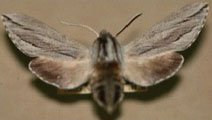 Larval Host |
Propagation
Description: Seed can be sown outdoors in fall or stratified and sown in spring. Seed germination is often poor, so a large quantity of seeds should be sown.Seed Collection: Collect seeds from late summer through fall when it has turned its ripe color. Seed can be extracted by running the fruits through a macerator. Thoroughly dry and clean seeds to avoid mold and overheating. If not planting immediately, air dry before storing. Store in sealed containers at 20-40 degrees.
Seed Treatment: Stratify at 41 degrees for 30-120 days. Germination may also be prompted with burn treatment.
Commercially Avail: yes
Find Seed or Plants
Find seed sources for this species at the Native Seed Network.
From the National Organizations Directory
According to the species list provided by Affiliate Organizations, this plant is on display at the following locations:Santa Barbara Botanic Garden - Santa Barbara, CA
Native Seed Network - Corvallis, OR
Bibliography
Bibref 1186 - Field Guide to Moths of Eastern North America (2005) Covell, C.V., Jr.Bibref 1185 - Field Guide to Western Butterflies (Peterson Field Guides) (1999) Opler, P.A. and A.B. Wright
Search More Titles in Bibliography
Web Reference
Webref 30 - Calflora (2018) CalfloraWebref 3 - Flora of North America (2014) Missouri Botanical Garden, St. Louis, MO & Harvard University Herbaria, Cambridge, MA.
Additional resources
USDA: Find Juniperus californica in USDA PlantsFNA: Find Juniperus californica in the Flora of North America (if available)
Google: Search Google for Juniperus californica
Metadata
Record Modified: 2022-10-06Research By: TWC Staff