Native Plants

Plant Database
Search for native plants by scientific name, common name or family. If you are not sure what you are looking for, try the Combination Search or our Recommended Species lists.
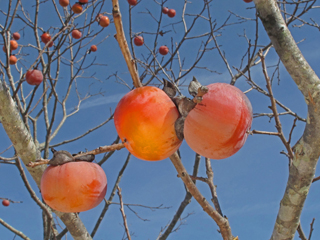
Cressler, Alan
Diospyros virginiana
Diospyros virginiana L.
Common Persimmon, Eastern Persimmon, Possumwood, Date Plum, Winter Plum, Jove's Fruit
Ebenaceae (Ebony Family)
Synonym(s): Diospyros mosieri, Diospyros virginiana var. mosieri, Diospyros virginiana var. platycarpa, Diospyros virginiana var. pubescens, Diospyros virginiana var. virginiana
USDA Symbol: divi5
USDA Native Status: L48 (N)
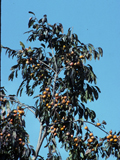
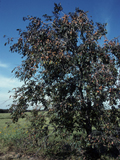
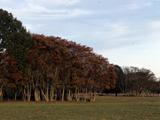
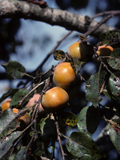
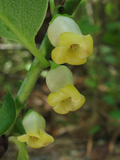
In old fields, common persimmon is a low, shrubby tree, 15 ft. tall. In rich, moist soil the species becomes a large tree, up to 100 ft. tall, with a spreading crown and pendulous branches. Bell-shaped, yellow flowers are hidden by half-grown leaves. Large, oval, mature leaves usually become yellow-green in fall. The large, orange, edible fruit attracts wildlife. On old trunks the bark is thick and dark-gray to almost black and broken into scaly, squarish blocks. Common persimmon is deciduous. Best-known by its sweet, orange fruit in autumn.
When ripe, the sweet fruit of Persimmon somewhat recalls the flavor of dates. Immature fruit contains tannin and is strongly astringent. Persimmons are consumed fresh and are used to make puddings, cakes, and beverages. American Indians made persimmon bread and stored the dried fruit like prunes. Foxes, opossums, raccoons, skunks, deer, and birds also feed on the fruit. Principal uses of the wood are for golf-club heads, shuttles for textile weaving, and furniture veneer. The word "persimmon" is of Algonquian origin, while the genus name Diospyros, from the Greek, means "fruit of the god Zeus."
Plant Characteristics
Duration: PerennialHabit: Tree
Leaf Retention: Deciduous
Breeding System: Flowers Unisexual , Dioecious
Fruit Type: Berry
Size Notes: Up to about 100 feet tall, usually much shorter.
Leaf: Dark Green
Autumn Foliage: yes
Flower: Flowers 1/2 inch
Fruit: Orange 2 inches long
Bloom Information
Bloom Color: Yellow , GreenBloom Time: Mar , Apr , May , Jun
Distribution
USA: AL , AR , CT , DC , DE , FL , GA , IA , IL , IN , KS , KY , LA , MA , MD , MO , MS , NC , NE , NJ , NY , OH , OK , PA , SC , TN , TX , UT , VA , WVNative Distribution: FL to e. TX, n. to CT, s. IN, s. IA & e. KS
Native Habitat: Dry woods; old fields; clearings
Growing Conditions
Water Use: MediumLight Requirement: Part Shade
Soil Moisture: Dry
CaCO3 Tolerance: None
Soil Description: Varibable, growing best in moist, rich soil. Sandy, Sandy Loam, Medium Loam, Clay Loam, Clay, Acid-based, Calcareous.
Conditions Comments: This tree is valued for its fruit and attraction to wildlife. Two trees are necessary for the production of fruit. Fruit is not edible until exposed to frost or consistent low temperatures. Persimmon is adaptable to varying pH and soil moisture regimes and is usually free of disease or insect problems. Because of a deep root system, successful underplanting is possible.
Benefit
Use Ornamental: Aromatic, Understory tree, Accent tree or shrub, Erosion control, Fall conspicuousUse Wildlife: The fruit attracts a variety of wildlife. Fruit-birds, Fruit-mammals, Browse
Use Food: Deliciously sweet when ripe, these persimmons were the native fruits most prized by indigenous people of the Southeast.
Interesting Foliage: yes
Attracts: Birds
Value to Beneficial Insects
Special Value to Honey BeesThis information was provided by the Pollinator Program at The Xerces Society for Invertebrate Conservation.
Butterflies and Moths of North America (BAMONA)
|
Luna moth (Actias luna) 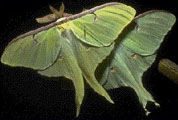 Adult Food Source |
Propagation
Propagation Material: Root CuttingsDescription: Germinates easily from stratified seeds; seedling grow slowly. Bury root cuttings in moist sand over winter and lift when shoot is well developed. Difficult to transplant because of a deep, coarse root system. This plant may be grafted like other frui
Seed Collection: Fruit ripens to bright orange in late Septemter to November. Clean fruit immediately to prevent mold and fermentation. Air-dry seeds and store in sealed, refrigerated containers.
Seed Treatment: Stratify seeds in moist peat for 30-60 days at 36-41 degrees. Scarification does not seem to improve germination but clipping the caps can result in higher germination by encouraging radicle emergence.
Commercially Avail: yes
Find Seed or Plants
View propagation protocol from Native Plants Network.
Mr. Smarty Plants says
Edible Plants for North Georgia
January 10, 2010
We are planning a forest food garden in the hollers of the N GA Mountains.
Which edible fruit, nut, berry, herb and creepers would be best for this reddish, clay-like soil? The food garden is in...
view the full question and answer
Edible plants native to Austin, TX
August 05, 2009
Hello,
I am a chef from Buenos Aires Argentina visiting Austin, Texas and would like to learn about native, edible plants in the region.
Please let me know if there are any native, edible plants...
view the full question and answer
Fruit trees for South Austin.
January 25, 2008
I live in South, South Austin, just a pinch West of 35 near 1626. I would like to plant some fruit trees in the back yard. Anyone will sell fruit trees, but they don't always grow. What fruiting var...
view the full question and answer
National Wetland Indicator Status
| Region: | AGCP | AK | AW | CB | EMP | GP | HI | MW | NCNE | WMVE |
| Status: | FAC | FAC | FAC | FAC | FAC | FAC | FACU |
From the National Organizations Directory
According to the species list provided by Affiliate Organizations, this plant is on display at the following locations:Pineywoods Native Plant Center - Nacogdoches, TX
Delaware Nature Society - Hockessin, DE
Crosby Arboretum - Picayune, MS
Stengl Biological Research Station - Smithville, TX
Texas Parks and Wildlife Department - Austin, TX
Jacob's Well Natural Area - Wimberley, TX
Mt. Cuba Center - Hockessin, DE
Wellspring Organic Farm and Education Center - West Bend, WI
Bibliography
Bibref 1186 - Field Guide to Moths of Eastern North America (2005) Covell, C.V., Jr.Bibref 298 - Field Guide to Texas Trees (1999) Simpson, B.J.
Bibref 1185 - Field Guide to Western Butterflies (Peterson Field Guides) (1999) Opler, P.A. and A.B. Wright
Bibref 1620 - Gardening with Native Plants of the South (Reprint Edition) (2009) Wasowski, S. with A. Wasowski
Bibref 841 - Native Alternatives to Invasive Plants (2006) Burrell, C. C.
Bibref 318 - Native Texas Plants: Landscaping Region by Region (2002) Wasowski, S. & A. Wasowski
Bibref 291 - Texas Wildscapes: Gardening for Wildlife (1999) Damude, N. & K.C. Bender
Bibref 1243 - The Southeastern Indians (1976) Hudson, Charles
Bibref 297 - Trees of Central Texas (1984) Vines, Robert A.
Search More Titles in Bibliography
Web Reference
Webref 3 - Flora of North America (2014) Missouri Botanical Garden, St. Louis, MO & Harvard University Herbaria, Cambridge, MA.Additional resources
USDA: Find Diospyros virginiana in USDA PlantsFNA: Find Diospyros virginiana in the Flora of North America (if available)
Google: Search Google for Diospyros virginiana
Metadata
Record Modified: 2023-03-30Research By: TWC Staff