Native Plants

Plant Database
Search for native plants by scientific name, common name or family. If you are not sure what you are looking for, try the Combination Search or our Recommended Species lists.
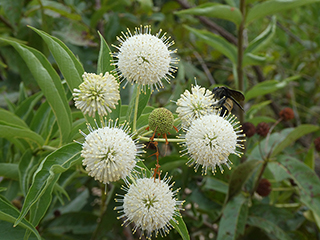
Page, Lee
Cephalanthus occidentalis
Cephalanthus occidentalis L.
Common Buttonbush, Buttonbush, Button Willow, Honey Bells, Honeybells, Honey Balls, Honeyballs, Button-bush
Rubiaceae (Madder Family)
Synonym(s): Cephalanthus occidentalis var. californicus, Cephalanthus occidentalis var. pubescens
USDA Symbol: ceoc2
USDA Native Status: L48 (N), CAN (N)
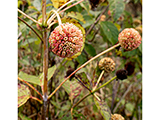
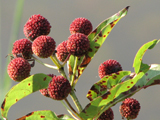
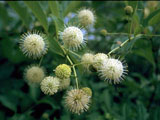
Common buttonbush is a multi-stemmed shrub which grows 6-12 ft. or occasionally taller. Leaves in pairs or in threes, petiolate; blade up to 8 inches long, ovate to narrower, sometimes 1/3 or less as wide as long, with a pointed tip and rounded to tapered base, smooth margins and glossy upper surface, lower surface duller. Glossy, dark-green leaves lack significant fall color. Flowers small, borne in distinctive, dense, spherical clusters (heads) with a fringe of pistils protruded beyond the white corollas. Long-lasting, unusual blossoms are white or pale-pink, one-inch globes. Subsequent rounded masses of nutlets persist through the winter. Trunks are often twisted. Spreading, much-branched shrub or sometimes small tree with many branches (often crooked and leaning), irregular crown, balls of white flowers resembling pincushions, and buttonlike balls of fruit.
Buttonbush is a handsome ornamental suited to wet soils and is also a honey plant. Ducks and other water birds and shorebirds consume the seeds.
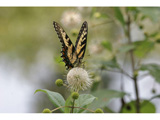
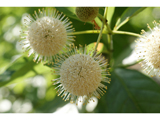
Plant Characteristics
Duration: PerennialHabit: Shrub
Leaf Retention: Deciduous
Leaf Complexity: Simple
Fruit Type: Nut
Size Notes: Up to about 12 feet tall.
Leaf: Green
Autumn Foliage: yes
Fruit: Brown, rounded ball of nutlets.
Bloom Information
Bloom Color: White , PinkBloom Time: Jun , Jul , Aug , Sep
Distribution
USA: AL , AR , AZ , CA , CT , DC , DE , FL , GA , IA , IL , IN , KS , KY , LA , MA , MD , ME , MI , MN , MO , MS , NC , NE , NH , NJ , NY , OH , OK , PA , RI , SC , TN , TX , VA , VT , WI , WVCanada: NB , NS , ON , PE , QC
Native Distribution: N.B. & Que. to upper Mississippi R. Valley, e. NE & e. KS, s. to FL & TX
Native Habitat: In swamps, around ponds and margins of streams throughout the state. Sand, loam, clay, limestone; moist, poor drainage or standing water okay. Prairie swales; lake, marsh, creek & swamp margins; dry, limestone bluffs
Growing Conditions
Water Use: HighLight Requirement: Part Shade , Shade
Soil Moisture: Moist , Wet
Soil pH: Circumneutral (pH 6.8-7.2)
CaCO3 Tolerance: Medium
Cold Tolerant: yes
Soil Description: Limestone-based, Sandy, Sandy Loam, Medium Loam, Clay Loam, Clay
Conditions Comments: Common buttonbush is a spreading, multi-branched shrub or sometimes small tree with many branches (often crooked and leaning), irregular crown, balls of white flowers resembling pincushions, and buttonlike balls of fruit. Buttonbush is a handsome ornamental suited to wet soils and is also a honey plant. Ducks and other water birds and shorebirds consume the seeds.
Benefit
Use Ornamental: Showy, Attractive, Blooms ornamental, Fruits ornamental, Bog or pond area, Aromatic, Water gardenUse Wildlife: Nectar-butterflies, Nectar-bees, Nectar-insects, Fruit-birds
Warning: The poisonous foliage of this abundant and widespread species is unpalatable to livestock. The bitter bark has served in home remedies, but its medicinal value is doubtful.
Conspicuous Flowers: yes
Fragrant Flowers: yes
Attracts: Birds , Butterflies
Nectar Source: yes
Deer Resistant: Moderate
Value to Beneficial Insects
Special Value to Native BeesSpecial Value to Bumble Bees
Special Value to Honey Bees
This information was provided by the Pollinator Program at The Xerces Society for Invertebrate Conservation.
Butterflies and Moths of North America (BAMONA)
|
Titan sphinx (Aellopos titan) 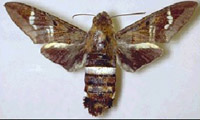 Adult Food Source |
Hydrangea sphinx (Darapsa versicolor) 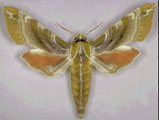 Adult Food Source |
Propagation
Propagation Material: SeedsDescription: Sow fresh, untreated seed.
Seed Collection: Gather seeds in late summer or early fall before the heads dry and fall apart.
Seed Treatment: No special treatment necessary.
Commercially Avail: yes
Find Seed or Plants
Order seed of this species from Native American Seed and help support the Wildflower Center.
Find seed sources for this species at the Native Seed Network.
View propagation protocol from Native Plants Network.
National Wetland Indicator Status
| Region: | AGCP | AK | AW | CB | EMP | GP | HI | MW | NCNE | WMVE |
| Status: | OBL | OBL | OBL | OBL | OBL | OBL | OBL |
From the National Organizations Directory
According to the species list provided by Affiliate Organizations, this plant is on display at the following locations:Fredericksburg Nature Center - Fredericksburg, TX
Lady Bird Johnson Wildflower Center - Austin, TX
Santa Barbara Botanic Garden - Santa Barbara, CA
Texas Discovery Gardens - Dallas, TX
Sibley Nature Center - Midland, TX
Delaware Nature Society - Hockessin, DE
Crosby Arboretum - Picayune, MS
Nueces River Authority - Uvalde, TX
Stengl Biological Research Station - Smithville, TX
Texas Parks and Wildlife Department - Austin, TX
NPSOT - Fredericksburg Chapter - Fredericksburg, TX
Georgia Native Plant Society - Atlanta, GA
NPSOT - Austin Chapter - Austin, TX
Native Seed Network - Corvallis, OR
Jacob's Well Natural Area - Wimberley, TX
NPSOT - Williamson County Chapter - Georgetown, TX
Mt. Cuba Center - Hockessin, DE
Wildflower Center Seed Bank
LBJWC-658 Collected 2008-07-02 in Burnet County by Lady Bird Johnson Wildflower CenterBibliography
Bibref 1186 - Field Guide to Moths of Eastern North America (2005) Covell, C.V., Jr.Bibref 1185 - Field Guide to Western Butterflies (Peterson Field Guides) (1999) Opler, P.A. and A.B. Wright
Bibref 355 - Landscaping with Native Plants of Texas and the Southwest (1991) Miller, G. O.
Bibref 354 - Native & Naturalized Woody Plants of Austin & the Hill Country (1981) Lynch, D.
Bibref 841 - Native Alternatives to Invasive Plants (2006) Burrell, C. C.
Bibref 318 - Native Texas Plants: Landscaping Region by Region (2002) Wasowski, S. & A. Wasowski
Bibref 248 - Texas Wildflowers: A Field Guide (1984) Loughmiller, C. & L. Loughmiller
Bibref 291 - Texas Wildscapes: Gardening for Wildlife (1999) Damude, N. & K.C. Bender
Bibref 1294 - The Midwestern Native Garden: Native Alternatives to Nonnative Flowers and Plants An Illustrated Guide (2011) Adelman, Charlotte and Schwartz, Bernard L.
Bibref 297 - Trees of Central Texas (1984) Vines, Robert A.
Bibref 286 - Wildflowers of the Texas Hill Country (1989) Enquist, M.
Search More Titles in Bibliography
Web Reference
Webref 23 - Southwest Environmental Information Network (2009) SEINet - Arizona ChapterResearch Literature
Reslit 168 - Baseline floristic assessment and classification of pine barrens vernal ponds (2009) J. T. Bried and G. J. EdingerReslit 655 - Nutrient uptake and growth response of six wetland/riparian plant species receiving swine lagoon effluent (1999) R. K. Hubbard, J. M. Ruter, G. L. Newton and J. G....
Reslit 755 - Ozone sensitivity of 28 plant selections exposed to ozone under controlled conditions (2008) L. J. Kline, D. D. Davis, J. M. Skelly, J. E. Sava...
Reslit 904 - Flood and salinity stress of wetland woody species, buttonbush (Cephalanthus occidentalis) and swamp Tupelo (Nyssa sylvatica var. biflora) (1998) J. K. McCarron, K. W. McLeod and W. H. Conner
Reslit 933 - Soil seed banks and the potential restoration of forested wetlands after farming (2003) B. A. Middleton
Reslit 934 - Effects of Hurricane Katrina on the Forest Structure of Taxodium Distichum Swamps of the Gulf Coast, USA (2009) B. A. Middleton
Reslit 957 - Nursery production techniques for obligate wetland species (2006) K. K. Moore, L. Fisher and D. L. Sutton
Reslit 1288 - Bottomland hardwood forest species responses to flooding regimes along an urbanization gradient (2007) M. E. Simmons, X. B. Wu and S. G. Whisenant
Reslit 1926 - A new species of Mompha Hubner (Lepidoptera : Coleophoridae : Momphinae) from buttonbush (Cephalanthus occidentalis L.) with descriptions of the early stages (2004) D. L. Wagner, D. Adamski and R. L. Brown
Reslit 2379 - Protandry, Incompatibility, and Secondary Pollen Presentation in Cephalanthus occidentalis (Rubiaceae) (1993) F. M. Imbert and J. H. Richards
This information was provided by the Florida WIldflower Foundation.
Search More Titles in Research Literature
Additional resources
USDA: Find Cephalanthus occidentalis in USDA PlantsFNA: Find Cephalanthus occidentalis in the Flora of North America (if available)
Google: Search Google for Cephalanthus occidentalis
Metadata
Record Modified: 2023-05-15Research By: TWC Staff