Native Plants

Plant Database
Search for native plants by scientific name, common name or family. If you are not sure what you are looking for, try the Combination Search or our Recommended Species lists.
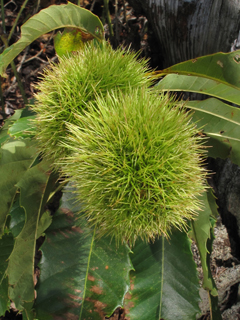
Cressler, Alan
Castanea pumila
Castanea pumila (L.) Mill.
Allegheny Chinquapin, Allegheny Chinkapin, Chinquapin, Chinkapin
Fagaceae (Beech Family)
Synonym(s):
USDA Symbol: capu9
USDA Native Status: L48 (N)
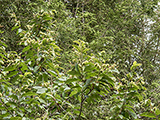
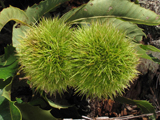
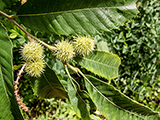
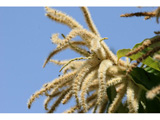
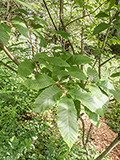
Tree or large, thicket-forming shrub to 30 ft, or taller. Single- or multi-trunked with horizontal lower branches, ascending in upper crown. Glossy, dark green, toothed leaves turn yellowish or purple in fall. Flower is a long, pencil-like, pale yellow spike and the fruit is a nut enclosed in a prickly, bur-like husk.
Captain John Smith published the first record of this nut in 1612: "They [Native Americans] have a small fruit growing on little trees, husked like a Chestnut, but the fruit most like a very small acorne. This they call Checkinquamins, which they esteem a great daintie."
Plant Characteristics
Duration: PerennialHabit: Shrub
Leaf Retention: Deciduous
Leaf Arrangement: Alternate
Leaf Complexity: Simple
Leaf Venation: Pinnate
Breeding System: Flowers Unisexual , Monoecious
Fruit Type: Nut
Size Notes: Up to about 50 feet tall, often much shorter.
Autumn Foliage: yes
Fruit: Brown
Bloom Information
Bloom Color: WhiteBloom Time: Mar , Apr , May , Jun
Distribution
USA: AL , AR , DC , DE , FL , GA , IN , KY , LA , MA , MD , MO , MS , NC , NJ , NY , OH , OK , PA , SC , TN , TX , VA , WVNative Distribution: S. NJ to GA, w. to s.e. OK & e. TX
Native Habitat: Sandy, open, dry woods & thickets
Growing Conditions
Water Use: LowLight Requirement: Part Shade
Soil Moisture: Dry
Soil pH: Acidic (pH<6.8)
Soil Description: Sandy, well-drained soils. Sandy, Sandy Loam
Conditions Comments: Produces a sweet nut. Susceptible to chestnut blight.
Benefit
Use Ornamental: Attractive, Blooms ornamental, AromaticUse Wildlife: Seeds are a favorite food of deer, squirrels, and other animals. Nectar-insects, Fruit-mammals, Fruit-birds
Use Food: The edible nuts were a favorite of indigenous people.
Conspicuous Flowers: yes
Butterflies and Moths of North America (BAMONA)
|
Orange-tipped oakworm moth (Anisota senatoria) 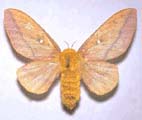 Larval Host |
Propagation
Description: Germination of seeds requires fall sowing or stratification. Remove husks before sowing. Cuttings should be made from juvenile wood.Seed Collection: Collect the ripe burs of husks as they begin to dry but before they split. Seeds are mature when firm, filled out, and glossy brown.
Seed Treatment: Stratification for 30-60 days at 41 degrees.
Commercially Avail: yes
Mr. Smarty Plants says
Edible Plants for North Georgia
January 10, 2010
We are planning a forest food garden in the hollers of the N GA Mountains.
Which edible fruit, nut, berry, herb and creepers would be best for this reddish, clay-like soil? The food garden is in...
view the full question and answer
Non-toxic shade trees for horses in Florida
April 01, 2009
Looking for non poisonous shade trees for pasture with horses. Would prefer flowering or something that changes color. Thank you.
view the full question and answer
From the National Organizations Directory
According to the species list provided by Affiliate Organizations, this plant is on display at the following locations:Crosby Arboretum - Picayune, MS
Mt. Cuba Center - Hockessin, DE
Bibliography
Bibref 1186 - Field Guide to Moths of Eastern North America (2005) Covell, C.V., Jr.Bibref 298 - Field Guide to Texas Trees (1999) Simpson, B.J.
Bibref 1185 - Field Guide to Western Butterflies (Peterson Field Guides) (1999) Opler, P.A. and A.B. Wright
Bibref 1243 - The Southeastern Indians (1976) Hudson, Charles
Search More Titles in Bibliography
Web Reference
Webref 3 - Flora of North America (2014) Missouri Botanical Garden, St. Louis, MO & Harvard University Herbaria, Cambridge, MA.Research Literature
Reslit 472 - Allozyme variation in endangered Castanea pumila var. pumila (2003) Y. Q. Fu and F. DaneReslit 319 - Intercontinental genetic divergence of Castanea species in eastern Asia and eastern North America (2003) F. Dane, P. Lang, H. Huang and Y. Fu
Reslit 317 - Genetic variation and population structure of Castanea pumila var. ozarkensis (1999) F. Dane, L. K. Hawkins and H. W. Huang
Reslit 318 - Short note: Variability and inheritance of diaphorases in American and Chinese Castanea species (2002) F. Dane and H. Huag
Reslit 794 - Molecular evidence for an Asian origin and a unique westward migration of species in the genus Castanea via Europe to North America (2007) P. Lang, F. Dane, T. L. Kubisiak and H. W. Huang
Reslit 1265 - Comparison of total lipids, fatty acids, sugars and nonvolatile organic acids in nuts from four Castanea species (1994) S. D. Senter, J. A. Payne, G. Miller and S. L. Ana...
Reslit 2000 - Castanea pumila (L) Mill - an Underused Native Nut Tree (1994) J. A. Payne, G. Miller, G. P. Johnson and S. D. Se...
Reslit 2092 - A New Species of Harmandia (Diptera, Cecidomyiidae) Damaging Leaves of Allegheny Chinkapin in Eastern United-States and a Redescription of the Genus (1992) R. J. Gagne and J. A. Payne
Reslit 2250 - Growth Form and Life Histories of American Chestnut and Allegheny and Ozark Chinquapin at Various North American Sites (1993) F. L. Paillet
This information was provided by the Florida WIldflower Foundation.
Search More Titles in Research Literature
Additional resources
USDA: Find Castanea pumila in USDA PlantsFNA: Find Castanea pumila in the Flora of North America (if available)
Google: Search Google for Castanea pumila
Metadata
Record Modified: 2022-10-03Research By: TWC Staff