Native Plants

Plant Database
Search for native plants by scientific name, common name or family. If you are not sure what you are looking for, try the Combination Search or our Recommended Species lists.
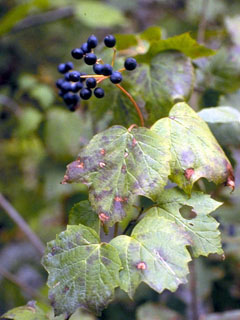
Vick, Albert F. W.
Viburnum acerifolium
Viburnum acerifolium L.
Mapleleaf Viburnum, Maple-leaf Viburnum, Maple-leaf Arrowwood, Arrowwood
Caprifoliaceae (Honeysuckle Family)
Synonym(s): Viburnum acerifolium var. acerifolium, Viburnum acerifolium var. densiflorum, Viburnum acerifolium var. glabrescens, Viburnum acerifolium var. ovatum, Viburnum densiflorum
USDA Symbol: VIAC
USDA Native Status: L48 (N), CAN (N)
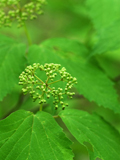
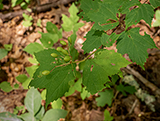
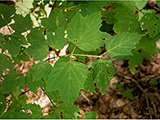
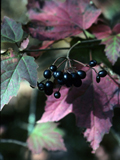
Maple-leaf arrow-wood is a low, densely branched shrub, 4-6 ft. tall and 3-4 ft. wide. Flat-topped clusters of white flowers are followed by berries turning from red to blue-black. Bright- to dark-green, deciduous foliage, maple-like in shape, is very colorful in fall. A shrub with maple-like leaves and small, white flowers or uniform size in flat topped clusters.
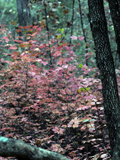
The distinctive, purplish-pink autumn foliage makes this one of our handsomest shrubs. Another native Viburnum with 3-lobed leaves, Cranberry Viburnum (V. opulus var. americanum), has large, showy, white, sterile outer flowers in each cluster and in late summer and autumn bears red fruits suitable for jam. Few-flowered Cranberry Bush (V. edule), with red fruit and only slightly lobed leaves, occurs at high elevations in the Northeast, extending far north into Canada.
Plant Characteristics
Duration: PerennialHabit: Shrub
Leaf Retention: Deciduous
Leaf Arrangement: Opposite
Leaf Complexity: Simple
Leaf Venation: Palmate
Leaf Margin: Dentate
Fruit Type: Drupe
Size Notes: Dense clumps up to about 6 feet tall.
Leaf: Green above, pale below.
Autumn Foliage: yes
Flower: Flower 1 1/2 to 3 inches across
Fruit: Red turning purple or black.
Bloom Information
Bloom Color: WhiteBloom Time: Apr , May , Jun , Jul , Aug
Distribution
USA: AL , AR , CT , DC , DE , FL , GA , IL , IN , KY , LA , MA , MD , ME , MI , MS , NC , NH , NJ , NY , OH , PA , RI , SC , TN , TX , VA , VT , WI , WVCanada: NB , ON , QC
Native Distribution: N.B. to Upper Peninsula MI, s. to FL & TX
Native Habitat: Thickets, Shaded woods. Mesic, mixed woods; bluffs; ravines
Growing Conditions
Water Use: MediumLight Requirement: Sun , Part Shade , Shade
Soil Moisture: Dry , Moist
Soil pH: Acidic (pH<6.8)
Drought Tolerance: High
Soil Description: Dry, rocky soils. Sandy, Sandy Loam, Medium Loam, Clay Loam, Clay, Acid-based
Conditions Comments: Suckers profusely to form large, loose, open colonies. Susceptible to Viburnum Leaf Beetle.
Benefit
Use Ornamental: Color, Blooms ornamental, Fruits ornamental, Fall conspicuous, Accent tree or shrubUse Wildlife: Birds eat the blue berries. Nectar-bees, Nectar-butterflies, Nectar-insects, Browse, Fruit-birds
Conspicuous Flowers: yes
Attracts: Birds , Butterflies
Larval Host: Spring Azure
Butterflies and Moths of North America (BAMONA)
|
Spring Azure (Celastrina "ladon" ) 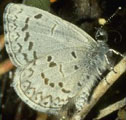 Larval Host |
Propagation
Seed Collection: Collect the fruit as soon as it has turned a dark blue-black color. Store seeds with pulp on at 41 degrees.Seed Treatment: If seeds must be stored, they will need a period of stratification.
Commercially Avail: yes
Find Seed or Plants
View propagation protocol from Native Plants Network.
Mr. Smarty Plants says
Native plant to replace invasive non-native nandina in Houston
February 28, 2010
I'm just now finding out that Nandinas are an invasive species from our local chapter of the Native Plant Society of Texas. I have three of them in my front yard and want to replace them. Can you sug...
view the full question and answer
National Wetland Indicator Status
| Region: | AGCP | AK | AW | CB | EMP | GP | HI | MW | NCNE | WMVE |
| Status: | FACU | UPL | UPL | UPL | UPL |
From the National Organizations Directory
According to the species list provided by Affiliate Organizations, this plant is on display at the following locations:Delaware Nature Society - Hockessin, DE
Texas Parks and Wildlife Department - Austin, TX
Georgia Native Plant Society - Atlanta, GA
Mt. Cuba Center - Hockessin, DE
Bibliography
Bibref 1186 - Field Guide to Moths of Eastern North America (2005) Covell, C.V., Jr.Bibref 1185 - Field Guide to Western Butterflies (Peterson Field Guides) (1999) Opler, P.A. and A.B. Wright
Bibref 1620 - Gardening with Native Plants of the South (Reprint Edition) (2009) Wasowski, S. with A. Wasowski
Bibref 841 - Native Alternatives to Invasive Plants (2006) Burrell, C. C.
Bibref 318 - Native Texas Plants: Landscaping Region by Region (2002) Wasowski, S. & A. Wasowski
Bibref 291 - Texas Wildscapes: Gardening for Wildlife (1999) Damude, N. & K.C. Bender
Search More Titles in Bibliography
Additional resources
USDA: Find Viburnum acerifolium in USDA PlantsFNA: Find Viburnum acerifolium in the Flora of North America (if available)
Google: Search Google for Viburnum acerifolium
Metadata
Record Modified: 2016-03-04Research By: TWC Staff