Native Plants

Plant Database
Search for native plants by scientific name, common name or family. If you are not sure what you are looking for, try the Combination Search or our Recommended Species lists.
Reveal, James L.
Typha latifolia
Typha latifolia L.
Broadleaf Cattail, Common Cattail
Typhaceae (Cat-Tail Family)
Synonym(s):
USDA Symbol: TYLA
USDA Native Status: L48 (N), AK (N), HI (I), CAN (N)
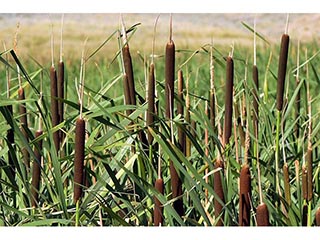
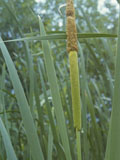
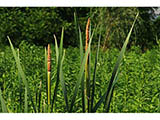
A stout-stemmed perennial, 4-10 ft. tall, often in found dense clumps. Broad linear leaf blades. The dense, brown, cylindrical flowering spike persist through autumn before becoming a downy mass of white. This tall, stiff plant bears a yellowish, club-like spike of tiny, male flowers extending directly above a brownish cylinder of female flowers.
By its creeping rootstocks, this typical marsh perennial forms dense stands in shallow water and provides a favorable habitat for red-winged blackbirds, as well as other marsh birds, and muskrats. The latter can cause extensive "eat outs," creating areas of open water in the marsh. The rootstock is mostly starch and edible; it was ground into meal by Native Americans, and the early colonists also used it for food. The young shoots can be eaten like asparagus, the immature flower spikes can be boiled and eaten like corn on the cob, and the sprouts at the tip of the rootstock can be used in salads or boiled and served as greens. The closely related Narrowleaf Cattail (T. angustifolia) has narrower leaves, up to 1/2 of an inch (1.3 cm) across, a narrower fruiting head, less than 3/4 of an inch (2 cm) wide, and a gap between the male and female flower clusters. Cattails are monoecious, which means that both male and female flowers appear on the same plant. The male flowers are at the top of the plant with the female part just below.

Plant Characteristics
Duration: PerennialHabit: Grass/Grass-like
Leaf Retention: Evergreen
Leaf Complexity: Simple
Leaf Shape: Linear
Leaf Venation: Parallel
Breeding System: Flowers Unisexual , Monoecious
Fruit Type: Follicle
Size Notes: Growing in dense, grassy mats, cattails reach a usual height of 7 feet, but may be up to about 10 feet. Stems are tall, erect and unbranched.
Leaf: Green
Bloom Information
Bloom Color: Yellow , Green , BrownBloom Time: Mar , Apr , May , Jun , Jul , Aug
Bloom Notes: In early spring, the male, staminate flowers appear above the female, pistillate flowers on the same stalk. The female flowers produce long hairs that easily catch and hold the wind-borne pollen. After pollination, the staminate portion of the stalk disintegrates, leaving behind the “cattail” with which we are most familiar.
Distribution
USA: AK , AL , AR , AZ , CA , CO , CT , DC , DE , FL , GA , HI , IA , ID , IL , IN , KS , KY , LA , MA , MD , ME , MI , MN , MO , MS , MT , NC , ND , NE , NH , NJ , NM , NV , NY , OH , OK , OR , PA , RI , SC , SD , TN , TX , UT , VA , VT , WA , WI , WV , WYCanada: BC , NB , NL , NS , ON , PE
Native Distribution: Native to almost all of the Americas, Africa, and western Eurasia
Native Habitat: Cattails are considered a sign of a transitional environment because they grow where land is changing from a wet to dry habitat. Creating dense monocultures, their aggressive behavior often requires management much like weeds. Cattails occur in freshwater wetlands, from sea level to 7,000 ft, usually in water not greater than 8” deep. They can also survive in constantly damp soil without standing water. Where most plants are concerned with getting enough water, cattails face the unusual challenge of getting enough oxygen. This plant has creatively evolved leaves with large air vessels that transfer the needed oxygen to the submerged rhizome.
Growing Conditions
Water Use: HighLight Requirement: Sun , Part Shade
Soil Moisture: Wet
CaCO3 Tolerance: Medium
Aquatic: yes
Soil Description: Rich, wet soils. Mud, Saline tolerant
Conditions Comments: Many people have clear memories as a child, playing with the fluff of a Cat-tail. You can grow them in a pond or container that does not drain and the flowers look stunning in flower arrangements. Caution: Cat-tails have a tendency to take over wetlands. They are easiest to control in a small pond or container. Starchy roots have been a staple food for people in the past. Good for wetland gardens and habitats.
Benefit
Use Ornamental: Water garden, Bog or pond area. Cattails can be used as an accent plant or for a thick privacy screen. Since cattails are aggressive they make great container plants when planted one per 12- to 19- inch pot. Blooming from March through May, cattails offer a unique flower perfect for dried arrangements.Use Wildlife: Cattails provide nesting sites for red-winged blackbirds, ducks, geese and fish. Nutria, muskrats and beavers enjoy the shoots and roots, while teal ducks, finches and least bitterns eat the seeds.
Use Food: Historically, many parts of the cattail have been eaten and used in a variety of ways. References to them appear in written records dating to the 1600’s, and it is known they were found in caves in Ohio dating 800-1400 A.D. The rootstock is mostly starch and edible; it ws ground into meal by First Nations, and the early colonists also used it for food. The young shoots can be eaten like asparagus, the immature flower spikes can be boiled and eaten like corn on the cob, and the sprouts at the tip of the rootstock can be used in salads or boiled and served as greens. Cattail pollen can also be used as a flour substitute in bread making, and was additionally used in Native American religious ceremonies.
Use Medicinal: Amerindians poulticed jelly-like pounded roots on wounds, sores, boils, carbuncles, inflammations, scalds, burns. Fuzz from mature female flower heads applied to scalds, burns and to prevent chafing in babies. Young flower heads eaten for diarrhea. Roots infused in mild for dysentery and diarrhea. (Foster & Duke) Down used as a dressing to pack burns. (Weiner) The Omaha tribe pulverized the root to form a paste used to heal burns, then covered the paste with the cattail flowers, while the Cheyenne took the powdered root for abdominal cramps.
Use Other: Used as padding for bedding, pillows & diapers. (Weiner) During World War II, the water-repellent and buoyant seeds were used by the U.S. Navy as substitute for kapok filler in life vests. Native Americans have used the feathery seeds for baby beds. When mixed with ash and lime, the seeds form cement that is reported to be harder than marble. For more than 10,000 years cattail leaves have provided Native Americans with a source for thatched roofs, woven floor mats and sandals. Leaves were twisted into rings and used under a collar to keep a horse’s neck from being injured. The stems produce a substance used as an adhesive. The Menomini and Meskwaki peoples used the root as a caulk to seal leaks in their boats.
Conspicuous Flowers: yes
Interesting Foliage: yes
Attracts: Birds
Deer Resistant: High
Propagation
Propagation Material: Root Division , SeedsDescription: Cattails naturally increase their numbers through seed dispersal and rhizome reproduction. Each fragmented piece of rhizome contains nodes that are able to send up new shoots because of the vast quantity of starch stored in the rhizome. They are considered very easy to establish.
Find Seed or Plants
Find seed sources for this species at the Native Seed Network.
National Wetland Indicator Status
| Region: | AGCP | AK | AW | CB | EMP | GP | HI | MW | NCNE | WMVE |
| Status: | OBL | OBL | OBL | OBL | OBL | OBL | OBL | OBL | OBL |
From the National Organizations Directory
According to the species list provided by Affiliate Organizations, this plant is on display at the following locations:Sibley Nature Center - Midland, TX
Brackenridge Field Laboratory - Austin, TX
Native Seed Network - Corvallis, OR
Jacob's Well Natural Area - Wimberley, TX
Herbarium Specimen(s)
NPSOT 0553A Collected Jun 25, 1988 in Bexar County by Harry CliffeNPSOT 0553B Collected Jun 25, 1988 in Bexar County by Harry Cliffe
NPSOT 0553C Collected Jun 25, 1988 in Bexar County by Harry Cliffe
Wildflower Center Seed Bank
LBJWC-605 Collected 2007-10-02 in Travis County by Lady Bird Johnson Wildflower CenterBibliography
Bibref 1207 - Earth Medicine, Earth Food (1990) Michael A. WeinerBibref 307 - Edible and Useful Plants of Texas and the Southwest: Including recipes, harmful plants, natural dyes, and textile fibers: A Practical Guide (1999) Tull, D.
Bibref 1000 - Field Guide to Edible Wild Plants: Eastern and Central North America (1982) Peterson, L.
Bibref 417 - Field Guide to Medicinal Plants and Herbs of Eastern and Central North America (2000) Foster, S. & J. A. Duke
Bibref 52 - Medicinal and other uses of North American plants : a historical survey with special reference to the eastern Indian tribes (1989) Erichson-Brown, C.
Bibref 318 - Native Texas Plants: Landscaping Region by Region (2002) Wasowski, S. & A. Wasowski
Search More Titles in Bibliography
Web Reference
Webref 38 - Flora of North America (2019) Missouri Botanical Garden, St. Louis, MO & Harvard University Herbaria, Cambridge, MA.From the Archive
Wildflower Newsletter 1988 VOL. 5, NO.5 - Penny Campaign Grows Oklahoma Wildflowers, Wildflower Center Collects Honors, Di...Wildflower Newsletter 1995 VOL. 12, NO.4 - The Natural Landscape Movement Comes of Age, Information and Clearinghouse, Exec...
Additional resources
USDA: Find Typha latifolia in USDA PlantsFNA: Find Typha latifolia in the Flora of North America (if available)
Google: Search Google for Typha latifolia
Metadata
Record Modified: 2023-05-23Research By: LAL, GAP, DEW