Native Plants

Plant Database
Search for native plants by scientific name, common name or family. If you are not sure what you are looking for, try the Combination Search or our Recommended Species lists.
Flaigg, Norman G.
Sapindus saponaria var. drummondii
Sapindus saponaria L. var. drummondii (Hook. & Arn.) L.D. Benson
Western Soapberry, Soapberry, Wild China Tree, Wild Chinaberry, Indian Soap Plant, Jaboncillo
Sapindaceae (Soapberry Family)
Synonym(s): Sapindus drummondii
USDA Symbol: SASAD
USDA Native Status: L48 (N)
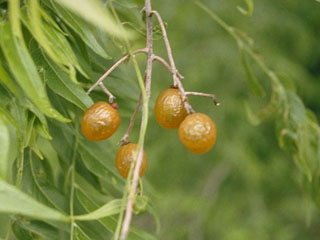
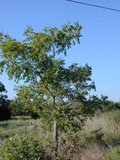
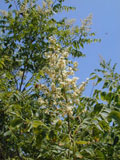
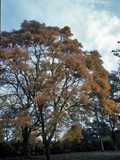
Soapberry is a single-stemmed, low-branched, round-crowned tree, growing 10-50 ft. tall, depending on habitat. Gray, sculpted bark is distinctive in the dormant season. Leaves up to 18 inches long with a central axis and as many as 24 paired leaflets, usually fewer, and often no terminal leaflet. Leaflets unsymmetric with the broader part of the blade toward the leaf tip and the base rounded on the broader side and tapering on the narrower side. Leaflet tip elongate. Flowers in large, cream colored clusters up to 10 inches long and 6 inches wide, appearing in May and early June. Fruit fleshy, globose, about 1/2 inch wide, flesh translucent, yellow turning darker with age, sometimes persistent on the tree until the next flowering season.
The poisonous fruit, containing the alkaloid saponin, has been used as a soap substitute for washing clothes. Necklaces and buttons are made from the round dark brown seeds, and baskets are made from the wood, which splits easily.
The variety name of this plant is named for Thomas Drummond, (ca. 1790-1835), naturalist, born in Scotland, around 1790. In 1830 he made a trip to America to collect specimens from the western and southern United States. In March, 1833, he arrived at Velasco, Texas to begin his collecting work in that area. He spent twenty-one months working the area between Galveston Island and the Edwards Plateau, especially along the Brazos, Colorado, and Guadalupe rivers. His collections were the first made in Texas that were extensively distributed among the museums and scientific institutions of the world. He collected 750 species of plants and 150 specimens of birds. Drummond had hoped to make a complete botanical survey of Texas, but he died in Havana, Cuba, in 1835, while making a collecting tour of that island.
Plant Characteristics
Duration: PerennialHabit: Tree
Leaf Retention: Deciduous
Leaf Arrangement: Alternate
Leaf Complexity: Pinnate
Breeding System: Flowers Unisexual , Dioecious
Inflorescence: Panicle
Fruit Type: Berry
Size Notes: Up to about 50 feet tall.
Leaf: Green
Fruit: Usually yellow, can be white to yellow to blackish.
Bloom Information
Bloom Color: WhiteBloom Time: May , Jun
Distribution
USA: AR , AZ , CO , KS , LA , MO , NM , OK , TXNative Distribution: LA, Mex. & NM, n. to KS & s.w. MO
Native Habitat: Stream banks; wood margins; rocky hillsides
Growing Conditions
Water Use: LowLight Requirement: Sun , Part Shade
Soil Moisture: Dry , Moist
CaCO3 Tolerance: High
Drought Tolerance: High
Cold Tolerant: yes
Soil Description: Rich, limestone soils.
Conditions Comments: An attractive and hardy tree, useful as a specimen or in groves. Can become a large tree in deep soil. In shallow soil it often remains a small tree. The fruits are considered to be poisonous to humans although they produce a good lather in water and are used in Mexico as a laundry soap. Soapberry often suckers and form groves. Tolerant of drought, wind, heat, poor soil, air pollution and other city conditions. Not affected by disease or insects. Currently difficult to find in the nursery trade.
Benefit
Use Wildlife: Birds eat fruit.Use Other: The poisonous fruit, containing the alkaloid saponin, has been used as a soap substitute for washing clothes. Necklaces and buttons are made from the round dark brown seeds, and baskets are made from the wood, which splits easily.
Warning: The root and leaves are sometimes used in herbal remedies but can be toxic and sometimes fatal in high quantities or if misused. Sensitivity to a toxin varies with a person’s age, weight, physical condition, and individual susceptibility.
Conspicuous Flowers: yes
Deer Resistant: High
Butterflies and Moths of North America (BAMONA)
|
Soapberry Hairstreak (Phaeostrymon alcestis) 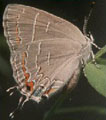 Larval Host |
Propagation
Description: Scarified and stratified seed sown after all danger of frost. Cuttings collected in May or June and treated with hormone root in 5-6 weeks.Seed Collection: Collect seeds in late fall or early winter. Seeds may be cleaned or dried with the pulp on. Store in sealed, refrigerated containers.
Seed Treatment: Scarify seeds in sulfuric acid for one to three hours and then stratify at 35-45 degrees for 40-60 days.
Commercially Avail: yes
Find Seed or Plants
View propagation protocol from Native Plants Network.
From the National Organizations Directory
According to the species list provided by Affiliate Organizations, this plant is on display at the following locations:Lady Bird Johnson Wildflower Center - Austin, TX
Sibley Nature Center - Midland, TX
Patsy Glenn Refuge, c/o Wimberley Birding Society - Wimberley, TX
Stengl Biological Research Station - Smithville, TX
Texas Parks and Wildlife Department - Austin, TX
Texas Master Naturalists - Lost Pines Chapter - Bastrop, TX
NPSOT - Austin Chapter - Austin, TX
National Butterfly Center - Mission, TX
NPSOT - Williamson County Chapter - Georgetown, TX
Bibliography
Bibref 1186 - Field Guide to Moths of Eastern North America (2005) Covell, C.V., Jr.Bibref 298 - Field Guide to Texas Trees (1999) Simpson, B.J.
Bibref 1185 - Field Guide to Western Butterflies (Peterson Field Guides) (1999) Opler, P.A. and A.B. Wright
Bibref 481 - How to Grow Native Plants of Texas and the Southwest: Revised and Updated Edition (2001) Nokes, J.
Bibref 841 - Native Alternatives to Invasive Plants (2006) Burrell, C. C.
Bibref 318 - Native Texas Plants: Landscaping Region by Region (2002) Wasowski, S. & A. Wasowski
Search More Titles in Bibliography
Web Reference
Webref 23 - Southwest Environmental Information Network (2009) SEINet - Arizona ChapterAdditional resources
USDA: Find Sapindus saponaria var. drummondii in USDA PlantsFNA: Find Sapindus saponaria var. drummondii in the Flora of North America (if available)
Google: Search Google for Sapindus saponaria var. drummondii
Metadata
Record Modified: 2023-05-16Research By: NPC