Native Plants

Plant Database
Search for native plants by scientific name, common name or family. If you are not sure what you are looking for, try the Combination Search or our Recommended Species lists.
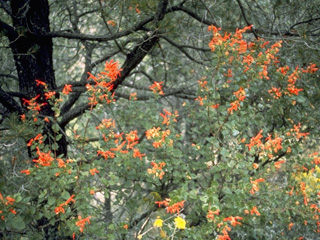
Loughmiller, Campbell and Lynn
Salvia regla
Salvia regla Cav.
Mountain Sage, Royal Sage
Lamiaceae (Mint Family)
Synonym(s):
USDA Symbol: SARE4
USDA Native Status: L48 (N)
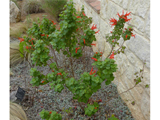
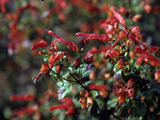
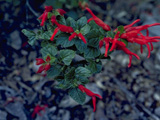
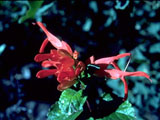
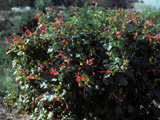
The showy, bright-red, tubular flowers of this ornamental, much-branched shrub occur in loose, terminal racemes. These top 3-5 ft. stems which bear glossy, aromatic, heart-shaped, deciduous leaves.
Flowers attract hummingbirds. This plant is disease and insect-free, drought tolerant, and adaptable to a variety of sites.
Plant Characteristics
Duration: PerennialHabit: Shrub
Leaf Retention: Deciduous
Size Notes: Up to about 5 feet tall.
Fruit: Nutlets.
Bloom Information
Bloom Color: RedBloom Time: Jun , Jul , Aug , Sep , Oct , Nov
Bloom Notes: Very showy crimson flowers.
Distribution
USA: TXNative Distribution: W. TX, in Chisos Mts.; also Mex.
Native Habitat: Native to the rocky wooded slopes of the Chisos Mountains and adapted to the rolling and high plains area. Often called one of the most beautiful shrubs of the Chisos Mountains.
Growing Conditions
Water Use: LowLight Requirement: Part Shade , Shade
Soil Moisture: Dry
Soil pH: Circumneutral (pH 6.8-7.2)
Cold Tolerant: yes
Soil Description: Prefers well-drained rocky soils, but very adaptable to other sites in cultivation.
Conditions Comments: Mountain sage's striking orange-red flower are hummingbird favorites. Disease and insect free, drought tolerant, and adaptable to a variety of sites. Once established, do not fertilize. Periodically prune to encourage bushy growth and more blooms, which occur on new wood.
Benefit
Use Ornamental: Showy, Long-blooming, Blooms ornamentalUse Wildlife: Nectar-hummingbirds
Conspicuous Flowers: yes
Attracts: Butterflies , Hummingbirds
Nectar Source: yes
Deer Resistant: Minimal
Propagation
Propagation Material: Seeds , Semi-hardwood Cuttings , Softwood CuttingsDescription: Most easily grown from softwood or semi-hardwood tip cuttings. Application of a rooting hormone improves rooting. Rooting should occur within three weeks. Also propagated from fresh, untreated seed sown in spring or root layering.
Seed Collection: Collect the seeds as the capsules begin to dry but before they have dropped the seeds. Spread seeds in thin layers to dry a few days before storing in sealed, refrigerated containers.
Commercially Avail: yes
Maintenance: After an extended period of flowering, you may wish to prune it halfway back to produce thicker, more compact foliage. Cut it back each winter to encourage bushy growth. Once established, it should not be fertilized.
From the National Organizations Directory
According to the species list provided by Affiliate Organizations, this plant is on display at the following locations:Lady Bird Johnson Wildflower Center - Austin, TX
Texas Discovery Gardens - Dallas, TX
NPSOT - Native Plant Society of Texas - Fredericksburg, TX
Texas Parks and Wildlife Department - Austin, TX
NPSOT - Austin Chapter - Austin, TX
Bibliography
Bibref 355 - Landscaping with Native Plants of Texas and the Southwest (1991) Miller, G. O.Bibref 995 - Native Landscaping from El Paso to L.A. (2000) Wasowski, S. and A. Wasowski
Bibref 318 - Native Texas Plants: Landscaping Region by Region (2002) Wasowski, S. & A. Wasowski
Bibref 248 - Texas Wildflowers: A Field Guide (1984) Loughmiller, C. & L. Loughmiller
Bibref 291 - Texas Wildscapes: Gardening for Wildlife (1999) Damude, N. & K.C. Bender
Search More Titles in Bibliography
Web Reference
Webref 23 - Southwest Environmental Information Network (2009) SEINet - Arizona ChapterWebref 1 - Texas Native Shrubs (2002) Texas A&M University Agriculture Program and Leslie Finical, Dallas Arboretum
Additional resources
USDA: Find Salvia regla in USDA PlantsFNA: Find Salvia regla in the Flora of North America (if available)
Google: Search Google for Salvia regla
Metadata
Record Modified: 2023-02-27Research By: TWC Staff, GHH