Native Plants

Plant Database
Search for native plants by scientific name, common name or family. If you are not sure what you are looking for, try the Combination Search or our Recommended Species lists.
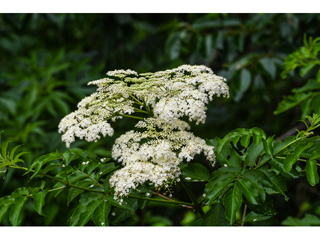
Suter, Jim
Sambucus nigra ssp. canadensis
Sambucus nigra L. ssp. canadensis (L.) R. Bolli
Common Elderberry, Black Elder, Mexican Elderberry, Common Elder, Elderberry, Tapiro, Sauco
Caprifoliaceae (Honeysuckle Family)
Synonym(s): Sambucus caerulea var. mexicana, Sambucus canadensis, Sambucus canadensis var. laciniata, Sambucus canadensis var. submollis, Sambucus cerulea var. mexicana, Sambucus mexicana, Sambucus orbiculata, Sambucus simpsonii
USDA Symbol: SANIC4
USDA Native Status: L48 (N), HI (I), PR (N), VI (I), CAN (N)
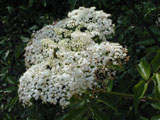
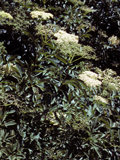
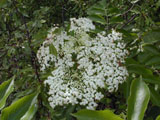
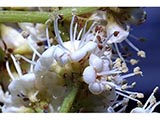
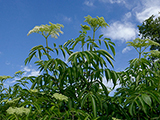
Black elder is a loose, graceful, deciduous shrub with both woody and herbaceous branches to 12 ft. Many long stems arise from the base, arching at the top. Broad, white pith in stems and branches. Pinnately-compound leaves up to 12 inches long, opposite, consisting of a central axis with 4 to 10 usually 4 to 6, paired leaflets and a terminal one often larger. Leaflets ovate to elliptic or narrower, up to 7 inches long, with an extended tip and a broadly wedge shaped base, margins toothed except at the tip and toward the base, the teeth narrow and pointed toward the tip. Flowers white, 3/16 to 1/4 inch across, in broad, flat, conspicuous clusters up to 10 inches or more in diameter, appearing from May to July. Fruit berrylike, dark purple when ripe, 3/16 to 1/4 inch wide, edible.
The genus name comes from Greek sambuce, an ancient musical instrument, and refers to the soft pith, easily removed from the twigs and used to make flutes and whistles. This subspecies incorporates several other forms that used to be considered separate species, including S. mexicana and S. canadensis.
Plant Characteristics
Duration: PerennialHabit: Shrub
Root Type: Tap
Leaf Retention: Deciduous
Leaf Arrangement: Opposite
Leaf Complexity: Pinnate
Leaf Shape: Elliptic , Ovate
Leaf Margin: Dentate
Fruit Type: Berry
Size Notes: Up to about 12 feet tall.
Leaf: Green
Autumn Foliage: yes
Fruit: Black, Purple
Bloom Information
Bloom Color: WhiteBloom Time: May , Jun , Jul
Distribution
USA: AL , AR , AZ , CA , CO , CT , DC , DE , FL , GA , HI , IA , IL , IN , KS , KY , LA , MA , MD , ME , MI , MN , MO , MS , MT , NC , ND , NE , NH , NJ , NM , NY , OH , OK , PA , RI , SC , SD , TN , TX , VA , VT , WI , WV , WYCanada: MB , NB , NS , PE , QC
Native Distribution: N.S. to FL, w. to s. Man., e. Dakotas, e. OK & TX
Native Habitat: Alluvial forests; bogs; ditches; drier, old fields. Edges of riparian thickets in Central and East Texas.
Growing Conditions
Water Use: MediumLight Requirement: Part Shade
Soil Moisture: Wet
Soil pH: Circumneutral (pH 6.8-7.2)
CaCO3 Tolerance: Medium
Soil Description: Tolerates a wide variety of wet to dry soils but prefers rich, moist, slightly acid soil.
Conditions Comments: This plant was used by Native Americans for many medicinal purposes. The purple-black fruit is attractive to birds that spread the seeds. The fruit makes tasty jelly and wine. Prune heavily in winter to maintain thick form. Elderberry is a fast grower and aggressive competitor with weeds and herbaceous species. Individual plants are very short-lived, however root masses produce new shoots. Cutting the whole bush to the groud every other year may be necessary to keep the bushes in check. This forest species will grow in full sun if the soil is well-tilled and watered. It can be planted as a hedge or alone. Provides effective erosion control on moist sites. S. simpsonii, occuring especially in FL, has twice-compound leaves and is considered a separate species.
Benefit
Use Wildlife: Berries are relished by many bird species and mammals. Deer eat twigs and leaves.Use Food: Elderberries, inedible when fresh and raw, are used for making jelly, preserves, pies, and wine.
Use Medicinal: The bark, leaves, and flowers have served in home remedies but can be toxic.
Warning: POISONOUS PARTS: Leaves, twigs (stems), roots, unripe fruits. Low toxicity if ingested. Symptoms include nausea, vomiting, diarrhea, coma. Toxic Principle: Cyanogenic glycoside and alkaloid.
Conspicuous Flowers: yes
Fragrant Flowers: yes
Attracts: Birds
Nectar Source: yes
Value to Beneficial Insects
Provides Nesting Materials/Structure for Native BeesSupports Conservation Biological Control
This information was provided by the Pollinator Program at The Xerces Society for Invertebrate Conservation.
Propagation
Description: Propagation is quickest from cuttings. Roots easily from softwood cuttings taken from one-year-old (juvenile) seedlings. For elderberry seeds to germinate they must be pretreated. Untreated, fall-sown seeds will not germinate until the second year.Seed Collection: Collect seeds as soon as the fruits ripen and turn dark blue. Clean seeds to avoid fermentation. Air dry two days before storing in sealed, refrigerated containers.
Seed Treatment: Scarify in sulfuric acid for 10-20 minutes followed immediately by stratification in moist peat at 36-40 degrees for two months.
Commercially Avail: yes
Find Seed or Plants
View propagation protocol from Native Plants Network.
From the National Organizations Directory
According to the species list provided by Affiliate Organizations, this plant is on display at the following locations:Fredericksburg Nature Center - Fredericksburg, TX
Lady Bird Johnson Wildflower Center - Austin, TX
Santa Barbara Botanic Garden - Santa Barbara, CA
Delaware Nature Society - Hockessin, DE
Brackenridge Field Laboratory - Austin, TX
Texas Parks and Wildlife Department - Austin, TX
NPSOT - Williamson County Chapter - Georgetown, TX
Mt. Cuba Center - Hockessin, DE
Wellspring Organic Farm and Education Center - West Bend, WI
Bibliography
Bibref 841 - Native Alternatives to Invasive Plants (2006) Burrell, C. C.Bibref 318 - Native Texas Plants: Landscaping Region by Region (2002) Wasowski, S. & A. Wasowski
Bibref 1294 - The Midwestern Native Garden: Native Alternatives to Nonnative Flowers and Plants An Illustrated Guide (2011) Adelman, Charlotte and Schwartz, Bernard L.
Search More Titles in Bibliography
Web Reference
Webref 23 - Southwest Environmental Information Network (2009) SEINet - Arizona ChapterAdditional resources
USDA: Find Sambucus nigra ssp. canadensis in USDA PlantsFNA: Find Sambucus nigra ssp. canadensis in the Flora of North America (if available)
Google: Search Google for Sambucus nigra ssp. canadensis
Metadata
Record Modified: 2022-10-21Research By: TWC Staff