Native Plants

Plant Database
Search for native plants by scientific name, common name or family. If you are not sure what you are looking for, try the Combination Search or our Recommended Species lists.
Marcus, Joseph A.
Salix nigra
Salix nigra Marshall
Black Willow, Gulf Black Willow, Swamp Willow, Sauz
Salicaceae (Willow Family)
Synonym(s): Salix ambigua, Salix denudata, Salix dubia, Salix falcata, Salix flavovirens, Salix ligustrina, Salix ludoviciana, Salix nigra var. altissima, Salix nigra var. brevifolia, Salix nigra var. brevijulis, Salix nigra var. falcata, Salix nigra var. lindheimeri, Salix nigra var. longifolia, Salix nigra var. marginata, Salix purshiana
USDA Symbol: SANI
USDA Native Status: L48 (N), CAN (N)
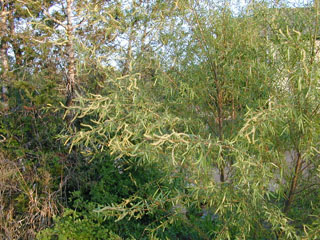
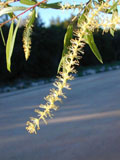
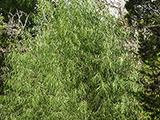
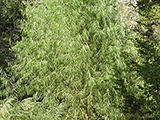
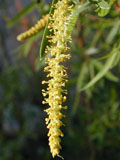
A fast-growing tree, 10-60 ft., with an open crown often with several trunks growing out at angles from one root. Found in wet soil along streams and at the margins of ponds and lakes. Leaf blades up to 5 inches long, narrow and tapering to an elongate tip, margins finely serrate. Bright yellow-green twigs bear yellow-green catkins. Flowers inconspicuous, arranged in elongate clusters which appear in March and April; male and female flowers on separate trees. Seeds wind-borne on silky hairs. The bark is deeply furrowed.
This is the largest and most important New World willow, with one of the most extensive ranges across the country. In the lower Mississippi Valley it attains commercial timber size, reaching 100-140' (30-42 m) in height and 4' (1.2 m) in diameter. Large trees are valuable in binding soil banks, thus preventing soil erosion and flood damage. Mats and poles made from Black Willow trunks and branches provide further protection of riverbanks and levees. One of the lightest of all eastern US hardwoods, it is extremely weak in a structural sense. Yet it has a strength of its own. When nails are driven into it, black willow does not split. Also a shade tree and honey plant.
Plant Characteristics
Duration: PerennialHabit: Tree
Leaf Retention: Deciduous
Leaf Arrangement: Alternate
Leaf Complexity: Simple
Breeding System: Flowers Unisexual , Dioecious
Fruit Type: Capsule
Size Notes: Up to about 60 feet tall.
Leaf: Green
Autumn Foliage: yes
Fruit: Brown
Bloom Information
Bloom Color: YellowBloom Time: Feb , Mar , Apr , May , Jun
Bloom Notes: "Flowering begins in February in the southern portion of the range and extends through late June at the northern limits." (Bibref:1826).
Distribution
USA: AL , AR , CT , DC , DE , FL , GA , IA , IL , IN , KS , KY , LA , MA , MD , ME , MI , MN , MO , MS , NC , NE , NH , NJ , NY , OH , OK , PA , RI , SC , TN , TX , VA , VT , WI , WVCanada: MB , NB , ON , QC
Native Distribution: S. New Brunswick and Maine south to NW. Florida, west to S. Texas, and north to SE. Minnesota; also from W. Texas west to N. California; local in N. Mexico; to 5000' (1524 m).
Native Habitat: Stream banks, ditches, tanks, low ground, and other areas of wet soil throughout Texas.
Growing Conditions
Water Use: HighLight Requirement: Sun , Part Shade , Shade
Soil Moisture: Moist , Wet
CaCO3 Tolerance: Low
Soil Description: Clay, Loam, Sand
Conditions Comments: Short-lived and fast-growing. Susceptible to insect and wind damage.
Benefit
Use Ornamental: Fall color is conspicuous. Fast growing. Shade tree.Use Wildlife: The bark, tender twigs and buds are food for browsers such as deer, rabbits and beaver. Early season harvest for songbirds, waterfowl and small mammals.
Use Other: The numerous uses of the wood include millwork, furniture, doors, cabinetwork, boxes, barrels, toys, and pulpwood. During the American Revolution, the wood of black willow (and of other willows) was made into fine charcoal, which was then used to make gunpowder. The young stems are very flexible and are used in basket and furniture making. The twigs can be split in half lengthways, sun-dried and used as the foundation of coiled basketry. The plant is usually coppiced annually when grown for basket making.
Interesting Foliage: yes
Attracts: Birds , Butterflies
Larval Host: Mourning Cloak, Viceroy, Red-spotted Purple, Viceroy and Tiger Swallowtail.
Value to Beneficial Insects
Special Value to Native BeesSpecial Value to Bumble Bees
Special Value to Honey Bees
Supports Conservation Biological Control
This information was provided by the Pollinator Program at The Xerces Society for Invertebrate Conservation.
Butterflies and Moths of North America (BAMONA)
|
Acadian Hairstreak (Satyrium acadica) 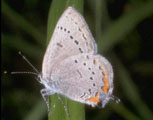 Larval Host |
Mourning Cloak (Nymphalis antiopa) 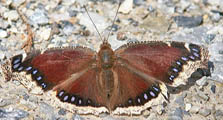 Larval Host |
Viceroy (Limenitis archippus) 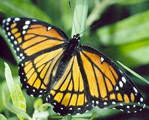 Larval Host |
Propagation
Description: Willows are among the easiest of all plants to root from cuttings. Stem and root cuttings are used. Propagation is also accomplished by sowing fresh, untreated seed into a moist seedbed.Seed Collection: Collect seeds as soon as the capsules begin to dry and turn yellow-brown. Separate from capsule and plant immediately.
Commercially Avail: yes
Find Seed or Plants
View propagation protocol from Native Plants Network.
Mr. Smarty Plants says
Decline in willow tree in West Virginia
June 15, 2008
I planted a willow tree about three years ago and it was progressing just beautifully with full leaves this spring in a nice green color. We staked it back about three weeks so it would grow straight...
view the full question and answer
National Wetland Indicator Status
| Region: | AGCP | AK | AW | CB | EMP | GP | HI | MW | NCNE | WMVE |
| Status: | OBL | OBL | FACW | OBL | OBL |
From the National Organizations Directory
According to the species list provided by Affiliate Organizations, this plant is on display at the following locations:Lady Bird Johnson Wildflower Center - Austin, TX
Pineywoods Native Plant Center - Nacogdoches, TX
Sibley Nature Center - Midland, TX
Brackenridge Field Laboratory - Austin, TX
Crosby Arboretum - Picayune, MS
Nueces River Authority - Uvalde, TX
Stengl Biological Research Station - Smithville, TX
Texas Parks and Wildlife Department - Austin, TX
National Butterfly Center - Mission, TX
Jacob's Well Natural Area - Wimberley, TX
Wellspring Organic Farm and Education Center - West Bend, WI
Herbarium Specimen(s)
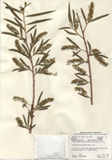
NPSOT 0764 Collected May 8, 1994 in Comal County by Mary Beth WhiteNPSOT 0306 Collected Apr 28, 1987 in Bexar County by Harry Cliffe
Bibliography
Bibref 1186 - Field Guide to Moths of Eastern North America (2005) Covell, C.V., Jr.Bibref 298 - Field Guide to Texas Trees (1999) Simpson, B.J.
Bibref 1185 - Field Guide to Western Butterflies (Peterson Field Guides) (1999) Opler, P.A. and A.B. Wright
Bibref 354 - Native & Naturalized Woody Plants of Austin & the Hill Country (1981) Lynch, D.
Bibref 841 - Native Alternatives to Invasive Plants (2006) Burrell, C. C.
Bibref 1826 - Silvics of North America (Agriculture Handbook 654) (1990) Burns, Russell M. and Barbara H Honkala
Bibref 291 - Texas Wildscapes: Gardening for Wildlife (1999) Damude, N. & K.C. Bender
Bibref 297 - Trees of Central Texas (1984) Vines, Robert A.
Search More Titles in Bibliography
Additional resources
USDA: Find Salix nigra in USDA PlantsFNA: Find Salix nigra in the Flora of North America (if available)
Google: Search Google for Salix nigra
Metadata
Record Modified: 2023-06-09Research By: TWC Staff