Native Plants

Plant Database
Search for native plants by scientific name, common name or family. If you are not sure what you are looking for, try the Combination Search or our Recommended Species lists.
Pyle, Lynn
Ruellia nudiflora
Ruellia nudiflora (Engelm. & A. Gray) Urb.
Violet Ruellia, Common Wild Petunia, Violet Wild Petunia, Wild Petunia, Hierba De La Calentura
Acanthaceae (Acanthus Family)
Synonym(s):
USDA Symbol: RUNU
USDA Native Status: L48 (N)
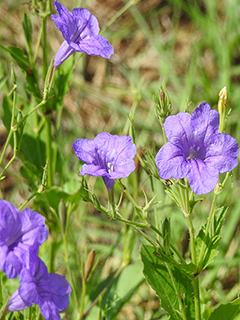
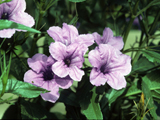
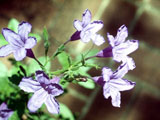
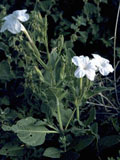
Wild Petunia has flowers much like those of the cultivated petunia (genus Petunia, family Solanaceae). The plants are erect, 1-2 feet tall, with few branches. The leaves are opposite, 2-5 inches long, narrowed at the base, on short stems. Gray-green leaves have curly or wavy-toothed margins. At the top of the plant are several trumpet-shaped, purplish blossoms that are nearly 2 inches across at the opening. Flowers are lavender to purple, trumpet-shaped, deeply lobed at the flared rim, and open about sunrise, falling from plant in early afternoon, lasting only one day.
This genus Ruellia is not the petunia common as potted plants which are in the Solanaceae (Potato Family).
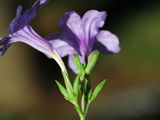
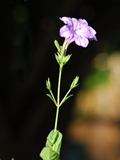
Plant Characteristics
Duration: PerennialHabit: Herb
Root Type: Fibrous
Leaf Retention: Deciduous
Leaf Complexity: Simple
Leaf Shape: Ovate
Leaf Venation: Pinnate
Leaf Pubescence: Puberulent
Leaf Margin: Ciliate
Leaf Apex: Obtuse
Leaf Base: Cuneate
Breeding System: Flowers Bisexual
Fruit Type: Capsule
Size Notes: Up to about 2 feet tall.
Leaf: gray-green
Flower: Flowers 55 mm long
Fruit: Seeds brown to dark brown 1.6-2 cm
Bloom Information
Bloom Color: PurpleBloom Time: Apr , May , Jun , Jul , Aug , Sep , Oct
Distribution
USA: AL , AZ , LA , MS , TXNative Distribution: Alabama west to Arizona, south through Mexico to Central America
Native Habitat: Woodlands' edge, Opening, Thickets
Growing Conditions
Water Use: Low , MediumLight Requirement: Sun , Part Shade , Shade
Soil Moisture: Dry , Moist
Soil Description: Sandy
Conditions Comments: Wild petunia is very easy to grow, spreading vigorously from seed, which in some cases may be problematic. Adds a nice touch to woodland gardens and to walkways. Works well as a groundcover and tolerants mowing. Differs from Drummond's wild petunia because both the flowers and the plant are smaller. Good nectar and larval food source for many butterflies. Cut back after each flush of blossoms to keep compact and blooming all summer.
Benefit
Use Ornamental: Perennial garden, Can be mowed, Shortgrass meadowConspicuous Flowers: yes
Attracts: Butterflies
Larval Host: Common Buckeye, Cuban Crescentspot, Fatima, Malachite, White Peacock butterfly
Nectar Source: yes
Deer Resistant: Minimal
Butterflies and Moths of North America (BAMONA)
|
Cuban Crescent (Anthanassa frisia) 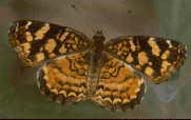 Larval Host |
Common Buckeye (Junonia coenia) 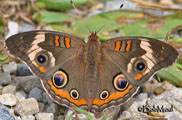 Larval Host |
White Peacock (Anartia jatrophae) 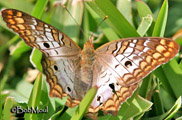 Larval Host |
Malachite (Siproeta stelenes) 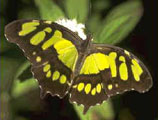 Larval Host |
Mr. Smarty Plants says
Sedges and ornamentals for shade in Bastrop County
June 20, 2007
I bought a home in Elgin, TX that was owned by an elderly woman. Most of
the lawn is shaded by elm or pecan trees. In the sunny areas, i got native
wildflowers to grow like lantana and coneflower,...
view the full question and answer
From the National Organizations Directory
According to the species list provided by Affiliate Organizations, this plant is on display at the following locations:Naval Air Station Kingsville - Kingsville, TX
Fredericksburg Nature Center - Fredericksburg, TX
Lady Bird Johnson Wildflower Center - Austin, TX
Tohono Chul Park, Inc. - Tucson, AZ
Brackenridge Field Laboratory - Austin, TX
Nueces River Authority - Uvalde, TX
NPSOT - Austin Chapter - Austin, TX
National Butterfly Center - Mission, TX
Jacob's Well Natural Area - Wimberley, TX
Wildflower Center Seed Bank
LBJWC-66 Collected 2006-08-23 in Travis County by Lady Bird Johnson Wildflower CenterBibliography
Bibref 766 - Dale Groom's Texas Gardening Guide (2002) Groom, D.Bibref 1186 - Field Guide to Moths of Eastern North America (2005) Covell, C.V., Jr.
Bibref 1185 - Field Guide to Western Butterflies (Peterson Field Guides) (1999) Opler, P.A. and A.B. Wright
Bibref 946 - Gardening with Prairie Plants: How to Create Beautiful Native Landscapes (2002) Wasowski, Sally
Bibref 355 - Landscaping with Native Plants of Texas and the Southwest (1991) Miller, G. O.
Bibref 841 - Native Alternatives to Invasive Plants (2006) Burrell, C. C.
Bibref 318 - Native Texas Plants: Landscaping Region by Region (2002) Wasowski, S. & A. Wasowski
Bibref 281 - Shinners & Mahler's Illustrated Flora of North Central Texas (1999) Diggs, G. M.; B. L. Lipscomb; B. O'Kennon; W. F...
Bibref 248 - Texas Wildflowers: A Field Guide (1984) Loughmiller, C. & L. Loughmiller
Bibref 328 - Wildflowers of Texas (2003) Ajilvsgi, Geyata.
Bibref 286 - Wildflowers of the Texas Hill Country (1989) Enquist, M.
Search More Titles in Bibliography
Web Reference
Webref 23 - Southwest Environmental Information Network (2009) SEINet - Arizona ChapterAdditional resources
USDA: Find Ruellia nudiflora in USDA PlantsFNA: Find Ruellia nudiflora in the Flora of North America (if available)
Google: Search Google for Ruellia nudiflora
Metadata
Record Modified: 2023-02-24Research By: TWC Staff, JSC