Native Plants

Plant Database
Search for native plants by scientific name, common name or family. If you are not sure what you are looking for, try the Combination Search or our Recommended Species lists.
Brundage, Stephanie
Rhus glabra
Rhus glabra L.
Smooth Sumac
Anacardiaceae (Sumac Family)
Synonym(s): Rhus borealis, Rhus calophylla, Rhus glabra var. cismontana, Rhus glabra var. laciniata, Rhus glabra var. occidentalis
USDA Symbol: RHGL
USDA Native Status: L48 (N), CAN (N)
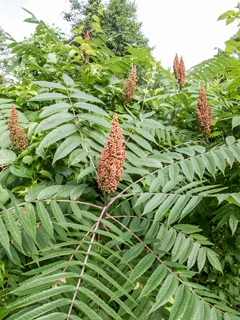
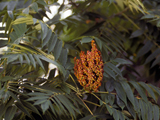
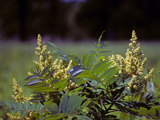
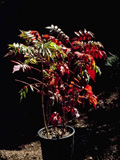
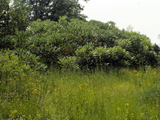
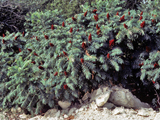
The colony-forming smooth sumac is a 10-20 ft. shrub with short, crooked, leaning trunks and picturesque branches. The pinnately compound leaves are alternate, with 13-30 sharp-toothed leaflets on each side of the midrib. Deciduous leaves become extremely colorful in early fall. On female plants, yellow-green flowers are followed by bright-red, hairy berries in erect, pyramidal clusters which persist throughout winter.
The only shrub or tree species native to all 48 contiguous states.
Plant Characteristics
Duration: PerennialHabit: Shrub
Leaf Retention: Deciduous
Leaf Arrangement: Alternate
Leaf Complexity: Pinnate
Leaf Shape: Lanceolate
Leaf Venation: Pinnate
Leaf Margin: Serrate
Breeding System: Flowers Unisexual , Dioecious
Fruit Type: Drupe
Size Notes: Up to about 20 feet tall.
Leaf: Green
Autumn Foliage: yes
Fruit: Red, Brown 1/8 inch
Bloom Information
Bloom Color: White , Yellow , Green , BrownBloom Time: Apr , May , Jun , Jul , Aug
Distribution
USA: AL , AR , AZ , CA , CO , CT , DC , DE , FL , GA , IA , ID , IL , IN , KS , KY , LA , MA , MD , ME , MI , MN , MO , MS , MT , NC , ND , NE , NH , NJ , NM , NV , NY , OH , OK , OR , PA , RI , SC , SD , TN , TX , UT , VA , VT , WA , WI , WV , WYCanada: AB , BC , MB , NB , NS , ON , PE , QC , SK
Native Distribution: Across most of Canada except the far north and almost all of the US, south into Tamaulipas in northeastern Mexico
Native Habitat: Roadsides; fields; wood borders; waste places
Growing Conditions
Water Use: LowLight Requirement: Sun , Part Shade , Shade
Soil Moisture: Dry
Soil pH: Circumneutral (pH 6.8-7.2)
Cold Tolerant: yes
Soil Description: Most dry soils. Sandy, Sandy Loam Medium Loam, Clay Loam, Clay, Caliche type
Conditions Comments: This is the dominant sumac of blackland prairies. Plants of Rocky Mountain origin are usually separated into the variety cismontana. This dwarf variety is becoming popular in cultivation. In a planned landscape, the species is most effective when drifts or colonies, typical of natural settings, are allowed to establish. Colonies can be rejuvenated every few years by cutting them to the ground in mid-winter. Sumacs will grow in dry waste areas, such as impossible slopes where even junipers struggle. They are fast growing, generally pest and disease-free, and drought-tolerant. Colonies are often single-sexed, formed from a single, suckering parent. Only female plants produce flowers and berries.
Benefit
Use Ornamental: The seeds remain firmly attached for a long time without noticeable deterioration and are often used in large decorative arrangements.Use Wildlife: Consumed by birds of many kinds and small mammals, mainly in winter. Deer browse the twigs and fruit throughout the year.
Use Food: Raw young sprouts were eaten by the Indians as salad. The sour fruit, mostly seed, can be chewed to quench thirst or prepared as a drink similar to lemonade.
Use Medicinal: Boiled fruit as a remedy for pianful menstruation and blood diarrhea. Diuretic. Roots and berries steeped to make wash for sores. Internal as a tea and externally as a wash for female complaints. (Kindscher)
Use Other: Roots make yellow dye. Mixed with tobacco to smoke. (Kindscher)
Conspicuous Flowers: yes
Attracts: Birds , Butterflies
Larval Host: Hairstreak butterfly
Value to Beneficial Insects
Special Value to Native BeesSpecial Value to Honey Bees
Provides Nesting Materials/Structure for Native Bees
Supports Conservation Biological Control
This information was provided by the Pollinator Program at The Xerces Society for Invertebrate Conservation.
Propagation
Propagation Material: SeedsDescription: Plant scarified and stratified seed 1/3-3/4 in. deep. Sumac is most commonly propagated by early winter root division. Place root cuttings in flats of moist sand.
Seed Treatment: Acid scarify one to three hours, then stratify immediately for 30 days at 41 degrees.
Commercially Avail: yes
Find Seed or Plants
Find seed sources for this species at the Native Seed Network.
View propagation protocol from Native Plants Network.
Mr. Smarty Plants says
Plant identfication
October 21, 2009
Hi...Can you please identfy the tall, evergreen shrub with purple plum-colored foliage that I have noticed in winter locally?...Hope so, need he color! THX
view the full question and answer
Hedge in central Texas
June 17, 2009
Help, my oleanders are dying. I am in need of hedge suggestions- ideal would be quick growing, maybe 8-12 feet at their tallest. I live in Central Texas.
view the full question and answer
Replacing grass with xeric plants in Nevada
March 20, 2009
I am looking to xeriscape my front yard - remove all grass! I am thinking 3-4 larger plants: bird of paradise (mesquite??), aloe, and ..?? Also, possibly a Chilean mesquite.
Do you have suggestio...
view the full question and answer
Evergreen native shrubs for poor drainage area in Cedar Hill, TX
March 21, 2008
Hi! I have one (big!) bed in on the front of my house. Due to the way the house/motorcourt is built, that area (when it rains as much as it did last year!) doesn't drain well. I now have to replac...
view the full question and answer
Variety of native tall plants for a screen in shady area near Ft. Worth
June 12, 2007
Hello, we live west of Ft Worth. We are looking for tall plants to form a visual screen along a chain link fence we share with a neighbor. We have post oaks there and it is very shady and the ground ...
view the full question and answer
From the National Organizations Directory
According to the species list provided by Affiliate Organizations, this plant is on display at the following locations:Pineywoods Native Plant Center - Nacogdoches, TX
Delaware Nature Society - Hockessin, DE
Stengl Biological Research Station - Smithville, TX
Texas Parks and Wildlife Department - Austin, TX
Native Seed Network - Corvallis, OR
Bibliography
Bibref 610 - Edible wild plants of the prairie : an ethnobotanical guide (1987) Kindscher, K.Bibref 1620 - Gardening with Native Plants of the South (Reprint Edition) (2009) Wasowski, S. with A. Wasowski
Bibref 946 - Gardening with Prairie Plants: How to Create Beautiful Native Landscapes (2002) Wasowski, Sally
Bibref 355 - Landscaping with Native Plants of Texas and the Southwest (1991) Miller, G. O.
Bibref 841 - Native Alternatives to Invasive Plants (2006) Burrell, C. C.
Bibref 318 - Native Texas Plants: Landscaping Region by Region (2002) Wasowski, S. & A. Wasowski
Bibref 248 - Texas Wildflowers: A Field Guide (1984) Loughmiller, C. & L. Loughmiller
Bibref 291 - Texas Wildscapes: Gardening for Wildlife (1999) Damude, N. & K.C. Bender
Bibref 297 - Trees of Central Texas (1984) Vines, Robert A.
Search More Titles in Bibliography
Web Reference
Webref 30 - Calflora (2018) CalfloraWebref 23 - Southwest Environmental Information Network (2009) SEINet - Arizona Chapter
From the Archive
Wildflower Newsletter 1985 VOL. 2, NO.3 - Greenhouse Assists Research, Wild color on the Hills, Director's Report, Clearin...Wildflower Newsletter 1990 VOL. 7, NO.1 - Congress Eyes Larger Issue, Research Update, Director's Report, Carlton B. Lees ...
Additional resources
USDA: Find Rhus glabra in USDA PlantsFNA: Find Rhus glabra in the Flora of North America (if available)
Google: Search Google for Rhus glabra
Metadata
Record Modified: 2022-10-20Research By: TWC Staff