Native Plants

Plant Database
Search for native plants by scientific name, common name or family. If you are not sure what you are looking for, try the Combination Search or our Recommended Species lists.
Richardson, Charmaine
Ratibida columnifera
Ratibida columnifera (Nutt.) Woot. & Standl.
Mexican Hat, Red-spike Mexican Hat, Upright Prairie Coneflower, Prairie Coneflower, Long-headed Coneflower, Thimbleflower
Asteraceae (Aster Family)
Synonym(s): Lepachys columnaris, Lepachys columnifera, Ratibida columnaris, Ratibida columnaris var. pulcherrima, Rudbeckia columnaris, Rudbeckia columnifera
USDA Symbol: RACO3
USDA Native Status: L48 (N), CAN (N)
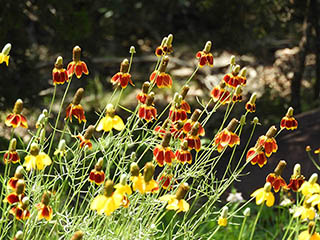
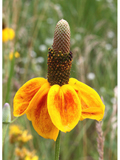
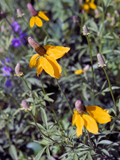
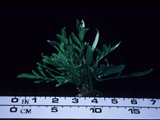
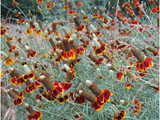
A plant branched and leafy in lower part with long leafless stalks bearing flower heads of 3-7 yellow or yellow and red-brown, drooping rays surrounding a long, red-brown central disc. With sombrero-shaped flower heads, it is usually 1 1/2 ft. tall but can reach 3 ft. Flower petals range from dark red and yellow, to all red or all yellow. The flowers central brown disc protrudes 1/2 to 2 in. above the drooping petals. Leaves on the lower portion of the stem are feathery and deeply cleft.
The colorful flower heads, resembling the traditional broad-brimmed, high-centered hat worn during Mexican fiestas, often bloom by the thousands. Green Prairie Coneflower (R. tagetes) has a spherical or oblong central disc and leaves closer to the flower head.
Plant Characteristics
Duration: PerennialHabit: Herb
Root Type: Tap
Leaf Retention: Deciduous
Size Notes: Up to about 3 feet tall.
Leaf: Green
Flower: Flowers 2 inches
Fruit: Fruit is a cypsela (pl. cypselae). Though technically incorrect, the fruit is often referred to as an achene.
Bloom Information
Bloom Color: Orange , Yellow , BrownBloom Time: May , Jun , Jul , Aug , Sep , Oct
Bloom Notes: Late spring through July; often into August and September if moisture is available.
Distribution
USA: AL , AR , AZ , CO , CT , FL , GA , IA , ID , IL , IN , KS , LA , MA , MI , MN , MO , MS , MT , NC , ND , NE , NJ , NM , NY , OH , OK , PA , SC , SD , TN , TX , UT , WI , WV , WYCanada: AB , BC , MB , SK
Native Distribution: S.e. B.C. to AZ, e. to WI, IL, MO, AR, OK & TX, south to central Mexico; naturalized eastward
Native Habitat: Prairie, Plains, Meadows, Pastures, Savannas, Roadsides
Growing Conditions
Water Use: MediumLight Requirement: Sun
Soil Moisture: Dry , Moist
Soil pH: Circumneutral (pH 6.8-7.2)
Drought Tolerance: High
Soil Description: Various well-drained, usually calcareous soils. Also Limestone-based, Caliche type, Clay, Clay Loam, Medium Loam, Sandy Loam, Sandy.
Conditions Comments: This is a drought tolerant plant that withstands competition. Plants with rich, brown-purple ray flowers are form pulcherima. Mexican Hat is a fast growing wildflower that is not fussy about soils and is easy to grow from seed. Showy flowers bloom over a long season. Foliage has a strong odor that repels deer. CAUTION: it grows aggressively and may push out other weaker species.
Benefit
Use Ornamental: Color, Attractive, Blooms ornamental, Wildflower meadow, Perennial garden, Rocky hillside, Patio pot plantUse Wildlife: Nectar-Bees, Nectar-Butterflies, Nectar-insects, Seeds-Granivorous birds, Deer will eat this flower
Use Food: Beverage tea from leaves. (Kindscher)
Use Medicinal: Tea from leaves and stalks used for stomach ache and pain in side. Tea from flower used for headache. Boiled leaves and stems used as wash for snakebite and poison ivy. (Kindscher)
Conspicuous Flowers: yes
Nectar Source: yes
Deer Resistant: High
Value to Beneficial Insects
Special Value to Native BeesThis information was provided by the Pollinator Program at The Xerces Society for Invertebrate Conservation.
Propagation
Propagation Material: SeedsDescription: Very easy to propagate from seed in spring or fall though a fall seeding is recommended. Seeds do not have to be treated but may benefit from a period of stratification. Plants from seed usually bloom the second year. Be sure the seed is in good contact with the soil by lightly raking it into loose topsoil. Seeding rate is two to four pounds per acre. There are approximately 1,230,000 seeds per pound.
Seed Collection: Seed is available commercially or can be collected in late summer. Collect seed from several plants to increase the spectrum of color. If possible, collect seed from plants with solid yellow ray petals to contrast with plants with reddish-brown ray plants.
Seed Treatment: Stratify at 40 degrees for 9 weeks.
Commercially Avail: yes
Maintenance: Supplemental watering may be required if the winter and spring are unusually dry. Watering in summer often extends the flowering period. After flowering ceases, allow seed to completely mature (let cones become dry and brown) before mowing for reseeding or collecting seed to plant in another area.
Find Seed or Plants
Order seed of this species from Native American Seed and help support the Wildflower Center.
Find seed sources for this species at the Native Seed Network.
View propagation protocol from Native Plants Network.
Mr. Smarty Plants says
Wildlife uses of wildflowers in Central Texas
May 01, 2006
How are wildflowers in Central Texas used by wildlife?
view the full question and answer
Medicinal plants at the Wildflower Center
April 19, 2006
What kinds of medicinal plants do you have at the Wildflower Center?
view the full question and answer
From the National Organizations Directory
According to the species list provided by Affiliate Organizations, this plant is on display at the following locations:Fredericksburg Nature Center - Fredericksburg, TX
Lady Bird Johnson Wildflower Center - Austin, TX
Brackenridge Field Laboratory - Austin, TX
Patsy Glenn Refuge, c/o Wimberley Birding Society - Wimberley, TX
Nueces River Authority - Uvalde, TX
Stengl Biological Research Station - Smithville, TX
Texas Parks and Wildlife Department - Austin, TX
National Butterfly Center - Mission, TX
Native Seed Network - Corvallis, OR
Jacob's Well Natural Area - Wimberley, TX
Herbarium Specimen(s)
NPSOT 0432A Collected May 5, 1993 in Bexar County by Cecil MayoNPSOT 0238 Collected June 9, 1992 in Comal County by Mary Beth White
NPSOT 0379 Collected May 12, 1987 in Bexar County by Harry Cliffe
NPSOT 0078 Collected Oct. 19, 1990 in Bexar County by Mollie Walton
NPSOT 0359 Collected May 5, 1993 in Bexar County by Cecil Mayo
NPSOT 0432B Collected May 5, 1993 in Bexar County by Cecil Mayo
NPSOT 0180 Collected May 15, 1991 in Bexar County by Judith C. Berry
Wildflower Center Seed Bank
LBJWC-38 Collected 2006-06-18 in Travis County by Lady Bird Johnson Wildflower CenterLBJWC-511 Collected 2007-06-27 in Travis County by Lady Bird Johnson Wildflower Center
Bibliography
Bibref 610 - Edible wild plants of the prairie : an ethnobotanical guide (1987) Kindscher, K.Bibref 946 - Gardening with Prairie Plants: How to Create Beautiful Native Landscapes (2002) Wasowski, Sally
Bibref 355 - Landscaping with Native Plants of Texas and the Southwest (1991) Miller, G. O.
Bibref 318 - Native Texas Plants: Landscaping Region by Region (2002) Wasowski, S. & A. Wasowski
Bibref 248 - Texas Wildflowers: A Field Guide (1984) Loughmiller, C. & L. Loughmiller
Bibref 291 - Texas Wildscapes: Gardening for Wildlife (1999) Damude, N. & K.C. Bender
Bibref 1294 - The Midwestern Native Garden: Native Alternatives to Nonnative Flowers and Plants An Illustrated Guide (2011) Adelman, Charlotte and Schwartz, Bernard L.
Bibref 328 - Wildflowers of Texas (2003) Ajilvsgi, Geyata.
Bibref 286 - Wildflowers of the Texas Hill Country (1989) Enquist, M.
Search More Titles in Bibliography
Web Reference
Webref 38 - Flora of North America (2019) Missouri Botanical Garden, St. Louis, MO & Harvard University Herbaria, Cambridge, MA.From the Archive
Wildflower Newsletter 1984 VOL. 1, NO.1 - First issue. Lady Bird\'s Center is a dream come true. National Clearinghouse a ...Wildflower Newsletter 1986 VOL. 3, NO.4 - Fall Highlights Busy Season at the Center, Wildflower Days Welcome the Holidays,...
Wildflower Newsletter 1987 VOL. 4, NO.4 - Wildflower Center Sows Seeds for the Country, Hotline for Texas, New Goals Plans...
Wildflower Newsletter 1990 VOL. 7, NO.4 - Research Update, Wild-Collecting Endangers Natives, Director's Report, Maryland ...
Wildflower Newsletter 1991 VOL. 8, NO.2 - Wildflower Outlook, Photography Seminars Offered, Ten Favorite Wildflower Areas,...
Additional resources
USDA: Find Ratibida columnifera in USDA PlantsFNA: Find Ratibida columnifera in the Flora of North America (if available)
Google: Search Google for Ratibida columnifera
Metadata
Record Modified: 2023-01-13Research By: NPIS, ADA