Native Plants

Plant Database
Search for native plants by scientific name, common name or family. If you are not sure what you are looking for, try the Combination Search or our Recommended Species lists.
Wasowski, Sally and Andy
Quercus muehlenbergii
Quercus muehlenbergii Engelm.
Chinkapin Oak, Chinquapin Oak, Chestnut Oak, Yellow Chestnut Oak, Rock Chestnut Oak, Yellow Oak, Rock Oak
Fagaceae (Beech Family)
Synonym(s): Quercus acuminata, Quercus alexanderi, Quercus prinoides, Quercus prinoides var. acuminata
USDA Symbol: QUMU
USDA Native Status: L48 (N), CAN (N)
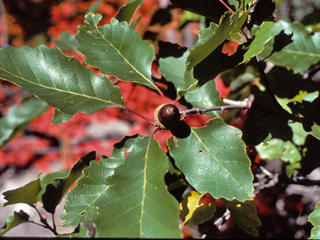
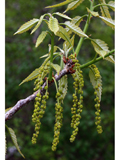
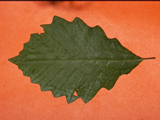
A tree with light gray platy or scaly bark and smooth, gray twigs changing to brown on the current year’s leaf-bearing growth. Leaves up to 8 inches long and 4 1/2 inches wide with their widest part nearer the apex than the base. Larger leaves broadly rounded from the widest part to the apex and tapered to the base, the smaller ones narrower, leaf margins shallowly lobed or coarsely toothed, each lobe or tooth with a minute tip; the upper surface smooth, with a sheen, the lower surface dull. Flowers inconspicuous in narrow clusters. Fruit an acorn up to 1 inch long and 3/4 inch wide.
The common name refers to the resemblance of the foliage to chinkapins (Castanea), while the Latin species name honors Henry Ernst Muehlenberg (1753-1815), a Pennsylvania botanist. Chinkapin oak can be separated from Q. prinoides on the same site by its single stem and sparse acorn production.
Plant Characteristics
Duration: PerennialHabit: Tree
Leaf Retention: Deciduous
Leaf Arrangement: Alternate
Leaf Complexity: Simple
Leaf Shape: Oblanceolate , Obovate
Leaf Venation: Pinnate
Leaf Margin: Dentate , Undulate
Leaf Base: Cuneate , Truncate
Leaf Texture: Leathery
Breeding System: Flowers Unisexual , Monoecious
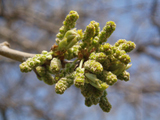
Inflorescence: Catkin
Fruit Type: Nut
Size Notes: Medium to large tree 45 - 110 feet (19.8 - 33.5 m) tall.
Leaf: Leaves shiny dark green above, light green with minute pubescence below.
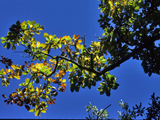
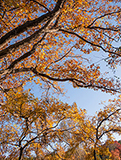
Autumn Foliage: yes
Fruit: Acorns annual; 1 - 2 acorns on peduncle 1⁄4 inch (6 mm) in length; thin cup with gray pubescence, covering 1⁄4 - 1⁄2 of the nut; light brown, oblong to ovoid nut, 5⁄8 - 1 inch (15 - 25 mm) long.
Bloom Information
Bloom Color: Yellow , Green , BrownBloom Time: Mar , Apr , May
Distribution
USA: AL , AR , CT , DC , FL , GA , IA , IL , IN , KS , KY , LA , MA , MD , MI , MN , MO , MS , NC , NE , NJ , NM , NY , OH , OK , PA , SC , TN , TX , VA , VT , WI , WVCanada: ON
Native Distribution: Eastern North America from Vermont, New York, and southern Ontario south across the eastern US as far west as Oklahoma, Texas, and southeastern New Mexico, south into northeastern Mexico as far south as Nuevo Leon and Hidalgo. In Texas, native from the northeast southwest across central Texas, with a separate population in far west Texas.
Native Habitat: Limestone and calcareous soils in mixed deciduous and pine forests.
Growing Conditions
Water Use: MediumLight Requirement: Sun , Part Shade
Soil Moisture: Dry
Soil pH: Alkaline (pH>7.2)
CaCO3 Tolerance: High
Soil Description: Rocky or sandy soils. This oak species is localized throughout its range and seems dependent upon soil type and a pH above 6.0.
Conditions Comments: This very attractive tree is relatively fast growing and relatively free of diseases and pests. Attractive fall color. Does best in well-drained soil and adapts to many different soil types. Grows in full sun.
Benefit
Use Wildlife: HummingbirdsUse Food: Acorns (nuts) are edible after tannins are leached or boiled out. Gather nuts during the fall from September to October. Only gather the ripe tan-to-brown acorns, rather than the unripe green ones. remove bitterness, shell the brown, ripe acorns and remove any corky skin layers, dice the meat, and boil the chunks in water from 15 to 30 minutes until the water turns brown. Then pour off the water and repeat the process until the water clears, indicating that the tannic acid has been removed. During the last boiling, salt water can be added; then the acorns can be deep fried or mixed in a soup. Finely chopped acorn meats can be added to bread doughs and muffin batters. After the leaching process, acorn meat can be frozen. To make flour, the boiled acorn meat can be split in two and dried by slowly baking in a 200 degree oven with the door cracked to allow moisture to escape. Crush or grind and use as a thickener or a flour. Another method is to roast the fresh acorn to work well in a grinder or blender. After grinding, place the flour into a cloth bag and boil to leach out bitterness. Leached acorns, after they are roasted until brittle, can be ground and used as a marginal coffee substitute. (Poisonous Plants of N.C.)
Use Other: Liquid merchandise was commonly rolled onto the boat in barrels made of this oak, for though its pores look large, they are admirably plugged by nature and so proof against leakage. (Peattie)
Warning: POISONOUS PARTS: Acorns (seeds of nuts) and young leaves. Low toxicity if eaten. Symptoms include stomach pain, constipation and later bloody diarrhea, excessive thirst and urination.
Attracts: Birds , Butterflies , Hummingbirds
Larval Host: Gray Hairstreak
Deer Resistant: No
Butterflies and Moths of North America (BAMONA)
|
Gray Hairstreak (Strymon melinus) 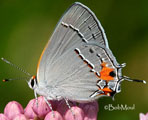 Larval Host |
Propagation
Description: Seedlings damp off readily.Seed Treatment: Scarification or hot water treatment is necessary.
Commercially Avail: yes
Find Seed or Plants
View propagation protocol from Native Plants Network.
Mr. Smarty Plants says
Plants for wildlife and trees for shade.
September 29, 2007
We live in Kempner Texas, our land has mostly cedar trees. We would like to make a wildlife habitat on the back side of our property. Can you recommend plants that will grow in shade to partial sun,...
view the full question and answer
National Wetland Indicator Status
| Region: | AGCP | AK | AW | CB | EMP | GP | HI | MW | NCNE | WMVE |
| Status: | UPL | FAC | UPL | FAC | FACU | FACU | FACU |
From the National Organizations Directory
According to the species list provided by Affiliate Organizations, this plant is on display at the following locations:Patsy Glenn Refuge, c/o Wimberley Birding Society - Wimberley, TX
NPSOT - Native Plant Society of Texas - Fredericksburg, TX
Texas Parks and Wildlife Department - Austin, TX
NPSOT - Fredericksburg Chapter - Fredericksburg, TX
NPSOT - Austin Chapter - Austin, TX
NPSOT - Williamson County Chapter - Georgetown, TX
Mt. Cuba Center - Hockessin, DE
Bibliography
Bibref 1186 - Field Guide to Moths of Eastern North America (2005) Covell, C.V., Jr.Bibref 1134 - Field Guide to Native Oak Species of Eastern North America (2003) Stein, John D. and Denise Binion
Bibref 1185 - Field Guide to Western Butterflies (Peterson Field Guides) (1999) Opler, P.A. and A.B. Wright
Bibref 841 - Native Alternatives to Invasive Plants (2006) Burrell, C. C.
Bibref 318 - Native Texas Plants: Landscaping Region by Region (2002) Wasowski, S. & A. Wasowski
Bibref 400 - Natural History of Trees of Eastern & Central North America (1991) Peattie, D.C. & P. H. Landacre
Bibref 663 - Poisonous Plants of North Carolina (1994) Vondracek, W. ; L. Van Asch
Search More Titles in Bibliography
Additional resources
USDA: Find Quercus muehlenbergii in USDA PlantsFNA: Find Quercus muehlenbergii in the Flora of North America (if available)
Google: Search Google for Quercus muehlenbergii
Metadata
Record Modified: 2015-11-18Research By: TWC Staff