Native Plants

Plant Database
Search for native plants by scientific name, common name or family. If you are not sure what you are looking for, try the Combination Search or our Recommended Species lists.
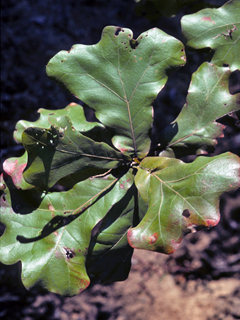
Wasowski, Sally and Andy
Quercus marilandica
Quercus marilandica Münchh.
Blackjack Oak, Barren Oak, Black Oak, Jack Oak
Fagaceae (Beech Family)
Synonym(s):
USDA Symbol: QUMA3
USDA Native Status: L48 (N)
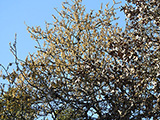
A small to medium-sized oak with bristle-lobed leaves. The short, nearly black trunk divides into many dense, contorted limbs, bark dark, furrowed; dead branches persistent. Leaf blades wedge shaped (obdeltoid - obovate) with a narrow, rounded base and broadening toward the tip. Blades shallowly lobed with usually an apical and 2 lateral lobes bearing bristlelike extensions (awns) of the main vein. Foliage glossy dark green turns dull reddish-brown in fall and persists into winter. This oak sometimes grows in colonies.
GROWTH FORM: small to medium sized tree usually between 15 - 45 feet (4.6 - 19.8 m), occasionally to 95 feet (28.9 m), with an open irregular spreading crown of crooked branches and some dead twigs, slow growing and short lived. BARK: thick rough bark, nearly black, with deep furrows, mature bark forming irregular or rectangular plates, orange inner bark. TWIGS and BUDS: light brown twigs, finely pubescent; narrowly ovoid pointed buds, reddish-brown pubescent scales, 5-angled in cross section. LEAVES: pubescent petiole 1⁄4 - 3⁄4 inch (6 - 19 mm) long; leaf broadly triangular and widest near tip, 2 3⁄4 - 8 inches (70 - 203 mm) long, 2 3⁄4 - 8 inches (70 - 203 mm) wide, leathery, base rounded, thickened blade with 3 - 5 broad lobes, with 1 - 3 bristle- tipped teeth, apex obtuse; glossy yellowish-green above, pale green with dense brown pubescence (scurfy) below, secondary veins raised on both surfaces. (Bibref 1134)
This species and Post Oak (Quercus stellata Wangenh.) form the Cross Timbers in Texas and Oklahoma, the forest border of small trees and transition zone to prairie grassland. This tree was first described in 1704 from a specimen in the colony of Maryland, referred to in the Latin species name. Blackjack oak is one of the few species of red oaks that shares the white oak group characteristic of vessels blocked by tyloses. Western populations in Texas and Oklahoma are often recognized as Q. marilandica var. ashei.



Plant Characteristics
Duration: PerennialHabit: Tree
Leaf Retention: Deciduous
Leaf Arrangement: Alternate
Leaf Complexity: Simple
Leaf Shape: Obovate
Leaf Venation: Pinnate
Leaf Apex: Obtuse
Breeding System: Flowers Unisexual , Monoecious
Inflorescence: Catkin
Fruit Type: Nut
Size Notes: Several authorities describe this species as growing from 30 - 60 feet tall. One authority describes it as growing to about 95 feet tall.
Autumn Foliage: yes
Fruit: Acorns biennial, 1 - 2 acorns on a short stalk, reddish-brown top-shaped cup with pubescent scales, inner surface pubescent, enclosing 1⁄3 - 2⁄3 of the nut; long elliptical nut, 1⁄2 - 3⁄4 inches (13 - 19 mm) in length, often faintly striped, ends in a stout point at the tip. (Bibref 1134)
Bloom Information
Bloom Color: White , Red , GreenBloom Time: Mar , Apr , May
Distribution
USA: AL , AR , DC , DE , FL , GA , IA , IL , IN , KS , KY , LA , MD , MO , MS , NC , NE , NJ , NY , OH , OK , PA , SC , TN , TX , VA , WVNative Distribution: Iowa east to New Jersey and Long Island, New York, south to Florida, west to Texas, and north to Nebraska.
Native Habitat: Usually exists on rather poor sites with dry sandy or clay soils in the central and southern forest regions.
Growing Conditions
Water Use: LowLight Requirement: Part Shade
Soil Moisture: Dry
CaCO3 Tolerance: Low
Cold Tolerant: yes
Soil Description: Variable. Gravelly, Sandy, Sandy Loam, Medium Loam, Clay Loam, Clay.
Conditions Comments: Restricted in nature to sandy soils and hardpans, this species is often seen as an scrubby, unattractive tree. When given good soil and room to develops an attractive, symmetrical form. Slow-growing, long-lived, and able to survive on very poor soils. Susceptible to oak wilt.
Benefit
Use Ornamental: Attractive shade tree.Use Wildlife: Cover, Substrate-insectivorous birds, Nesting site, Fruit-birds, Fruit-mammals, Fruit-rodents, Fruit-deer.
Use Medicinal: Indians used bark for dysentery and acorns for drink. Choctaw people used blackjack oak as medication to aid in childbirth.
Use Other: Firewood, charcoal, railroad ties; leaves used for cigarette wrappers.
Interesting Foliage: yes
Attracts: Birds , Butterflies
Larval Host: Horace's Duskywing, White M hairstreak.
Butterflies and Moths of North America (BAMONA)
|
White M Hairstreak (Parrhasius m-album) 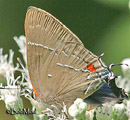 Larval Host |
Find Seed or Plants
View propagation protocol from Native Plants Network.
From the National Organizations Directory
According to the species list provided by Affiliate Organizations, this plant is on display at the following locations:Pineywoods Native Plant Center - Nacogdoches, TX
Crosby Arboretum - Picayune, MS
Stengl Biological Research Station - Smithville, TX
Texas Parks and Wildlife Department - Austin, TX
Jacob's Well Natural Area - Wimberley, TX
Bibliography
Bibref 283 - Cast Iron Forest: a natural and cultural history of the North American Cross Timbers (2000) Francaviglia, R. V.Bibref 766 - Dale Groom's Texas Gardening Guide (2002) Groom, D.
Bibref 1134 - Field Guide to Native Oak Species of Eastern North America (2003) Stein, John D. and Denise Binion
Bibref 298 - Field Guide to Texas Trees (1999) Simpson, B.J.
Bibref 355 - Landscaping with Native Plants of Texas and the Southwest (1991) Miller, G. O.
Bibref 354 - Native & Naturalized Woody Plants of Austin & the Hill Country (1981) Lynch, D.
Bibref 291 - Texas Wildscapes: Gardening for Wildlife (1999) Damude, N. & K.C. Bender
Bibref 297 - Trees of Central Texas (1984) Vines, Robert A.
Search More Titles in Bibliography
Web Reference
Webref 3 - Flora of North America (2014) Missouri Botanical Garden, St. Louis, MO & Harvard University Herbaria, Cambridge, MA.Additional resources
USDA: Find Quercus marilandica in USDA PlantsFNA: Find Quercus marilandica in the Flora of North America (if available)
Google: Search Google for Quercus marilandica
Metadata
Record Modified: 2022-09-23Research By: TWC Staff