Native Plants

Plant Database
Search for native plants by scientific name, common name or family. If you are not sure what you are looking for, try the Combination Search or our Recommended Species lists.
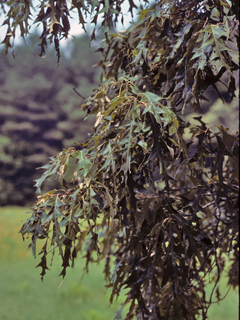
Wasowski, Sally and Andy
Quercus falcata
Quercus falcata Michx.
Southern Red Oak, Bottomland Red Oak, Three-lobed Red Oak, Spanish Oak
Fagaceae (Beech Family)
Synonym(s): Quercus falcata var. triloba, Quercus triloba
USDA Symbol: QUFA
USDA Native Status: L48 (N)
Southern red oak is a medium-sized, straight-trunked oak which, in time, develops long, spreading branches, giving the top an even, well-formed appearance. Its smooth gray bark becomes dark and furrowed, eventually becoming black. Thin, papery, lobed, bristle-tipped deciduous leaves turn reddish-brown in fall. Twigs pubescent reddish-brown twig with star shaped pith; reddish-brown terminal bud is ovoid and pubescent. Leaf petiole 3/4 - 2 3/8 inches (19 - 60 mm) in length, smooth to sparsely pubescent; leaves are elliptical to ovate, 4 - 11 3/4 inches (101 - 298 mm) long and 2 3/8 - 6 1/4 inches (60 - 159 mm) wide, u-shaped base, margin has 3 - 7 deeply divided lobes with 1 - 3 bristle-tipped teeth, apex longer than lateral lobes; upper surface a glossy green often with some pubescence along midrib, lower surface covered with gray or tawny pubescence, secondary veins raised on both surfaces.
Often called Spanish Oak, possibly because it commonly occurs in areas of the early Spanish colonies. It is unlike any oaks native to Spain. The lumber is marketed as Red Oak. Cherrybark Oak (Q. pagoda Raf.) is sometimes considered a variety of Q. falcata (Q. falcata var. pagodifolia Ell). The lobes of its leaves taper to points that remind some people of the graduated roofs of pagodas. The leaves have 5-11 broad shallow lobes and whitish hairs beneath, and the bark is smooth and cherry-like with short ridges.


Plant Characteristics
Duration: PerennialHabit: Tree
Leaf Retention: Deciduous
Leaf Arrangement: Alternate
Leaf Complexity: Simple
Leaf Shape: Elliptic , Ovate
Leaf Venation: Pinnate
Leaf Margin: Lobed
Breeding System: Flowers Unisexual , Monoecious
Inflorescence: Catkin
Fruit Type: Nut
Size Notes: Moderately fast growing, medium to large tree, which grows to 150 feet (45.7 m).
Leaf: Upper surface a glossy green often with some pubescence along midrib, lower surface covered with gray or tawny pubescence.
Autumn Foliage: yes
Fruit: Acorns biennial; thin, reddish-brown cup with pubescent inner and outer surface, usually covers up to 1/3 of the nut; rounded, brown nut, 3/8 - 5/8 inch (9 - 16 mm) long, may be striated at the tip with pubescence. Maximum potential height is 70 ft., alth
Bloom Information
Bloom Color: YellowBloom Time: Mar , Apr , May
Distribution
USA: AL , AR , DC , DE , FL , GA , IL , IN , KY , LA , MD , MO , MS , NC , NJ , OH , OK , PA , SC , TN , TX , VA , WVNative Distribution: Occurs from New Jersey and Florida west to Oklahoma and Texas.
Native Habitat: Dry upland sites of sandy or clay loam throughout the southeastern United States.
Growing Conditions
Water Use: MediumLight Requirement: Part Shade
Soil Moisture: Dry
CaCO3 Tolerance: Medium
Cold Tolerant: yes
Soil Description: Sandy, loamy or clay soils. Acid-based, Sandy, Sandy Loam
Conditions Comments: Southern red oak can subsist on some of the most abused, degraded soils found anywhere in the South. In these conditions, however, the tree develops a weather-beaten, unkempt appearance. The tree grows relatively quickly, for an oak, and is long-lived.
Benefit
Use Ornamental: Shade tree, Fall conspicuous, Long-living, Fast growingUse Wildlife: Substrate-insectivorous birds, Nesting site, Fruit-birds, mammals, rodents, deer. Cover.
Use Other: Southern red oak lumber is marketed as red oak for construction and furniture.
Attracts: Butterflies
Larval Host: Banded hairstreak, White M hairstreak.
Butterflies and Moths of North America (BAMONA)
|
Banded Hairstreak (Satyrium calanus) 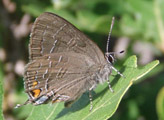 Larval Host |
White M Hairstreak (Parrhasius m-album) 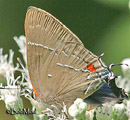 Larval Host |
Propagation
Description: Oaks are most often propagated from seed. Stratify seeds. Plant outdoors or in deep containers to accomodate long initial taproot. Many oaks require cold temperatures to initiate shoot development. Protect outdoor beds with wire mesh to deter rodent pSeed Collection: Best quality acorns are picked or shaken from the tree. Collect when color has changed to brown. Best if sown immediately as acorns lose viability quickly in storage. Short-term storage in moist, shaded saw dust or sand. Acorns to be sown immediately can be soaked in hot water for 15 min. to prevent weevil infestation. Stored seed should be fumigated with methyl bromide.
Seed Treatment: Stratify seeds in moist sand or potting soil for 30-60 days at 32-38 degrees.
Commercially Avail: yes
Find Seed or Plants
View propagation protocol from Native Plants Network.
National Wetland Indicator Status
| Region: | AGCP | AK | AW | CB | EMP | GP | HI | MW | NCNE | WMVE |
| Status: | FACU | FACU | FACU | FACU | FACU |
From the National Organizations Directory
According to the species list provided by Affiliate Organizations, this plant is on display at the following locations:Pineywoods Native Plant Center - Nacogdoches, TX
Crosby Arboretum - Picayune, MS
Texas Parks and Wildlife Department - Austin, TX
Georgia Native Plant Society - Atlanta, GA
Mt. Cuba Center - Hockessin, DE
Bibliography
Bibref 766 - Dale Groom's Texas Gardening Guide (2002) Groom, D.Bibref 1134 - Field Guide to Native Oak Species of Eastern North America (2003) Stein, John D. and Denise Binion
Bibref 298 - Field Guide to Texas Trees (1999) Simpson, B.J.
Bibref 1620 - Gardening with Native Plants of the South (Reprint Edition) (2009) Wasowski, S. with A. Wasowski
Bibref 355 - Landscaping with Native Plants of Texas and the Southwest (1991) Miller, G. O.
Bibref 308 - Lone Star Field Guide to Wildflowers, Trees, and Shrubs of Texas, Revised Edition (2003) Tull, D. & G.O. Miller
Bibref 291 - Texas Wildscapes: Gardening for Wildlife (1999) Damude, N. & K.C. Bender
Search More Titles in Bibliography
Additional resources
USDA: Find Quercus falcata in USDA PlantsFNA: Find Quercus falcata in the Flora of North America (if available)
Google: Search Google for Quercus falcata
Metadata
Record Modified: 2015-11-16Research By: TWC Staff