Native Plants

Plant Database
Search for native plants by scientific name, common name or family. If you are not sure what you are looking for, try the Combination Search or our Recommended Species lists.
Moore, April
Podophyllum peltatum
Podophyllum peltatum L.
Mayapple, Indian Apple, Wild Mandrake, Pomme De Mai, Podophylle Pelt
Berberidaceae (Barberry Family)
Synonym(s):
USDA Symbol: POPE
USDA Native Status: L48 (N), CAN (N)
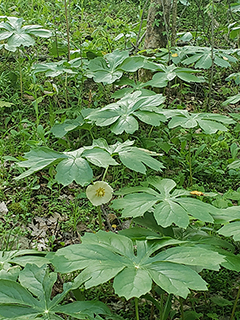
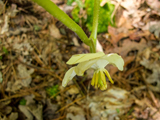
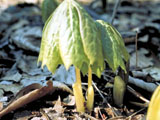
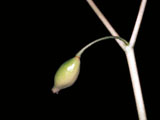
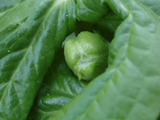
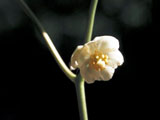
Mayapple is unique in that It has only 2 leaves and 1 flower, which grows in the axil of the leaves. The large, twin, umbrella-like leaves of mayapple are showy and conspicuous. They remain closed as the stem lengthens, unfolding 6-8 inches across when the plant has reached its 1-1 1/2 ft. height. The solitary, nodding, white to rose-colored flower grows in the axil of the leaves and has 6-9 waxy white petals, with many stamens. The nodding fruit is a large, fleshy, lemon-shaped berry.
Mayapple colonizes by rhizomes, forming dense mats in damp, open woods. The common name refers to the May blooming of its apple-blossom-like flower. Although the leaves, roots, and seeds are poisonous if ingested in large quantities, the roots were used as a cathartic by Native Americans. The edible, ripe, golden-yellow fruits can be used in jellies. The alternate popular name "Mandrake" rightly belongs to an unrelated Old World plant with a similar root.
Plant Characteristics
Duration: PerennialHabit: Herb
Leaf Complexity: Simple
Leaf Venation: Palmate
Leaf Pubescence: Glabrous
Breeding System: Flowers Bisexual
Fruit Type: Berry
Size Notes: Height: 12-18 inches
Leaf: Green
Flower: Flowers 2 inches
Fruit: Yellow, sometimes tinged with pink, rose, or purple 2 inches long
Bloom Information
Bloom Color: White , PinkBloom Time: Mar , Apr , May
Bloom Notes: Flowers usually white, but some populations display pinkish, rosy, or purplish flowers. Pink/rose/purple-flowered plants are sometimes referred to as a separate form of this species: Deamii.
Distribution
USA: AL , AR , CT , DC , DE , FL , GA , IA , IL , IN , KS , KY , LA , MA , MD , ME , MI , MN , MO , MS , NC , NE , NH , NJ , NY , OH , OK , PA , RI , SC , TN , TX , VA , VT , WI , WVCanada: NS , ON , QC
Native Distribution: Que. & s. Ont. to FL, w. to MN, e. NE, e. KS & e. TX
Native Habitat: Mixed deciduous forest, shaded fields, shaded moist road banks, shaded riverbanks.
Growing Conditions
Water Use: MediumLight Requirement: Part Shade , Shade
Soil Moisture: Moist
Soil pH: Acidic (pH<6.8)
Soil Description: Moist, humus-rich soils. Acid-based, Sandy, Sandy Loam, Medium Loam
Conditions Comments: Drought-tolerant within its eastern forest range, but should not be tried anywhere else. Grows under deciduous hardwoods, not under pines. Do not mix with other plants, as it does not like competition.
Benefit
Use Ornamental: Sometimes cultivated in woodland gardens.Use Food: Ripe (yellow and soft) fruit is edible raw, but in limited quantity. Collect in August or September The fruit has a lemon-like flavor and can be used to make jams, jellies and marmalade.
Use Medicinal: Native Americans used Podophyllum for a wide variety of medicinal purposes and as an insecticide (D. E. Moerman 1986).
Warning: POISONOUS PARTS: Unripe fruit, leaves, roots. Highly Toxic, May be Fatal if Eaten! Symptoms include salivation, vomiting, diarrhea, excitement, headache, fever, coma. Toxic Principle: Podophyllin.
Conspicuous Flowers: yes
Interesting Foliage: yes
Propagation
Propagation Material: Root Division , SeedsDescription: Seeds should be planted immediately or they will need to be treated. Plant thickly. Seedlings take several years to mature. The easiest way to propagate is by root division while the plant is dormant. Divide the rhizomes in fall with at least one bud.
Seed Treatment: Cold-moist stratification for three months.
Commercially Avail: yes
Maintenance: Do not mow, as mowing will kill them.
National Wetland Indicator Status
| Region: | AGCP | AK | AW | CB | EMP | GP | HI | MW | NCNE | WMVE |
| Status: | FACU | FACU | FACU | FACU | FACU |
From the National Organizations Directory
According to the species list provided by Affiliate Organizations, this plant is on display at the following locations:Pineywoods Native Plant Center - Nacogdoches, TX
Texas Discovery Gardens - Dallas, TX
Delaware Nature Society - Hockessin, DE
Mt. Cuba Center - Hockessin, DE
Bibliography
Bibref 1620 - Gardening with Native Plants of the South (Reprint Edition) (2009) Wasowski, S. with A. WasowskiBibref 1232 - Native American Ethnobotany (1998) Moerman, Daniel E.
Bibref 318 - Native Texas Plants: Landscaping Region by Region (2002) Wasowski, S. & A. Wasowski
Bibref 248 - Texas Wildflowers: A Field Guide (1984) Loughmiller, C. & L. Loughmiller
Bibref 1294 - The Midwestern Native Garden: Native Alternatives to Nonnative Flowers and Plants An Illustrated Guide (2011) Adelman, Charlotte and Schwartz, Bernard L.
Bibref 328 - Wildflowers of Texas (2003) Ajilvsgi, Geyata.
Search More Titles in Bibliography
Additional resources
USDA: Find Podophyllum peltatum in USDA PlantsFNA: Find Podophyllum peltatum in the Flora of North America (if available)
Google: Search Google for Podophyllum peltatum
Metadata
Record Modified: 2021-09-16Research By: DEW