Native Plants

Plant Database
Search for native plants by scientific name, common name or family. If you are not sure what you are looking for, try the Combination Search or our Recommended Species lists.
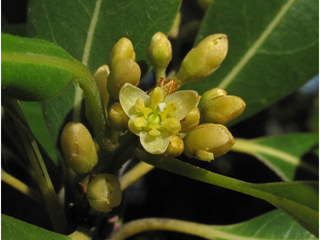
Cressler, Alan
Persea borbonia
Persea borbonia (L.) Spreng.
Redbay, Red Bay, Sweet Bay, Silk Bay, Red Bay Persea, Laurel Tree
Lauraceae (Laurel Family)
Synonym(s): Persea littoralis, Tamala borbonia, Tamala littoralis
USDA Symbol: PEBO
USDA Native Status: L48 (N)
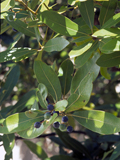
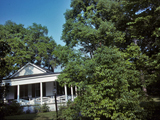
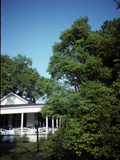
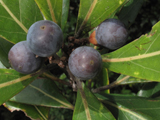
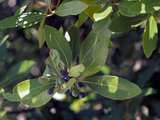
Red Bay is a tall, evergreen shrub or short-trunked tree, usually reaching a maximum height of 65 ft. Form is dense and well-rounded. Handsome, aromatic, evergreen tree, with dense crown. The ascending branches are covered with a dense, rusty pubescence and its aromatic leaves are leathery and narrowly oval. Pale-yellow flowers occur in small panicles from leaf axils and are followed by dark-blue to black fruit.
The wood, which takes a beautiful polish, is used for fine cabinetwork and also for lumber. The spicy leaves can be used to flavor soups and meats. Birds eat the bitter fruit. Swampbay (P. palustris (Raf.) Sarg.) is found in coastal swamps and characterized by twigs and lower leaf surfaces covered with rust-colored hairs.
Plant Characteristics
Duration: PerennialHabit: Tree
Leaf Retention: Evergreen
Leaf Complexity: Simple
Fruit Type: Drupe
Size Notes: Up to about 80 feet tall, often shorter.
Leaf: Dark Green
Bloom Information
Bloom Color: YellowBloom Time: Mar , Apr , May , Jun
Distribution
USA: AL , AR , FL , GA , LA , MS , NC , SC , TXNative Distribution: Coastal Plain from s. DE to FL and the Bahamas, w. to s.e. TX, with an isolated population in central TX in Travis County along Hamilton Creek.
Native Habitat: Low woods; coastal forests; bogs
Growing Conditions
Water Use: HighLight Requirement: Part Shade
Soil Moisture: Moist
CaCO3 Tolerance: None
Soil Description: Moist, acid soils.
Conditions Comments: Laurel-like in habit and persistence, the aromatic foliage makes sweet bay a worthy ornamental.
Butterflies and Moths of North America (BAMONA)
|
Palamedes Swallowtail (Papilio palamedes) 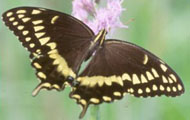 Larval Host |
Propagation
Description: Sow seeds directly after collection of stratify and sow in spring.Seed Collection: Gather fruits in the fall when they are dark blue to black. Remove pulp before storing. Store in sealed, refrigerated containers for up to one year.
Seed Treatment: Stratify in moist sand or peat for one month at 41 degrees.
Commercially Avail: yes
Mr. Smarty Plants says
Edible Plants for a Virginia Rain Garden
October 21, 2009
Can you recommend edible plants that would be appropriate for use in a rain garden? I'm located in Charlottesville, VA, but this can be in general as well.
view the full question and answer
National Wetland Indicator Status
| Region: | AGCP | AK | AW | CB | EMP | GP | HI | MW | NCNE | WMVE |
| Status: | FACW | FACW | FACW |
From the National Organizations Directory
According to the species list provided by Affiliate Organizations, this plant is on display at the following locations:Texas Discovery Gardens - Dallas, TX
Crosby Arboretum - Picayune, MS
Texas Parks and Wildlife Department - Austin, TX
NPSOT - Austin Chapter - Austin, TX
Mt. Cuba Center - Hockessin, DE
Bibliography
Bibref 1186 - Field Guide to Moths of Eastern North America (2005) Covell, C.V., Jr.Bibref 298 - Field Guide to Texas Trees (1999) Simpson, B.J.
Bibref 1185 - Field Guide to Western Butterflies (Peterson Field Guides) (1999) Opler, P.A. and A.B. Wright
Bibref 1620 - Gardening with Native Plants of the South (Reprint Edition) (2009) Wasowski, S. with A. Wasowski
Bibref 841 - Native Alternatives to Invasive Plants (2006) Burrell, C. C.
Search More Titles in Bibliography
Web Reference
Webref 3 - Flora of North America (2014) Missouri Botanical Garden, St. Louis, MO & Harvard University Herbaria, Cambridge, MA.Webref 23 - Southwest Environmental Information Network (2009) SEINet - Arizona Chapter
Additional resources
USDA: Find Persea borbonia in USDA PlantsFNA: Find Persea borbonia in the Flora of North America (if available)
Google: Search Google for Persea borbonia
Metadata
Record Modified: 2023-04-10Research By: TWC Staff