Native Plants

Plant Database
Search for native plants by scientific name, common name or family. If you are not sure what you are looking for, try the Combination Search or our Recommended Species lists.
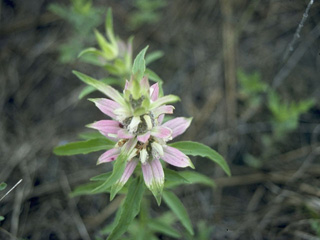
Flaigg, Norman G.
Monarda punctata
Monarda punctata L.
Spotted Beebalm, Spotted Horsemint, Horsemint
Lamiaceae (Mint Family)
Synonym(s):
USDA Symbol: MOPU
USDA Native Status: L48 (N), CAN (N)
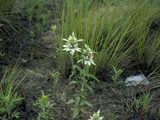
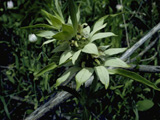
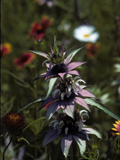
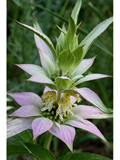
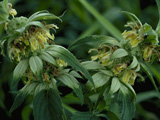
An aromatic, erect perennial ranging from only 6 in. to almost 3 ft. tall. Rosettes of yellowish, purple-spotted, tubular flowers occur in whorls, forming a dense, elongated spike at the end of the stem or from leaf axils. Each whorl is subtended by large, conspicuous, whitish, purple-tinged, leaf-like bracts.
Linnaeus named the genus Monarda in honor of a 16th century Spanish physician and botanist, Nicolas Bautista Monardes (1493-1588). Monardes never went to the Americas but was able to study medicinal plants in Spain.
Plant Characteristics
Duration: PerennialHabit: Herb
Leaf Retention: Deciduous
Fruit Type: Nut
Size Notes: Up to about 3 feet tall.
Fruit: Nutlets.
Bloom Information
Bloom Color: White , Pink , Yellow , Green , PurpleBloom Time: Apr , May , Jun , Jul , Aug , Sep
Bloom Notes: While the flowers of this plant are usually yellow with maroon markings on the upper petals, they may also be white or green. However, the bracts are showier and may be purple, pink, white or yellow.
Distribution
USA: AL , AR , CA , CT , DC , DE , FL , GA , IA , IL , IN , KS , KY , LA , MA , MD , MI , MN , MO , MS , NC , NJ , NM , NY , OH , OK , PA , SC , TN , TX , VA , VT , WICanada: ON
Native Distribution: VT to MN, s. to TX, NM & n. to KS, through to e. coast. Isolated in CA.
Native Habitat: Prairie, Plains, Meadows, Pastures, Savannas
Growing Conditions
Water Use: LowLight Requirement: Sun
Soil Moisture: Dry
Soil pH: Circumneutral (pH 6.8-7.2)
Soil Description: Dry, sandy soils
Conditions Comments: The tubular flowers are pale yellow spotted with purple on top of bracts that are white to light purple. Leaves smell like fine Greek oregano. This plant is propagated by seed sown in situ or in pots and transplanted to sandy, well drained soil. It can also be propagated by cuttings of young foliage. Drought tolerant but summer watering can keep plants fresh and blooming longer. Spotted beebalm can become aggressive. It is noticeably fragrant. Two other common subspecies of Monarda punctata are Monarda punctata ssp. punctata, occurring in sandy soil on the coastal plain from VA to KY, s. to FL & TX; and Monarda punctata ssp. occidentalis, occurring from s.w. IL to KS, s.w. to TX & NM. All Monarda species are susceptible to powdery mildew.
Benefit
Use Ornamental: Wildflower meadow, Pocket prairieUse Wildlife: Insect pollinated.
Use Medicinal: Fresh leaves crushed and steeped in cold water drunk to ease backache; used for fever, inflammation and chills. (Weiner)
Conspicuous Flowers: yes
Attracts: Butterflies
Nectar Source: yes
Value to Beneficial Insects
Special Value to Native BeesSpecial Value to Bumble Bees
Special Value to Honey Bees
Supports Conservation Biological Control
This information was provided by the Pollinator Program at The Xerces Society for Invertebrate Conservation.
Propagation
Description: Easily propagated from untreated seed sown in fall or stratified seed sown in spring.Seed Collection: Collect in Sep. or Oct.
Seed Treatment: Dry or moist stratification
Commercially Avail: yes
Find Seed or Plants
Order seed of this species from Native American Seed and help support the Wildflower Center.
Find seed sources for this species at the Native Seed Network.
National Wetland Indicator Status
| Region: | AGCP | AK | AW | CB | EMP | GP | HI | MW | NCNE | WMVE |
| Status: | FACU | UPL | UPL | UPL | UPL | UPL | UPL |
From the National Organizations Directory
According to the species list provided by Affiliate Organizations, this plant is on display at the following locations:Brackenridge Field Laboratory - Austin, TX
Native Seed Network - Corvallis, OR
Bibliography
Bibref 1207 - Earth Medicine, Earth Food (1990) Michael A. WeinerBibref 946 - Gardening with Prairie Plants: How to Create Beautiful Native Landscapes (2002) Wasowski, Sally
Bibref 765 - McMillen's Texas Gardening: Wildflowers (1998) Howard, D.
Bibref 1294 - The Midwestern Native Garden: Native Alternatives to Nonnative Flowers and Plants An Illustrated Guide (2011) Adelman, Charlotte and Schwartz, Bernard L.
Bibref 328 - Wildflowers of Texas (2003) Ajilvsgi, Geyata.
Bibref 286 - Wildflowers of the Texas Hill Country (1989) Enquist, M.
Search More Titles in Bibliography
Web Reference
Webref 80 - Illinois Wildflowers (2002) John HiltyWebref 23 - Southwest Environmental Information Network (2009) SEINet - Arizona Chapter
Research Literature
Reslit 464 - Spatial and temporal variation in natural enemy assemblages on Maryland native plant species (2008) S. D. Frank, P. M. Shrewsbury and O. EsiekpeReslit 537 - Nectar plant selection by the Karner blue butterfly (Lycaeides melissa samuelis) at the Indiana Dunes National Lakeshore (2000) R. Grundel, N. B. Pavlovic and C. L. Sulzman
Reslit 1181 - Assessment of heat-expanded slate and fertility requirements in green roof substrates (2006) D. B. Rowe, M. A. Monterusso and C. L. Rugh
Reslit 2402 - Monarda humilis (Lamiaceae), a new combination for a species from New Mexico, and a key to the species of section Cheilyctis (2003) L. A. Prather and J. A. Keith
Reslit 2625 - Performance of 67 native midwestern US perennials in a low-maintenance landscape (2004) A. L. Thomas, D. Schrock
This information was provided by the Florida WIldflower Foundation.
Search More Titles in Research Literature
Additional resources
USDA: Find Monarda punctata in USDA PlantsFNA: Find Monarda punctata in the Flora of North America (if available)
Google: Search Google for Monarda punctata
Metadata
Record Modified: 2023-02-20Research By: DEW, JSC, ADA, SCB