Native Plants

Plant Database
Search for native plants by scientific name, common name or family. If you are not sure what you are looking for, try the Combination Search or our Recommended Species lists.
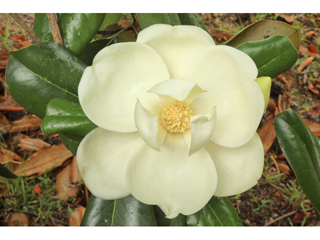
Cressler, Alan
Magnolia grandiflora
Magnolia grandiflora L.
Southern Magnolia, Evergreen Magnolia, Loblolly Magnolia, Great Laurel Magnolia, Big Laurel, Bull Bay
Magnoliaceae (Magnolia Family)
Synonym(s):
USDA Symbol: MAGR4
USDA Native Status: L48 (N), PR (I)
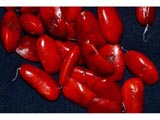
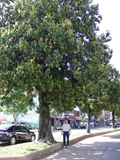
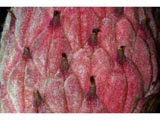
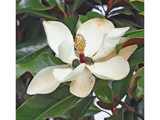
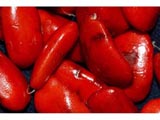
One of the most beautiful native trees, evergreen with straight trunk, conical crown, and very fragrant, very large, white flowers. The pyramidal southern magnolia does not get extremely large in most of its range. It is usually 50 ft. tall, rarely growing to 100 ft. They have a dense growth of smooth, leathery evergreen leaves that are alternate, 5-10 inches long, shiny on top and rusty below. Fragrant, creamy-white flowers, which discolor easily if bruised, appear on the ends of thick, tough stems all over the tree. They are cup-shaped, about 8 inches across, with 6 thick petals, wider at the tip, where they are cupped. The blossoms open about 9:00 A.M. and close at night for 2 or 3 days; then all the stamens are shed and the flower reopens, turns brown, and disintegrates. The flowers appear throughout the summer and into fall. The flowers produce conelike seedpods that contain large red seeds. When the pods open, the seeds often fall from their place and hang by silky threads.
Planted around the world in warm temperate and subtropical regions, it is a popular ornamental and shade tree, hardy north to Philadelphia. Several horticultural varieties have been developed.
Plant Characteristics
Duration: PerennialHabit: Tree
Leaf Retention: Evergreen
Leaf Arrangement: Alternate
Leaf Complexity: Simple
Leaf Venation: Pinnate
Leaf Margin: Entire
Breeding System: Flowers Bisexual
Fruit Type: Aggregate , Follicle
Size Notes: Up to about 100 feet tall.
Leaf: Green
Flower: Flowers 6 inches
Fruit: Cone-like aggregated follicles.
Bloom Information
Bloom Color: WhiteBloom Time: Mar , Apr , May , Jun
Distribution
USA: AL , AR , FL , GA , LA , MD , MS , NC , SC , TN , TX , VANative Distribution: Coastal Plain from extreme s.e. VA to FL, w. to e. TX
Native Habitat: Lowland & coastal woods
Growing Conditions
Water Use: HighLight Requirement: Part Shade
Soil Moisture: Dry
CaCO3 Tolerance: Low
Cold Tolerant: yes
Soil Description: Rich, porous, acid soils. Sandy, Sandy Loam, Medium Loam, Clay Loam Clay, Acid-based, Calcareous
Conditions Comments: Southern magnolia is a relatively fast-growing tree. It casts a dark shade, making underplanting difficult. Prune after blooming during the growing season because dormant magnolias do not easily heal. Fallen leaves are messy and never seem to decompose. They can be chopped with a rotary mower and blown back under the branches to recycle nutients. Must be given protection from winter winds and sun in northern part of its range. Relatively pest free. Seedlings are quite sensitive to frost.
Benefit
Use Ornamental: Blooms ornamental, Accent tree or shrub, Aromatic, Understory tree, Shade tree. The dried leaves are used by florists in decorations.Use Other: Principal uses of the wood are furniture, boxes, cabinetwork, and doors.
Conspicuous Flowers: yes
Fragrant Flowers: yes
Interesting Foliage: yes
Propagation
Propagation Material: SeedsDescription: Propagation methods include the use of fresh seed sown in fall, stratified seed, or wounded, semi-hardwood cuttings taken in summer. The seed of evergreen magnolias seems to germinate more quickly than that of the deciduous varieties.
Seed Collection: Gather as soon as cones drop or the red seeds appear. When ripe, the seeds are bright red, fleshy, oily, soft on the outside and stony on the inside. Clean and store in moist sand or sphagnum moss in refrigerator. Cold, moist storage also serves at stratification.
Seed Treatment: Stored seed must be kept moist and cool which will also serve as stratification. Stratify at least 60 days.
Commercially Avail: yes
Maintenance: Maintain moist soil, Remove dead growth, Prevent complete soil dryness, Do not prune lower limbs & leaves, Fertilize in spring, mid-season & fall with azalea/camellia-type fertilizer
Mr. Smarty Plants says
Eucalyptus tree for Spring, Texas
October 31, 2008
I've heard eucalyptus trees do not lose their leaves in the winter and grow considerably tall. I want to replace a decaying pine tree with a eucalyptus tree. Do you recommend that for the Spring, T...
view the full question and answer
Treatment of black mildew on magnolia
April 17, 2008
I think my magnolia has black mildew. How do I treat it?
view the full question and answer
Tree ordinances re Magnolia Ladybird Johnson tree
July 02, 2006
What exactly is a Ladybird Johnson tree? Also, is there any type of federal or state law(s) that prohibits the cutting, trimming or removal of a LadyBird Johnson tree? Thank you for your time!
view the full question and answer
National Wetland Indicator Status
| Region: | AGCP | AK | AW | CB | EMP | GP | HI | MW | NCNE | WMVE |
| Status: | FAC | UPL | FACU | FAC |
From the National Organizations Directory
According to the species list provided by Affiliate Organizations, this plant is on display at the following locations:Pineywoods Native Plant Center - Nacogdoches, TX
United States Botanic Garden - Washington, DC
Crosby Arboretum - Picayune, MS
Texas Parks and Wildlife Department - Austin, TX
Georgia Native Plant Society - Atlanta, GA
Mt. Cuba Center - Hockessin, DE
Wellspring Organic Farm and Education Center - West Bend, WI
Bibliography
Bibref 766 - Dale Groom's Texas Gardening Guide (2002) Groom, D.Bibref 298 - Field Guide to Texas Trees (1999) Simpson, B.J.
Bibref 1620 - Gardening with Native Plants of the South (Reprint Edition) (2009) Wasowski, S. with A. Wasowski
Bibref 355 - Landscaping with Native Plants of Texas and the Southwest (1991) Miller, G. O.
Bibref 318 - Native Texas Plants: Landscaping Region by Region (2002) Wasowski, S. & A. Wasowski
Bibref 248 - Texas Wildflowers: A Field Guide (1984) Loughmiller, C. & L. Loughmiller
Search More Titles in Bibliography
Web Reference
Webref 38 - Flora of North America (2019) Missouri Botanical Garden, St. Louis, MO & Harvard University Herbaria, Cambridge, MA.Webref 23 - Southwest Environmental Information Network (2009) SEINet - Arizona Chapter
Additional resources
USDA: Find Magnolia grandiflora in USDA PlantsFNA: Find Magnolia grandiflora in the Flora of North America (if available)
Google: Search Google for Magnolia grandiflora
Metadata
Record Modified: 2023-04-13Research By: TWC Staff