Native Plants

Plant Database
Search for native plants by scientific name, common name or family. If you are not sure what you are looking for, try the Combination Search or our Recommended Species lists.
Bransford, W.D. and Dolphia
Ledum groenlandicum
Ledum groenlandicum Oeder
Bog Labrador Tea, Rusty Labrador Tea, Labrador Tea, Hudson's Bay Tea, Muskeg Tea
Ericaceae (Heath Family)
Synonym(s): Ledum palustre ssp. groenlandicum, Ledum palustre var. latifolium, Rhododendron groenlandicum
USDA Symbol: LEGR
USDA Native Status: L48 (N), AK (N), CAN (N), GL (N), SPM (N)
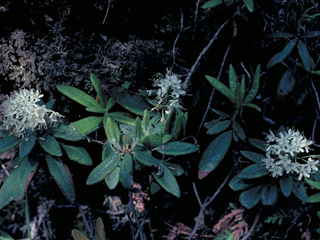
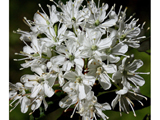
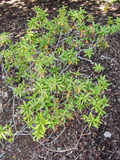
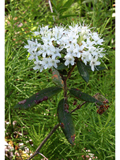
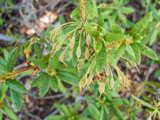
A low, evergreen shrub with densely hairy twigs and rounded, terminal clusters of white flowers. Rusty Labrador-tea is a small, globular, broadleaf evergreen shrub, to 5 ft. tall, with a picturesque habit created by many erect stems and upright, spreading branches. The smooth, slightly cracked, bark is coppery-orange to reddish-brown. Thick, glossy, narrowly elliptic leaves are aromatic. Upright, bell-shaped flowers comprise flat-topped, terminal clusters.
This northern shrub, typical of acidic, boggy areas, can easily be recognized by the woolly brown undersurfaces of its leaves. In northern Canada, the plant is known as Hudson’s Bay Tea.
Plant Characteristics
Duration: PerennialHabit: Shrub
Leaf Retention: Evergreen
Leaf Complexity: Simple
Fruit Type: Capsule
Size Notes: Up to about 5 feet tall.
Leaf: Gray-Green
Bloom Information
Bloom Color: WhiteBloom Time: Mar , Apr , May , Jun , Jul , Aug
Distribution
USA: AK , CT , ID , MA , ME , MI , MN , ND , NH , NJ , NY , OH , OR , PA , SD , VT , WA , WICanada: AB , BC , MB , NB , NL , NS , ON , PE , QC , SK
Native Distribution: Lab. to AK, s. to PA, n.e. OH, MI, n.e. MN, c. Sask. & n.w. OR
Native Habitat: Peat bogs; cold, damp woods; wet shores
Growing Conditions
Water Use: MediumLight Requirement: Sun , Part Shade , Shade
Soil Moisture: Moist , Wet
Soil pH: Acidic (pH<6.8)
CaCO3 Tolerance: Low
Soil Description: Acid, wet to moist organic soils, peats & mucks.
Conditions Comments: Ledum groenlandicum is a slow-growing, short-lived shrub that demands acid soil. Occasional anthracnose is the only disease or pest problem. It is a very flood tolerant plant.
Benefit
Warning: POISONOUS PARTS: All parts. Highly Toxic, May be Fatal if eaten. Symptoms include salivation, watering of eyes and nose, abdominal pain, loss of energy, depression, nausea and vomiting, diarrhea, weakness, difficult breathing, progressive paralysis of arms and legs, coma. Toxic Principle: Andromedotoxin. (Poisonous Plants of N.C.)Conspicuous Flowers: yes
Fragrant Flowers: yes
Interesting Foliage: yes
Fragrant Foliage: yes
Attracts: Butterflies
Larval Host: Northern Blue butterfly (Lycaeides idas)
Butterflies and Moths of North America (BAMONA)
|
Northern Blue (Plebejus idas) 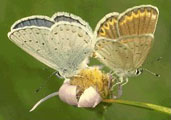 Larval Host |
Propagation
Description: Layers and fall-collected cuttings can be used for propagation. Seeds should be sown on shaded peat moss. There is no dormancy and germination takes 2-3 weeks.Seed Treatment: No pretreatment is necessary.
Commercially Avail: yes
Find Seed or Plants
View propagation protocol from Native Plants Network.
National Wetland Indicator Status
| Region: | AGCP | AK | AW | CB | EMP | GP | HI | MW | NCNE | WMVE |
| Status: | FAC | OBL | FACW | OBL | OBL | OBL |
Bibliography
Bibref 1186 - Field Guide to Moths of Eastern North America (2005) Covell, C.V., Jr.Bibref 1185 - Field Guide to Western Butterflies (Peterson Field Guides) (1999) Opler, P.A. and A.B. Wright
Search More Titles in Bibliography
Web Reference
Webref 38 - Flora of North America (2019) Missouri Botanical Garden, St. Louis, MO & Harvard University Herbaria, Cambridge, MA.Webref 23 - Southwest Environmental Information Network (2009) SEINet - Arizona Chapter
Additional resources
USDA: Find Ledum groenlandicum in USDA PlantsFNA: Find Ledum groenlandicum in the Flora of North America (if available)
Google: Search Google for Ledum groenlandicum
Metadata
Record Modified: 2023-02-15Research By: TWC Staff