Native Plants

Plant Database
Search for native plants by scientific name, common name or family. If you are not sure what you are looking for, try the Combination Search or our Recommended Species lists.
Bransford, W.D. and Dolphia
Iris douglasiana
Iris douglasiana Herb.
Douglas Iris, Mountain Iris, Western Iris
Iridaceae (Iris Family)
Synonym(s): Iris douglasiana var. major, Iris douglasiana var. oregonensis
USDA Symbol: IRDO
USDA Native Status: L48 (N)
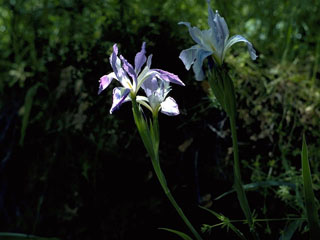
The rhizomes of Mountain Iris or Douglas Iris spread slowly, eventually creating a 2-4 ft. wide clump. Tufts of 1-2 ft., sword-shaped, dark-evergreen leaves arise from the rhizome and surround a flowering stalk of equal height. Several showy iris blossoms emerge from leafy bracts atop the stalks. The flowers are usually blue, though the colors can range from pale cream to yellow to reddish purple. Large, reddish-purple, pinkish, white, or cream flowers, with lilac veins, on stout branched stalks rising from clumps of sword-shaped leaves.
This is a common iris in the Redwood region. The genus name, Greek for "rainbow," refers to the variegated coloration of the flower. In Greek mythology, Iris, a member of Hera's court and goddess of the rainbow, so impressed Hera with her purity that she was commemorated with a flower that blooms in the rainbow colors of her robe.


Plant Characteristics
Duration: PerennialHabit: Herb
Fruit Type: Capsule
Size Notes: Up to about 2 feet tall.
Bloom Information
Bloom Color: White , Blue , PurpleBloom Time: Mar , Apr , May , Jun
Distribution
USA: CA , ORNative Distribution: Coastal region from Santa Barbara Co., CA to Coos Co., OR
Native Habitat: Grassy slopes; open woods
Growing Conditions
Light Requirement: Part ShadeSoil Moisture: Moist
Soil pH: Acidic (pH<6.8)
Soil Description: Moist to dry, nutrient-rich soils.
Conditions Comments: Douglas iris is a vigorous, shade and drought tolerant iris. Crosses with I. innominata and other West Coast species are collectively called Pacific Coast hybrids.
Benefit
Conspicuous Flowers: yesPropagation
Description: Increase by seed or rhizome divisions. Divide rhizomes in late fall or early spring but cutting the leaves back to about 5 in. and then cutting between the tufted clumps. Plant fresh seeds in early fall in permanent location or flats that are left out oSeed Collection: Easily collected from the large capsules.
Seed Treatment: No pretreatment is necessary, although a moist stratification (3 mo. at 40 degrees) may be beneficial.
Commercially Avail: yes
Find Seed or Plants
Find seed sources for this species at the Native Seed Network.
View propagation protocol from Native Plants Network.
From the National Organizations Directory
According to the species list provided by Affiliate Organizations, this plant is on display at the following locations:Santa Barbara Botanic Garden - Santa Barbara, CA
Native Seed Network - Corvallis, OR
Bibliography
Bibref 995 - Native Landscaping from El Paso to L.A. (2000) Wasowski, S. and A. WasowskiSearch More Titles in Bibliography
Web Reference
Webref 38 - Flora of North America (2019) Missouri Botanical Garden, St. Louis, MO & Harvard University Herbaria, Cambridge, MA.Webref 23 - Southwest Environmental Information Network (2009) SEINet - Arizona Chapter
From the Archive
Wildflower Newsletter 1984 VOL. 1, NO.4 - Lady Bird Heartened by Progress, Horticultural Society Annual Meeting Held, Dire...Additional resources
USDA: Find Iris douglasiana in USDA PlantsFNA: Find Iris douglasiana in the Flora of North America (if available)
Google: Search Google for Iris douglasiana
Metadata
Record Modified: 2023-02-14Research By: TWC Staff